Here's how the league is looking three weeks into the regular season
 By Mike Axisa Apr 15, 2026 at 9:30 am ET • 6 min read
  Imagn Images
 The 2026 MLB regular season is three weeks old and you have my permission to say "it's still early" if things aren't going your favorite team's or your favorite player's way. It is early! It is so, so, early. If the 162-game season were a nine-inning game, there would be two outs in the bottom of the first inning right now. It is a long season, folks. A very long season.
That said, but there are a few things we can glean from the little bit of baseball that has been played. Here now are three trends worth knowing three weeks into the new season.
Garrett Crochet's missing velocity

 Garrett Crochet BOS • RP • #35 ERA7.58WHIP1.58IP19BB7K22 View Profile
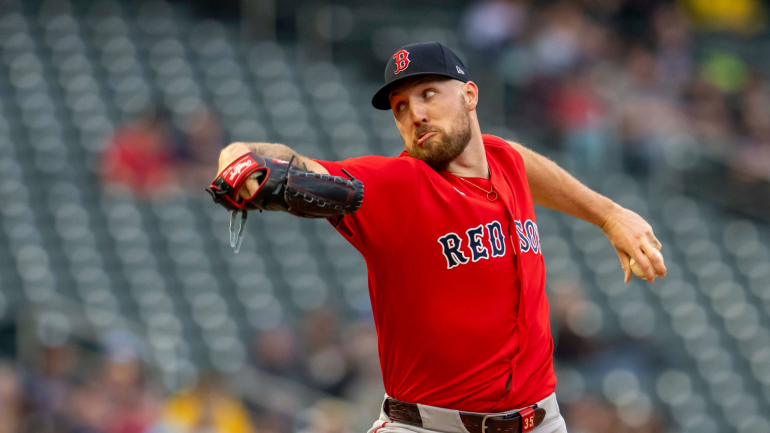
 Of all pitchers, Boston Red Sox ace Garrett Crochet threw what figures to go down as the worst start of 2026. The Twins hammered Crochet, last year's American League Cy Young runner-up, for 11 runs in 1 ⅔ innings at Target Field on Monday. They had nine hits off him, including two homers, and drew three walks. Crochet did not strike out a batter. A disastrous outing all the way around.
It will take weeks for Crochet to whittle his 7.58 ERA back down to respectability. His ERA isn't a big deal though. More worrisome is the decline in his stuff. Crochet's velocity was down and has been since the start of spring training. He was also without his usual spin and movement. The pitch grading algorithms had Crochet with "B" stuff Monday, not his usual "A+."
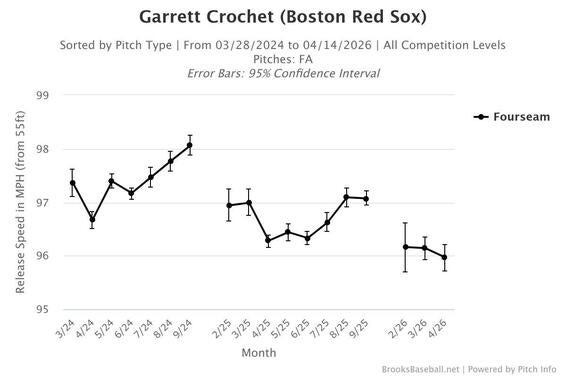 Crochet's velocity has been down across the board in 2026. Brooks Baseball
 "Yep," Crochet told reporters, including MassLive.com, when asked if he's healthy after Monday's start. "... It's tough to say (why I got hit so hard). I mean, command as a whole has been spotty. Gotten away with it a little this early in the year, but tonight they made me pay. It was weak contact, hard contact, walks, hit by pitch, a little bit of everything."
Including the postseason, Crochet threw 213 innings last year, an increase of 68 from 2024. He skipped the World Baseball Classic and the Red Sox slow-played his build-up in spring training because they didn't want to overdo it and put him at risk of injury. Also, they're playing the long game. Crochet wants to be at his best in October. If the trade-off is a sluggish April, so be it.
"I know the velocity will come, especially as we're building up at this time," Crochet told MLB.com in spring training. "So there's going to be ebbs and flows to that. Across the course of the season, there will be as well. So for me right now, it's just kind of hitting checkpoints in my delivery."
Bad starts happen and there are nights pitchers just don't have their best stuff. In Crochet's case, the missing velocity and quality of his entire arsenal is a thing to monitor early in the season more than a cause for panic. The Red Sox have a little too much going wrong at the moment. They're slow-playing their ace, but they will need him to pitch like Garrett Crochet pretty soon.
Munetaka Murakami struggling with the heat

 Munetaka Murakami CHW • 1B • #5 BA0.167R12HR5RBI9SB0 View Profile
 The White Sox signing Munetaka Murakami was my favorite move of the offseason. I love that a rebuilding team took a relatively cheap swing (two years and $34 million) on a 26-year-old slugger with game-changing power. We saw that power right away: Murakami became the first player in franchise history to go deep in each of his first three career games.
"I'm truly grateful and happy that I was able to keep that kind of record," Murakami told MLB.com through an interpreter after going deep for the third straight day. "But like I said before, there's still a long way to go and a lot of ways to improve. So that is what I'll keep on doing in the upcoming days."
The few weeks since that first series have been tougher sledding for Murakami, who homered Tuesday to raise his slash line to .167/.343/.444. He's struck out 22 times in 70 plate appearances, including six times in 10 plate appearances this past weekend. His 31.4% strikeout rate was top 20 among qualified hitters and well above 22.7% league average.
In a way, Murakami is living up to the scouting report perfectly. He brings enormous power and ranks among the league leaders in exit velocity, hard-hit rate, and the like. He's also drawing a lot of walks (15 so far). And with the power and those walks come a lot of swing and miss, especially against better velocity. The cutoff line is 95 mph:
95+ mph fastballsSub-95 mph fastballsBatting average
.091
.333
Slugging percentage
.091
1.333
Whiff rate
40.0%
17.4%
The MLB average against 95 mph and above heaters is a .240 batting average and .374 slugging percentage, and a 22.3% whiff rate (that's misses per swing). Against sub-94 mph heaters, it's a .295 batting average and .447 slugging percentage, and a 16.9% whiff rate. Murakami does still whiff a good deal against sub-94 mph fastballs, but that's where his power plays.
Case in point: Murakami's five home runs have come on a 90.5 mph cutter, a 91.8 mph four-seamer, a 93.2 mph cutter, a 93.9 mph sinker, and a 94.1 mph four-seamer. Four of the five were center-cut mistake pitches and hey, you're supposed to hit those balls out of the park. You can have a good long career punishing mistakes even while struggling against higher-end velocity.
There is not as much velocity in Japan as there is in MLB and it can be difficult to evaluate how Japanese players will handle top-shelf fastballs. Shohei Ohtani initially had trouble with velocity when he came over, then figured it out. Murakami deserves a chance to do the same. Right now though, it's a clear weakness. You can beat him with heat.
Starters outperforming relievers
Throughout baseball history, relievers have outperformed starters on a per-inning basis, and you needn't try hard to understand why. Starters have to go through a lineup multiple times, whereas relievers get to air it out for an inning at a time, and they often work in specific matchups that make best use of their skills. Starters don't get the luxury of optimized matchups.
This year though, starters are outdoing their bullpen brethren three weeks into the season. Here are the numbers through the same point of the season over the last few years:
StartersRelievers2023
4.59 ERA
4.07 ERA
2024
4.17 ERA
4.02 ERA
2025
4.02 ERA
3.87 ERA
2026
4.05 ERA
4.23 ERA
Those 2023-25 numbers carried through to the end of the season. Relievers were better than starters three weeks into the season, three months into the season, the whole nine. It has been like that for just about the entirety of baseball history too, or at least since bullpens and dedicated closers started to become a thing in the 1970s.
This year, though, starters have relievers beat by 0.18 points of ERA, which works out to one fewer run every 50 innings. It may not sound like much (and it's really not), but on any given 15-game night, starters throw about 150 innings and relievers about 120, so you're talking a few extra runs per night league-wide. It adds up pretty quickly during his long season.
Why are starters outperforming relievers in 2026? Well, the line between starters and relievers has never been more blurred. Openers and bullpen games are common (late-inning reliever Grant Taylor leads the White Sox in starts) and you're seeing more multi-inning relievers, guys who take on something close to a starter's workload while coming out of the bullpen.
Also, there's just a lot of bad bullpens out there right now. Injuries and roster churn have teams dipping deep into their reserves just to get to the finish line of a nine-inning game. Entering play Tuesday, 12 of 30 teams had a sub-replacement level bullpen. Already, 320 different pitchers have made a relief appearance in 2026. That number was 713 at the end of last season. We're nearly halfway there in mid-April.
My hunch is there's some sample size weirdness in play here as well and things will go back to normal as we get deeper into the season. Relievers will eventually go back to being better than starters on a per-inning basis. Right now though, the guys at the start of the game have the advantage, and it is very out of the ordinary even three weeks into the season.
Join the Conversation comments