After just two weeks, let's check in around the league
 By Mike Axisa Apr 8, 2026 at 9:45 am ET • 6 min read
  Getty Images
 The 2026 MLB regular season is two weeks old and you have my permission to say "it's still early" if things aren't going your favorite team's or your favorite player's way. It is early! It is so, so, early. If the 162-game season were a nine-inning game, we would be wrapping up the top of the first inning right now. It is a long season, folks. A very long season.
That said, but there are a few things we can glean from the little bit of baseball that has been played. Here now are three trends worth knowing two weeks into the new season.
Edward Cabrera's new fastball mix

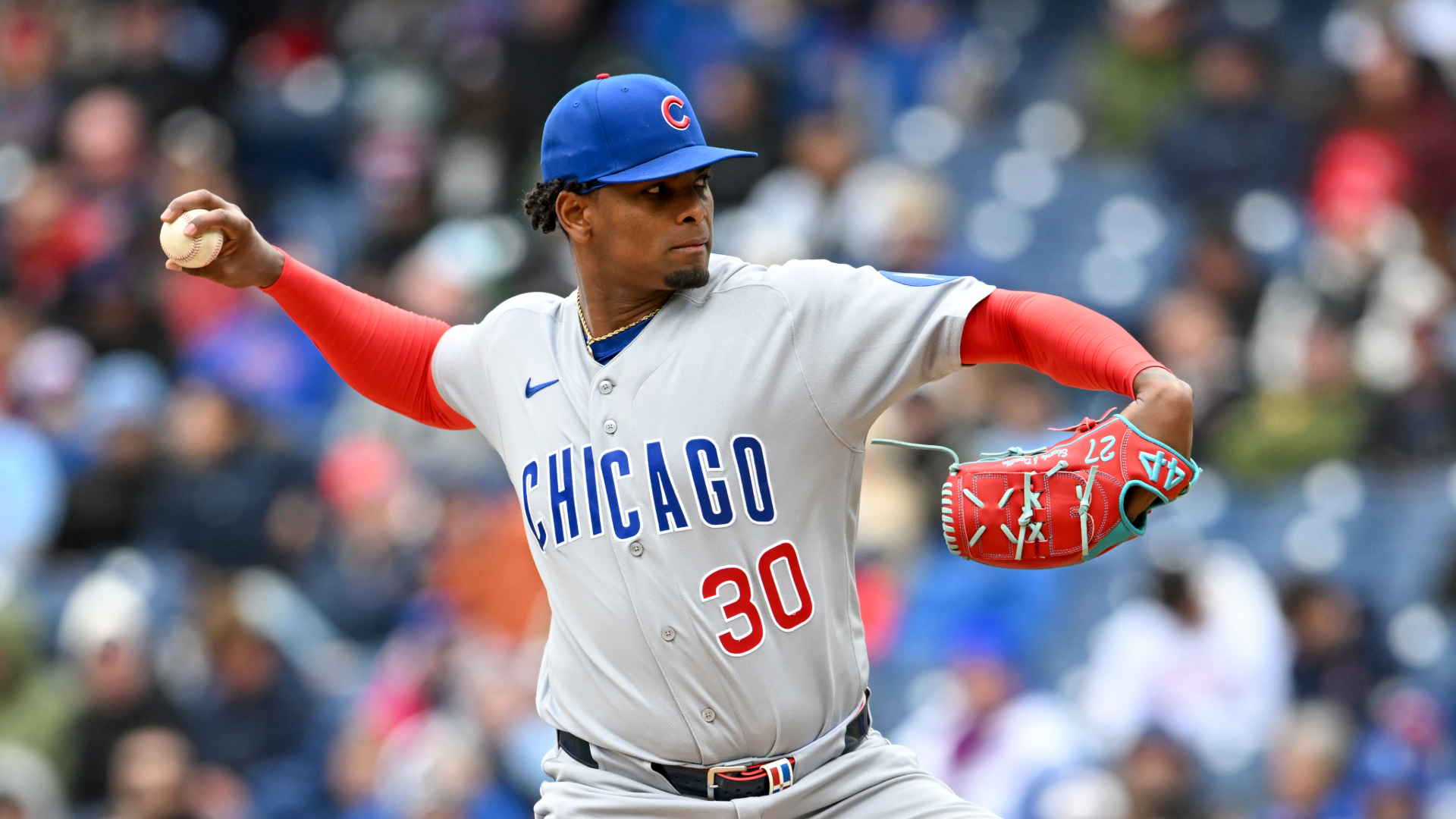
 Edward Cabrera CHC • SP • #30 2025 stats ERA3.53WHIP1.23IP137.2BB48K150 View Profile
 I won't call it a crisis just yet, but the Cubs are pushing the limits of their rotation depth two weeks into the season. Matthew Boyd (biceps) and Cade Horton (elbow) are hurt, Horton long-term, and Shota Imanaga and Jameson Taillon are looking a little long in the tooth. Swingmen Javier Assad and Colin Rea are in the rotation until further notice.
For now, Chicago's ace is offseason trade pickup Edward Cabrera, who spun 11 ⅔ scoreless innings on only two hits allowed in his first two starts. The six walks are an eyesore, but Cabrera has never been a control artist. He makes it work with strikeouts and also a knack for generating weak contact on the ground, which plays well in front of the Cubs' excellent infield defense.
Whenever a pitcher joins a new team these days, you have to assume that new team will make some tweaks. A new pitch, altering an existing pitch, lowering his arm slot, whatever. That has always been the case, really, but it is especially true these days with all the high-tech tools teams have at their disposal. Pitcher development and pitch design have never been better.
In Cabrera's case, the Cubs have flipped his fastball usage, and have him throwing more four-seamers than sinkers. He was a sinker-over-four-seamer guy with the Marlins last season, but the Cubs have a thing for a four-seamers, and have fit Cabrera into that mold. From 2024-25, only the Nationals threw more four-seamers than the Cubs, and no team was close to them.
Four-seamersSinkers2025 with Marlins
13.0%
20.4%
2026 with Cubs
23.7%
6.8%
"I definitely feel more comfortable with the four-seam," Cabrera told The Athletic after throwing 22 four-seamers in his season debut, which was more than all but one of his 26 starts in 2025. "So I went out there and used it."
Taking it a step further, Chicago has a thing for pitchers with low spin efficiency on their four-seamer. Low spin efficiency creates a cutting action. It's not a true cutter, but a four-seamer with a little cut that avoids the barrel more than misses the bat completely. The Cubs haven't had many big strikeout pitchers in recent years. They lean on weak control and letting their defense play.
Cabrera is right in their wheelhouse then as a pitcher with lower spin efficiency on his four-seamer, so it's really no surprise then that the Cubs a) traded for him, and b) have him throwing more four-seam fastballs than sinkers. Specifically, Cabrera is using the four-seamer up in the zone to change eye levels, mostly to lefties right now but also to righties a good deal.
Truth be told, the two fastballs are Cabrera's second- and third-best pitches at best. He's a changeup guy first and foremost and it is a great, great changeup. Leaning into Cabrera's low spin efficiency four-seamer is a very Cubs thing. Through two starts, it's working nicely, and Chicago needs it to continue given the state of the rest of their rotation.
Oneil Cruz showing promise against lefties

 Oneil Cruz PIT • SS • #15 2025 stats BA0.200R62HR20RBI61SB38 View Profile
 First impressions can be hard to shake and Pirates center fielder Oneil Cruz made a pretty terrible one on Opening Day. He made two costly defensive misplays in the first inning and also struck out three times, including once when he began walking down to first base thinking it was a walk, only for an ABS challenge to overturn it into strike three. Ouch.
If you stopped paying attention to Cruz on Opening Day, I'd understand, though you've missed an incredible tear. He is 12 for 39 (.308) with four home runs since that ugly Game 1, and, most impressively, three of those four home runs have come against left-handed pitching. Cruz hit one homer off a lefty all last season.
Cruz is 7 for 12 (.583) with two strikeouts against lefties. Last year, he went 11 for 108 (.102) with 44 strikeouts against lefties, or one strikeout every 2.8 plate appearances, give or take. To take it further, Cruz missed with 42.4% of his swings against lefties in 2025, which is abysmal. In the tiny sample this year, that's down to a more manageable 26.7%.
It is so early in the season that, of course, this might only be small sample size noise, and obviously Cruz won't hit .583 against lefties all season. Improving against southpaws was a priority in the offseason though. Cruz hired a left-handed pitcher to throw him batting practice at home in the Dominican Republic throughout the winter, and got after it.
"It feels pretty good," Cruz told the Pittsburgh Tribune-Review about his early season success against lefties. "The work I did during the offseason is showing up. I feel like I'm in a really good spot against lefties right now."
Chances are Cruz will never be great against lefties, but can he get to league average? He has a career 113 OPS+ against righties. Above-average against righties plus average against lefties equals a dangerous hitter, especially with Cruz's power. The early returns on his offseason work are very promising.

Twins acing ABS challenges
Two weeks into the season, things are going OK for the Twins, and OK can be considered a positive given the expectations entering the season. They are 5-6 with a plus-1 run differential, so a .500-ish team. An awful start can make for a miserable season and the Twins have thus far avoided that.
One area the Twins have excelled in is ABS challenges. They lead the league in ABS challenges by a pretty big margin and are above average with their success rate. Here's the breakdown ("fielders" is pitchers plus catchers, but it's basically all catchers because there have been only 14 pitcher challenges league-wide):
TwinsMLB rankMLB best/next bestHitter challenges
20
1st
Yankees (18)
Hitter success rate
50%
13th
Diamondbacks (80%)
Fielder challenges
18
2nd
Marlins (22)
Fielder success rate
67%
6th
Tigers (90%)
Total challenges
38
1st
Marlins (28)
Total success rate
58%
10th
Diamondbacks (69%)
It's early in the season and small sample size definitely comes into play here. Arizona's hitters have an 80% success rate because they've only challenged five pitches all season (to save you the math, they've won four of them). Detroit's catchers are 9 for 10. Only 11 teams' fielders have challenged fewer pitches. So, take these numbers with a grain of salt at this point in the season.
What is clear though is the Twins are, by far, the most aggressive team with ABS challenges. Their 38 challenges are 10 more than any other team, and the gap between No. 1 and No. 2 is the same as the gap between No. 2 and No. 25. The MLB average success rate is 54%. The Twins are in the sweet spot of lots of challenges and an above-average success rate.
Statcast created a metric -- Gained vs. Expected -- that puts a run value on ABS challenges and the Twins lead the league at +2.6 runs added, well ahead of the second-place Braves (plus-1.1). The rule of thumb in the WAR world is 10 runs equals one win, so you can see how a team could add a win or two via ABS challenges over the long haul 162-game season.
We're still learning about ABS challenges but there does appear to be real skill here. Some players are just better at it than others. Is it coachable and are some organizations better at it than others? Maybe! It's a little too early to say. All we know for sure is that, two weeks into the ABS challenge era, the Twins lead the pack. They're using them way more than any other team.
Join the Conversation comments