Plus, how successful were challenges during spring training?
 By Mike Axisa Mar 24, 2026 at 12:29 pm ET • 6 min read
  Getty Images
 Robo-umps have arrived. Kinda of. Beginning this season, Major League Baseball will use the ABS (short for automated balls and strikes) challenge system, so it's not full robo-umps, but there is now a mechanism in place for players to appeal ball/strike calls. Human umpires will still call the vast majority of pitches. Only a handful will be challenged and even fewer will be overturned.
"I'm excited for it," Yankees captain Aaron Judge told MLB.com about the ABS challenge system last month. "I think it's going to be a little weird, because I'm not an umpire. I'm a hitter. I've never been in the box trying to think about, 'Is this a ball? Is that a strike?' If I feel like I can hit it, I feel like it's a strike."
MLB has tested and retested ABS, both as a fully automated zone and the challenge system, in the minors over the last several years. They did not pull this out of thin air and implement it. The strike zone is far too important to take lightly. The system you will see this season has been calibrated and fine-tuned over a number of years and has been deemed ready for primetime.
With the new season beginning this week, here's what you need to know about the ABS challenge system and what to expect.
How it works
The short version is that each team gets two challenges per game with which they can appeal a ball/strike call. Similar to instant replay, you keep a successful challenge, so a team could theoretically challenge every single pitch as long as they're successful. Only the hitter, pitcher, and catcher can challenge pitches. It can't come from the dugout. Here now is the long version:
The strike zone
Strike zones are personalized and every single player was measured. The top of the zone is set at 53.5% of the player's height and the bottom of the zone is set at 27.0%. Those numbers (53.5% and 27.0%) were tested and retested and fine-tuned in the minors. The width of the strike zone is unchanged. It's still the 17-inch home plate. Players were measured standing straight up, so guys with a crouched batting stance might be at a little disadvantage.
ABS uses a two-dimensional strike zone set over the middle of the plate. They tested a three-dimensional zone over the entire plate, which led to an excessive amount of strike calls and thus more strikeouts, which no one wants. They also tested a two-dimensional zone at the front of the plate, and again there were excessive strikes. A two-dimensional zone over the middle of the plate produces the results most consistent with the zone we're used to seeing, so that's what's being used.
Challenges
Again, it's two challenges per team, and you keep successful challenges. Only the hitter, pitcher, and catcher can challenge. Players tap on their head to initiate the challenge, which must happen immediately. They can't look to the dugout for help. The numbers have shown that catchers are the most successful challengers, which makes sense given their vantage points. Pitchers are least successful. In the minors, some teams went as far as to ban their pitchers from challenging. Will an MLB team do that? Possibly.
What it looks like
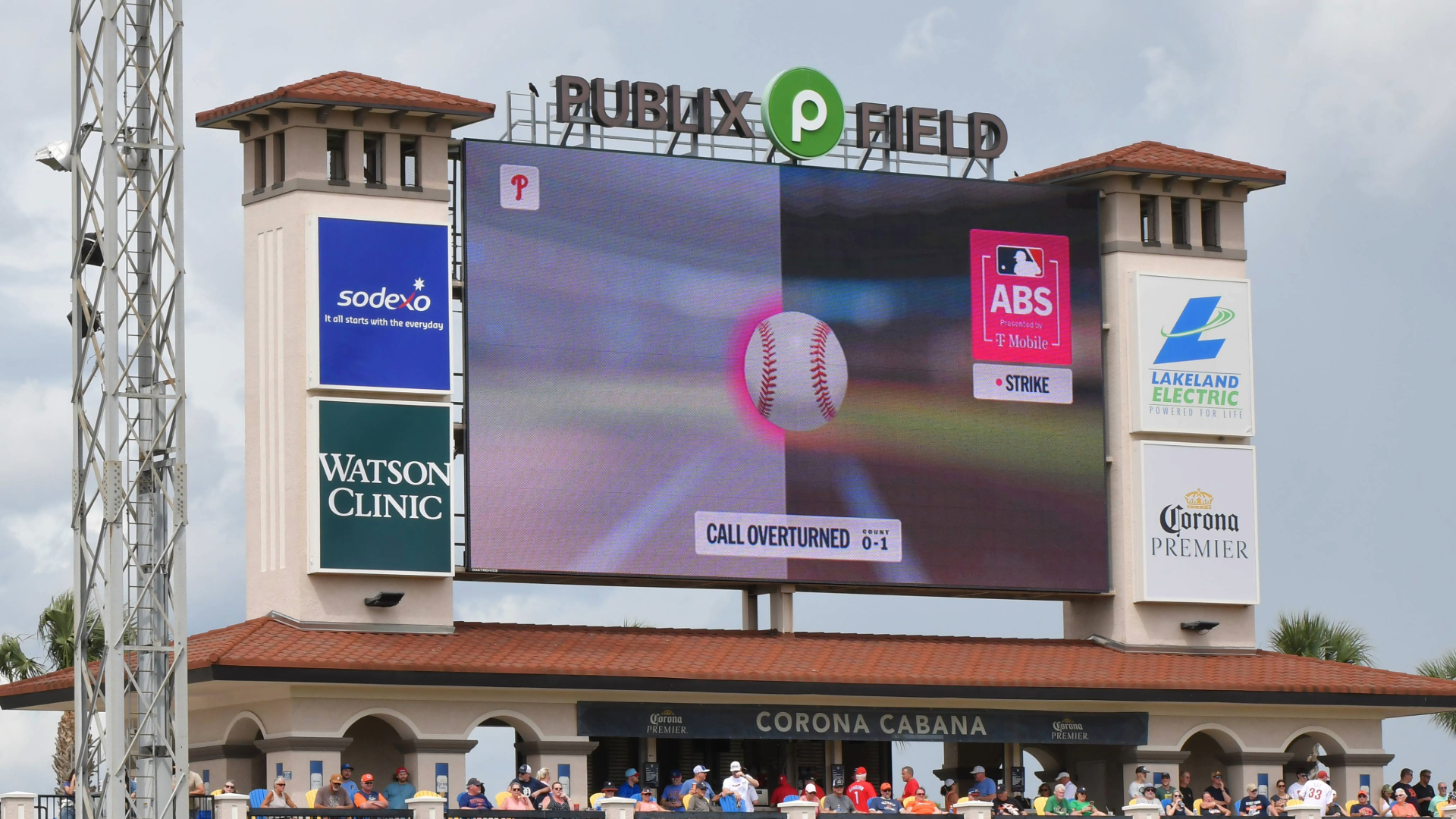
Once a challenge is initiated, the home plate umpire announces it to the crowd and ABS is shown on the television broadcast and also the scoreboard at the stadium. The entire process takes about 15 seconds. Here's the ABS challenge system in action:
Similar to regular instant replay, the goal of the ABS challenge system is to correct the most egregious missed calls, though we will inevitably see some ticky-tack replays as well. More than a few times this spring, calls were overturned on pitches ABS measured at less than 0.1 inch in or out of the zone.
How did it go in spring training?
On average, there were 4.5 challenges per game between the two teams this spring. I would not expect that many during regular-season games. Players used spring training to familiarize themselves with the system and their own personal strike zones, so they let the challenges fly without regard for the game situation. It was about four challenges per game between the two teams in Triple-A last season. That's closer to what we'll see in regular-season games this year.
Here are the numbers on spring training challenges:
Challenge rateSuccess rateBatters
4.8%
45.7%
Fielders
2.3%
59.5%
Total
3.5%
53.1%
"Fielders" includes both pitchers and catchers, though pitchers accounted for only 5% of fielder challenges this spring, so that group is almost all catchers. Also, just so it's clear, the 3.5% overall challenge rate does not mean 3.5% of all pitches were challenged. It means 3.5% of ball/strike calls were challenged. About 1% of all pitches were challenged this spring.
Batters challenged more often than catchers this spring but were far less successful. Again, catchers reign supreme with ABS challenges. They have the best view of the zone. Overall, the challenge success rate was a tick above 50%, which goes to show how good human umpires really are. In Triple-A last year, the success rate was 49.5%, or damn close to 50/50.
What to expect during the regular season
The biggest thing to watch is who gets to challenge and when they're allowed to challenge. Some teams might flat out take the ability to challenge away from some players. Some situations may be off-limits for a challenge, such as the No. 8 hitter taking a called strike three with the bases empty and two outs in the second inning. Is it worth taking a shot there? Probably not.
There will be the temptation to hold the challenge(s) for the late innings in case there's a high-leverage situation, but games are won and lost in the early innings all the time. If there are two on with one out in the third inning and your starter's pitch count is climbing, it's probably worth challenging that 1-2 pitch if it can help him limit the damage and get closer to escaping the inning.
ABS challenges are a strategic decision as much as anything. Who gets to challenge and when they get to challenge will be very important, and every team will have different guidelines. You can't just challenge the first incorrect call every game, you know? Expect a feeling-out process early in the season as teams figure out what works and doesn't work for them.
Is this a skill?
We're still learning about ABS and the challenging system but yes, it appears so. Spring training is a small sample that doesn't tell us much (no hitter challenged more than seven pitches this spring and no catcher challenged more than 23 pitches). In Triple-A last year though, there was a huge spread between the best and worst ABS challengers.
Here are the top Triple-A challengers in 2025 (minimum 20 challenges):
HittersCatchers1. Riley Tirotta: 67%
1. P.J. Higgins: 77%
2. Rafael Lantigua: 62%
2. Andrew Knizner: 73%
3. Trenton Brooks: 60%
3. J.C. Escarra: 68%
...
...
34. Ernesto Martinez Jr.: 26%
88. René Pinto: 42%
35. Tre' Morgan: 25%
89. Alex Jackson: 42%
36. Zac Veen: 12%
90. Kenny Piper: 40%
The samples are still small enough that we don't know exactly how repeatable successful challenges are as a skill, but there's a big enough spread between the best and worst challengers in Triple-A last year to suggest that, yeah, some guys are better at it than others. The overall success rate may be close to 50%, but that doesn't mean every challenge is a coin flip.
Join the Conversation comments