Opening Day is around the bend, and these six players could make big contributions
 By Mike Axisa Mar 20, 2026 at 8:19 am ET • 11 min read
  Getty Images
 Opening Day is less than a week away and soon that spring training optimism will be met with a reality check. Some players really are on their way to bigger and better things. Others are a March mirage. With that in mind, it's time to cobble together a list of breakout picks for the 2026 season. These are players who I expect to level up this summer and become staples for their club.
"Breakout" is an ambiguous term that means different things for different players. For some, a breakout means going to the All-Star Game and getting awards votes. For others, it's holding a big-league roster spot all season and becoming a regular. I'm defining breakout pick as a player I expect to reach new heights and perform better than he has to date. Easy enough, right?
Here are six breakout picks -- three hitters and three pitchers -- for the 2026 season. Be sure to bookmark this page for future mocking purposes.
Pitchers with big stuff and injury problems
That is a broad category but is also one ripe with breakout candidates. Last spring, Kris Bubic and Trevor Rogers would've fit the description, then they had tremendous (albeit abbreviated) regular seasons. Here are two of about two dozen pitchers with big arms and lengthy injury histories poised for a big 2026.
RHP River Ryan, Dodgers

 River Ryan LAD • P • #77 View Profile
 Tommy John surgery wiped out Ryan's 2025, though he was far enough along with his rehab that Los Angeles strongly considered adding him to their World Series roster. He made four effective starts in 2024 and it is a near certainty he'll see big-league action in 2026. Blake Snell will open the season on the injured list and the Dodgers always use a ton of starters.
This spring, Ryan, 27, has shown the same five-pitch mix that made him so exciting before elbow surgery (mid-90s four-seamer and sinker, slider, curveball, changeup) as well as a new cutter that sits right around 94 mph. The cutter gives Ryan another weapon against lefties. He's now mostly a north/south guy against lefties and an east/west guy against righties.
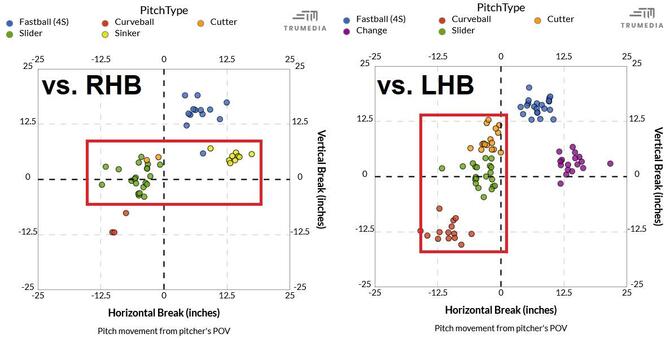 Ryan's wide arsenal gives him multiple attack lanes. TruMedia/CBS Sports
 The shape and movement traits on all five pitches are very good and have the analytical models going 👀. A deep arsenal and a solid enough history of throwing strikes give Ryan an excellent chance to stick in the rotation long-term. That could be difficult with the Dodgers, which is why they've used him out of the bullpen three times this spring (one start). They want to find a role for him.
Justin Wrobleski, last year's breakout pitcher for the Dodgers, threw 66 ⅔ innings across two starts and 22 relief appearances. That could be Ryan's role this year: a reliever, but one who goes multiple innings, even in high-leverage situations. He brings velocity and a wide arsenal, and is with a team that knows how to max out a pitcher's effectiveness. All the arrows are pointing up.
LHP Ryan Weathers, Yankees

 Ryan Weathers NYY • SP • #40 View Profile
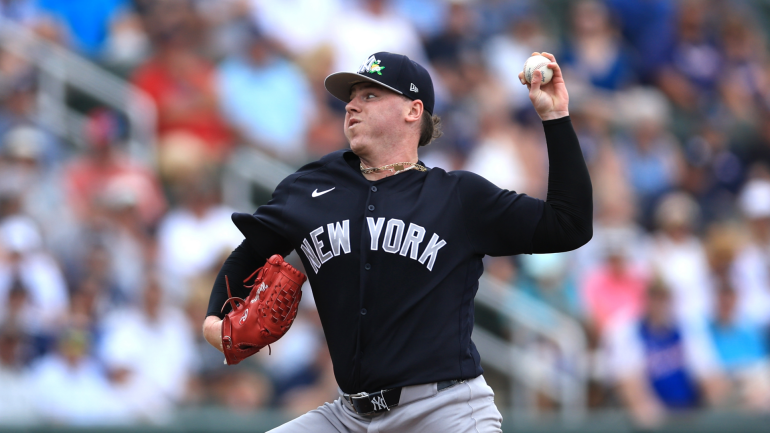
 The Yankees had an offseason that seemed designed specifically to enrage the fan base. Their biggest moves were re-signing Cody Bellinger and Trent Grisham, which makes for a boring winter. Their biggest addition from outside the organization was Weathers, who spent the last few years flashing huge stuff with the Marlins when he wasn't injured.
Last year, flexor and lat strains limited Weathers to 38 ⅓ innings. The year before, he had a finger strain. In an effort to avoid injuries, Weathers changed his offseason workouts and tailored them more toward agility and flexibility than strength. Will that keep him on the field? Beats me. We'll find out this summer. Point is, though, Weathers is doing what he can to avoid injuries.
Now 26, Weathers is a breakout candidate because it is loud stuff from the left side. Statcast's pitcher comparison tool, which uses velocity and spin and all that to compare pitchers, says the most similar pitchers to Weathers stuff-wise are, in order, Jesús Luzardo, Tarik Skubal, and Garrett Crochet. That's what upper-90s gas and multiple swing-and-miss secondary pitches get you.
Here at Pitch Profiler, we’ve been known to get a little too hyped at times. But this is legitimately insane. This is a 5-pitch arsenal with nothing but 60+ grade pitches. The fastball and slider proStuff+ grades are the highest we’ve seen from any starter this Spring Training! pic.twitter.com/Dcjp3OD0Ex
— Pitch Profiler (@pitchprofiler) February 26, 2026
The Yankees have Weathers using his sinker to lefties more often this spring, a pitch usage tweak designed to avoid the barrel more than miss the bat entirely, and get quicker outs. New York's thing is strikeouts and limited hard contact. As a team, they've ranked near the very top of the league at limiting exit velocity over the last five years. They're fitting Weathers into that mold now.
Beyond injuries, Weathers' biggest issue is commanding his fastball while pitching from the stretch. He tends to rush through his delivery and winds up spraying the ball all around, leading to walks and hittable mistakes. Mechanical adjustments can help with that, for sure, as can experience. When the game speeds up on you, it's time to take a breath and slow down on the mound.
Staying on the field is the single biggest obstacle in the way of a breakout season. Weathers has premium stuff and a history of throwing strikes (6.8% walk rate the last two years), and is now in an organization that knows how to generate weak contact. All the ingredients are there for a breakout season. It's just a matter of staying on the field so the talent can shine.
Post-hype former top prospects
Not every top prospect hits the ground running like Nick Kurtz or Paul Skenes. Sometimes young players need a year or two (or three) to find their footing at the big-league level and live up to the prospect hype. Think Hunter Brown and Geraldo Perdomo. Here are two breakout picks who are a few years removed from ranking among the game's tippy top best prospects.
C Francisco Alvarez, Mets

 Francisco Alvarez NYM • C • #4 View Profile
 I was on the fence about including Alvarez as a breakout pick because he was very good last year around a hamate fracture and a thumb sprain (and a Triple-A demotion): .256/.339/.447 with 11 home runs in 277 plate appearances. The 26.4% strikeout rate is a bit high but not excessive. You can live with that for a catcher slugging well over .400 and walking close to 10% of the time.
Alvarez, 24, has been held back by injuries as much as anything, and some of those injuries were bad luck. He stumbled on the bases in 2024 and tore a ligament in his left thumb. Last year, he sprained a ligament in his right thumb on a slide. The hamate fracture is just an unfortunate thing that happens. There's no chronic injury, no achy body part that gives him trouble every year.
What Alvarez brings to the plate is excellent hard-hit ability (108 mph 90th percentile exit velocity in 2025) and room to grow as a hitter by pulling the ball in the air more often. Alvarez's pulled fly ball rate is going in the wrong direction:
- 2023: 19.0%
- 2024: 14.7%
- 2025: 9.2%
The MLB average is 16.7%. We all love those Nice Piece of Hitting™ singles the other way, but pulling the ball gets you to heaven. Last season, balls pulled in the air produced a .612 batting average and a 1.329 slugging percentage. Pulled fly balls are the most productive batted ball and Alvarez a) didn't do it enough last year, and b) is doing it less and less with each passing year.
This can be attributed at least somewhat to coaching. Several other young Mets hitters (hello, Brett Baty) have had issues fully tapping into their power in recent years. To fix that, the Mets brought in a new hitting coach (Troy Snitker) and elevated Jeff Albert to director of hitting this past offseason. Two new school, analytically inclined coaches are running the team's hitting apparatus now.
As good as he's been in his career to date, Alvarez stands out as a breakout pick because the team's new hitting coaches figure to help pull the ball more often, which will turn those impressive exit velocities into more output. More pulled fly balls plus good health equals significant breakout potential. Now, please just watch your thumbs when you're running the bases, Francisco.
LHP Kyle Harrison, Brewers

 Kyle Harrison MIL • SP • #52 View Profile
 "He's working on a new pitch" is the modern day "best shape of his life." Sometimes those new pitches don't amount to much and they go on the shelf once the regular season begins, like Paul Skenes' cutter last spring. Sometimes they stick and change a player's outlook. Jesús Luzardo picked up a sweeper last spring and it fueled his breakout season.
Still only 24, Harrison went from the Giants to the Red Sox in the Rafael Devers trade last summer, and from the Red Sox to the Brewers in the Caleb Durbin trade last month. He has a solid enough 4.39 ERA in 194 ⅔ MLB innings, though the big strikeout numbers he posted in the minors have dried up. Harrison's career 10.0% swinging strike rate is below the 11.0% league average.
To that end, Harrison is working on a new pitch this spring, specifically a kick-change, which is a fancy name for a changeup thrown with the middle finger spiked. Harrison has long been a four-seam fastball/slurve pitcher who didn't have anything with downward action. The fastball rises and the slurve slurves. The kick-change gives him something with sink.
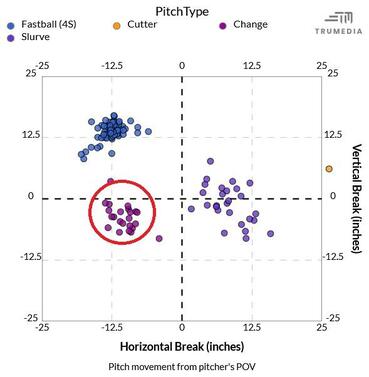 Harrison's new kick-change create a new downward look. TruMedia/CBS Sports
 The Red Sox tried to teach Harrison a changeup modeled after Connelly Early's last year, but it didn't take, according to the Milwaukee Journal Sentinel. He got together with former Giants' teammate Hayden Birdsong (one of the original kick-change guys) over the winter, and that's when it stuck. Milwaukee helped fine-tune the pitch into a legitimate weapon.
The Brewers are at the top of the sport when it comes to getting the most out of a pitcher. They optimize arsenals and put their guys in position to succeed as well as any team in the game. Harrison's always had a quality fastball/slurve combination. The changeup looks like it will stick and it's the kind of pitch that can level him up by finding those missing swings and misses.
Deep sleeper bats for the baseball sickos
Sickos is a term of endearment, to be clear. If you're a casual fan, that's cool and a great way to take in the sport (I'm very much a casual NBA and NHL fan), but some of us are major seamheads who obsess over our favorite team's 40th 40-man roster spot and Double-A backup catcher. Here are two deep sleeper breakout hitters for the sickos among us.
OF Carlos Cortes, Athletics

 Carlos Cortes ATH • LF • #26 View Profile
 Last seen hitting cleanup for Puerto Rico in the World Baseball Classic, Cortes is a very fun switch-throwing utility man. He throws left-handed when he plays the outfield and right-handed when he plays the infield, which, unfortunately, he doesn't do much these days. Cortes has spent the last few years as a corner outfielder capable of manning second or third (or first) in a pinch.
That doesn't bode well for his playing time with the A's. They've locked up Lawrence Butler and Tyler Soderstrom, their starting corner outfielders, to long-term deals, plus Brent Rooker is signed long-term at DH. Cortes' best hope for regular playing time might be at second base, with Jeff McNeil sliding to third. Either that or Butler shifting to center, where he started 51 games in 2025.
If Cortes hits, the playing time will sort itself out. The 28 year old slashed .309/.323/.543 in limited action with the A's last season, and he's consistently mashed in Triple-A. Cortes has two things going for him at the plate. One, he's a left-handed hitter who's hit lefties well throughout his career, so he's on the heavy side of the platoon and doesn't need to be sheltered.
And two, a strong blend of plate discipline and contact skills. Cortes rates very well in SEAGER, which measures swing decisions, and there's enough thump in his bat to hammer anything out over the plate. Here is his 2025 Triple-A expected slugging percentage heat map against righties:
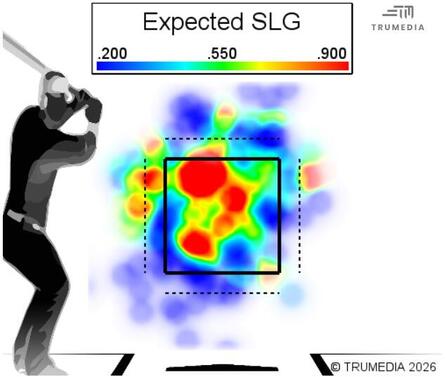 Leave something out over the plate, and Cortes will punish it. TruMedia
 Swinging at the right pitches, hammering mistakes in the zone, and playing multiple positions is a pretty good way to stick on a big league roster. There's a clear lane for Cortes to make the Athletics' Opening Day roster and, even if he doesn't get many starts out of the gate, his lefty bat will be useful in pinch-hitting situations for righty Denzel Clarke and whoever plays third base that night.
UTIL Trei Cruz, Tigers

 Trei Cruz DET • SS • #40 View Profile
 Cruz, 27, is one phone call away from being a third-generation big leaguer. He's the son of Jose Cruz Jr. and the grandson of Astros great Jose Cruz Sr., and the Tigers added him to the 40-man roster in November. Last season, Cruz slashed .279/.411/.456 with 13 home runs and 102 walks between Double-A and Triple-A. Those 102 walks were six more than any other minor leaguer.
It is a skill set that is easy to love. Cruz is a switch-hitter with speed and high-end plate discipline, plus the athleticism and defensive chops that have allowed him to play every position except first base and catcher. He defends well everywhere, including at shortstop and in center field, two positions that aren't exactly locked down long-term in Detroit. That equals opportunity.
Cruz does his best work as a left-handed hitter (he hasn't hit a home run right-handed since 2023), so he's on the heavy side of the platoon, and there is pop in his bat. This isn't a slap hitter. Here are his 2025 Triple-A numbers as a lefty batter:
CruzTriple-A averageAverage exit velocity
90.8 mph
88.2 mph
90th percentile exit velocity
105 mph
103 mph
Hard-hit rate
50.0%
37.1%
That isn't to say Cruz will become a 20-homer bat in the big leagues. It just means that he has sneaky pop and can make pitchers pay for their mistakes. Cruz's calling card is his up-the-middle defense and versatility. On top of that, he'll give tough at-bats and stolen bases, plus some dingers. It will never be difficult to get Cruz in the lineup, and there's enough offense to stay there.
Trey Sweeney isn't cutting it and Javier Báez's 2025 resurgence ended in mid-June. I can see a scenario in which A.J. Hinch falls in love with Cruz and he becomes Detroit's most-of-the-time shortstop in 2026. Even if he settles in as a utility guy, he'll be a utility guy who fills up the box score and makes his manager feel comfortable when he puts his head down on the pillow at night.
Join the Conversation comments