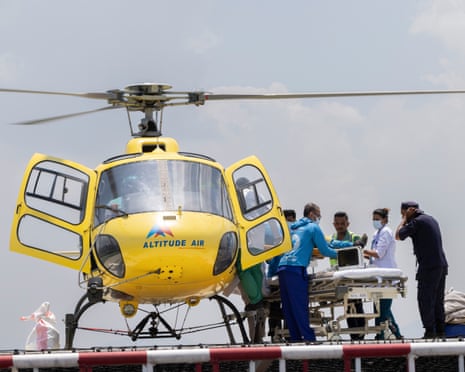
 Hillary Dawa Sherpa is airlifted to hospital in Kathmandu, Nepal, after being found alive at Everest base camp on the second day of his funeral rites. Photograph: Narendra Shrestha/EPAHillary Dawa Sherpa is airlifted to hospital in Kathmandu, Nepal, after being found alive at Everest base camp on the second day of his funeral rites. Photograph: Narendra Shrestha/EPAMissing Sherpa guide found alive on Everest after funeral rites had begun
Climbing support team rescue Hillary Dawa Sherpa almost a week on from when he was last seen
A Nepali guide who was believed to have died on Mount Everest has been found crawling to base camp a week after going missing – and after his funeral rites had begun.
Dawa Sherpa, also known as Hillary Dawa Sherpa after the famous climber Edmund Hillary, was last seen on 29 May but did not reach base camp with other climbing groups.
A fellow climber said he was last seen around the “death zone” region of the world’s highest mountain, where the pressure is so low that oxygen levels are insufficient for sustained human survival.
A helicopter rescue team had failed to find the 52-year-old, but Dawa Sherpa was located on Thursday morning, according to Pemba Sherpa of 8K Expeditions, which coordinated the search. A climbing support team found him as he crawled down the snowy slopes around the Khumbu icefall, just above base camp, said Pemba Sherpa.
He had frostbite on his hands but appeared to be in good health, and was quickly carried down to safety and given food and water. A rescue helicopter flew him to a hospital in Kathmandu, where his wife and daughter, who had already begun funeral rituals, were waiting.
“We first heard that he was still alive on the local news,” said his wife, Damu Sherpa.
Record 274 climbers summit Everest from Nepalese side in single dayRead moreDawa’s teenage daughter, Mendo Lhamu Sherpa, said they were on the second day of a funeral ritual, which traditionally lasts for several days. “When we first heard about it [the rescue], we could not be sure if that person was indeed our father,” she said. “So to be certain we asked for photos to be sent and then only we were sure and very happy.”
Dawa Sherpa was last seen at spot called Yellow Band above camp 3, which is located at 7,200 meters (23,622ft). The base camp is at 5,300 meters.
He works for a small Kathmandu-based company called Himalayan Traverse, and was guiding a Polish climber. He comes from the town of Okhaldhunga, south of Everest.
Earlier this week, Chris Thrall, a British climber and former Royal Marine, posted a video tribute to Dawa Sherpa, believing he had died on the mountain.
Thrall said Dawa Sherpa had sat for a rest on the way down. “I turned and I said: ‘Hillary, are you OK, brother?’ He said: ‘Yes, yes, fine Chris, please go, go!’” Thrall said, adding that the guide had a satellite phone and a radio but that he was not sure if they were functioning.
Thrall said he had continued and found Dawa Sherpa’s Polish client “with no oxygen and frostbite” and decided to help him down, believing the experienced Nepali guide would make his own way down. “The weather was so changeable and so bitter,” said Thrall. “Tragic. Unfortunate. But it’s the high mountains. That’s it.”
Nepal’s mountaineering community has hailed Dawa Sherpa’s survival as miraculous.
“This is nothing short of a miracle surviving so many days on the mountains facing such harsh conditions,” said Ang Tshering Sherpa, a leading figure in the community. “Sherpas are built tough growing up in the mountains,” he said. “If there was someone else in his place, they might not have survived.”
The team that spotted Dawa Sherpa near base camp was part of the Sagarmatha Pollution Control Committee, which lays the ladders and ropes on the route at the start of each climbing season and then removes the equipment and cleans up the site after climbers have left.
Members of the Sherpa community were mostly yak herders and traders living deep in the Himalayas until Nepal opened its borders in the 1950s. Their stamina and familiarity with the mountains quickly made them sought-after guides and porters, eventually allowing them to dominate the Himalayan climbing business.
More than 1,000 climbers and their guides scaled Everest this May, which was the busiest climbing season ever on the world’s highest mountain. It began late because of a huge ice block on the route just above the base camp that took about two weeks to clear.
Five people have died this season. Mountaineering experts often criticise authorities for allowing large numbers of climbers on the mountain, which sometimes leads to risky jams or long queues in the “death zone” area.
The 8,849-metre high peak was first climbed on 29 May 1953, by a guide Tenzing Norgay Sherpa and New Zealander Edmund Hillary.
The Associated Press contributed to this report
Explore more on these topicsShareReuse this content