
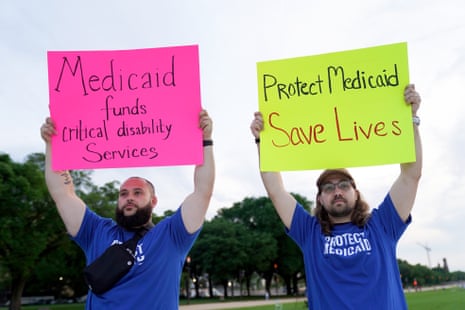
 People protest cuts to Medicaid on 7 May 2025 in Washington DC. Photograph: Leigh Vogel/Getty Images for Caring Across GenerationsPeople protest cuts to Medicaid on 7 May 2025 in Washington DC. Photograph: Leigh Vogel/Getty Images for Caring Across GenerationsMillions of Medicaid recipients to face draconian requirements as of 1 January
Trump’s reform law that seeks to make coverage harder to get, and to keep, includes working 80 hours per month
It is a date keeping US healthcare providers up at night: 1 January 2027.
As the midterm elections loom, everyone from hospital leaders and to patient advocates are focused on the New Year, when Republicans scheduled the most controversial elements of their healthcare reform law to go into effect.
Millions of Medicaid beneficiaries will be required, though a maze of government paperwork, to show they’re working 80 hours per month. And that’s just the marquee change.
“The costs to the family – and society as a whole – cannot be overstated,” said the American Academy of Pediatrics president, Dr Andrew Racine.
HR 1, also known as the “One Big Beautiful Bill Act” and signed into law by Donald Trump on 4 July 2025, cut roughly $1tn in federal spending from the healthcare industry – the biggest clawback of federal health spending ever. Paired with Republicans’ refusal to extend subsidies for plans in Obamacare marketplaces, the cuts are expected to result in about 17 million newly uninsured individuals through 2034.
US maternity wards face wave of closures as Medicaid cuts kick inRead moreAlthough the US has one of the most widely privatized healthcare systems in the world, nearly half of all health spending is paid for by government – whether federal, state or local, according to the Centers for Medicare and Medicaid (CMS). Nearly 40% of US health spending in 2024 was from just two programs: Medicare and Medicaid, the public health insurance programs for the aging and low-income. To put the scale of the $1tn cut into context, Medicaid spent $937bn in 2024, according to the CMS.
As a result, advocates, researchers, hospital leaders and doctors are all expecting more medical debt, more delayed care and more people losing coverage for which they technically qualify.
“There couldn’t be a clearer link,” said Dr Luke Messac, an emergency physician at Mass General Brigham and a historian who has written about medical debt. “We saw that when Medicaid eligibility was expanded the flow of medical debt rapidly declined and sustained that decline.
“The easiest way to reverse that trend – to make medical debt more of a problem – is to yank people off Medicaid and leave them uninsured and unprotected.”
To understand Republicans’ new work requirements, you have to go all the way back to the Affordable Care Act (ACA) of 2010, when the Obama administration required states to expand Medicaid to cover people earning up to 138% of the federal poverty level, or about $16,000 for a single person today. Republicans hated this, and for the better part of a decade resisted the change through a supreme court case and dozens of Obamacare repeal votes.
However, over fits and starts, 44 states opted in. The deal was too sweet to pass up: states could insure many of their poorest residents and help their hospitals survive, with the overwhelming majority of the cost paid by the federal government.
Today, more than 82 million people rely on Medicaid for health insurance, or about 23% of the entire American public, according to the Kaiser Family Foundation (KFF), a health policy research organization. HR 1 is a direct assault on that system.
Consider first: the effects on regular people. Work requirements that go into effect in January will apply only to people in the 44 states that “expanded” Medicaid, and then only to people in the “expansion population”. That’s about 20 million people, according to KFF. Those people will need to prove they are working, going to school or volunteering at least 80 hours or earning $580 per month. People will also need to re-certify eligibility every six months, instead of every year. In short, Medicaid will be harder to get and harder to keep.
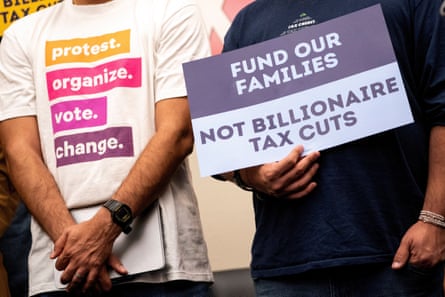 Demonstrators hold signs during a press conference to discuss cuts to Medicaid on Capitol Hill in Washington DC on 13 May 2025. Photograph: Nathan Howard/Reuters
KFF has come up with some hypothetical scenarios to illustrate how even qualified people might be tripped up by these bureaucratic hurdles. Consider Jane, who has a depressive disorder that does not qualify for an exemption from work requirements. In May, she experiences a depressive episode that makes it impossible for her to work 80 hours. In June, when her work requirement verification is due, her hours mean she is no longer eligible for Medicaid, and she becomes uninsured. Without insurance, she can no longer get her medication, which results in another depressive episode.
Or, consider John, who loses his job and is out of work in April and May. He gets a job in June, but his state requires people to satisfy three months of work before they are eligible for Medicaid. John does not satisfy this requirement, and is denied Medicaid. September 2026 will be the first month in a “look-back period” in some states.
“The insistence on these Medicaid work requirements, which is really just a way to decrease the rolls – that was the intention – is really going to increase the number of people with medical debt and the amount of medical debt in the system, which is bad not just for patients but for providers,” said Messac.
skip past newsletter promotionafter newsletter promotion
HR 1 has wrought other changes too. Come January, Medicaid coverage will be winnowed down from three months of retroactive coverage to two months – or one depending on the applicant and the state. Alongside those changes in January are others that already went into effect. For instance, HR 1 made some legal immigrants ineligible for Medicaid. In the future, HR 1 will cut some accounting mechanisms that benefit children’s hospitals.
All of the different types of patients HR 1 will affect has created a long list of advocacy groups worried about the effects. Advocates for the elderly are worried some people won’t be able to get as much retroactive Medicaid coverage for nursing care, since the legislation shortened retroactive Medicaid benefits. (Elderly or unwell people often don’t file for Medicaid coverage for nursing care right away, either because they are too sick or falsely believe Medicare covers it.)
Advocates for children are worried parents will lose health insurance and have “spillover” to children. “When parents lose their health insurance, children may lose their coverage, too, even if they remain eligible,” said Racine.
Medicare for All remains key pressure point for Democrats before midtermsRead moreBeyond the impacts on individuals: consider the systemic. One of the most common places to seek healthcare in the US is the hospital, for everything from births to cancer screenings. The Urban Institute estimates that HR 1 will cause $278bn in “uncompensated care” by 2034 – health industry parlance for unpaid bills. That puts hospitals in a bind, many of which operate on the thinnest imaginable margins.
“There is a consensus that, particularly in rural healthcare, there is this deepening crisis,” said Dr John Osborne, a former doctor at the Veterans Affairs administration in Washington state, and one of the organizers of a grassroots declaration of a rural health crisis in October. “I would say what’s happening in rural America is a harbinger of things to come throughout healthcare in the US.”
Although rural hospitals were a particular concern during passage – a closure can leave patients traveling hours for even routine care – new research shows both rural and urban hospitals are now closing at the same rate.
“Loss of access for acute care in-patient hospitals is not just a rural problem – it’s a national problem,” said Dr Thomas Tsai, a health policy researcher and surgeon at Brigham and Women’s hospital in Massachusetts and an author of the research.
That raises the possibility that even in urban cores, healthcare is inaccessible as patients from near and far crowd in to try to access care, including many newly uninsured people who will tend to use the emergency room more often.
“The impact will be profound,” said Dr John McCarthy, assistant dean for rural programs at the University of Washington School of Medicine, about HR 1. “Unless you have something that’s obviously really impressive, you have a five-hour wait – if you’re lucky.”
Explore more on these topicsShareReuse this content