
 Courtesy MicrosoftMicrosoft is developing two new AI-enabled hardware products
Microsoft is developing new wearable technology with an artificial intelligence (AI) enabled gadget.
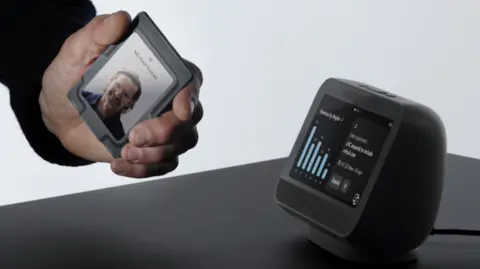
During its yearly conference for technology developers, Microsoft executive Steven Bathiche showed off two "concepts" that the company has developed for hardware products intended for people who often use AI tools in their work.
One device was a small portable cube with a touch and voice-activated screen, meant for a desk. The other was "a wearable access badge," Bathiche said, to hang around the neck or on a belt loop, giving quick access to AI-driven work
Satya Nadella, Microsoft chief executive, said such gadgets represented a "new form factor" for technology devices.
While Microsoft did not say it would bring either of these products to market, it said current pilots with the devices "will inform how these form factors can be built" in the future.
Currently, they are being used by a few hundred Microsoft employees.
Microsoft has previously attempted to break into the wearable devices.
The company developed a wearable headset, called the Hololens, akin to the Meta Quest or Apple's Vision Pro headsets.
The Hololens was even set to be sold to the US Army in a contract worth billions of dollars.
But after almost a decade of development, and ongoing issues during testing by the military, Microsoft said in 2024 it would stop producing Hololens.
Google is also having a second go at wearables, as that company recently said it would try again with "smart glasses" more than a decade after its notorious Google Glass flop.
In a video demonstrating Microsoft's AI-driven access badge and desktop device, part of what Nadella called Project Solara, people doing mainly office work were shown tapping the screens on both devices in order to see and connect to work being done by AI agents. Agents are essentially AI bots doing tasks somewhat autonomously.
Such agents are widely used by technology workers, assisting in their writing of software code, for instance.
The advancement of this kind of AI assistance has been cited widely by major tech executives in a recent wave of layoffs that have impacted many thousands of workers.
Microsoft's badge and the desktop device would connect to various Microsoft software and PCs, letting a person interact with their AI agents outside of a laptop or desktop computer.
While the access badge is meant to be worn, Bathiche said it "is lightweight and designed for agent interactions on the go."
Nadella was shown at one point in a recorded video wearing the access badge on a lanyard around his neck, similar to the way people wear identification cards required to enter office buildings.
The badge is also equipped with a small camera.
During Bathiche's demonstration, he took the wearable badge, activated it using his fingerprint, and pointed it at the audience of the conference, telling it to take some pictures of the crowd and send them to him for review.
It did so, he said.
The camera allows agents "to better understand and help take action on the environment around them," Bathiche said in an online blog post about the devices.
Cameras on other AI-centric devices, like Meta's AI eyeglasses, for instance, have come under intense scrutiny about when, why and how they record and store video.
Wearable technologyMicrosoftArtificial intelligence