Miami at preseason No. 1 wasn't a popular choice, and I knew that when our post-spring rankings came together. Most of the CBS Sports national college football staff leaned toward Texas or Ohio State, given the star power, proven depth and championship-caliber rosters returning for each program in 2026.
However, the Hurricanes checked every box for me. While colleagues expressed varying levels of skepticism about Miami due to offensive line losses, pass-rush personnel now in the NFL, and reservations about Mario Cristobal's game management, the selection never felt controversial. If anything, it highlighted just how much respect the Longhorns and Buckeyes continue to command nationally entering the season.
After digesting spring practice reports and roster intel the last few months, I can confidently say this team appears to have wiped away last season's national championship game appearance and all the hype that came with it.
Can Miami's defense reload up front? Why Armondo Blount and Marquise Lightfoot are keys to 2026 success Cody Nagel
Complacency does not exist at Miami, a mindset Cristobal said he took from being on Nick Saban's title-winning staffs at Alabama.
"Always attack human nature, I mean wake up in the morning with (your) hair on fire and making sure you never allow complacency or entitlement to permeate the building," Cristobal told CBS Sports' Adam Breneman this month. "I still think the best thing (Saban) did was wake up in the morning, and he's going to come in on fire. Even if it's not complacent, he's going to make you feel like somebody is, and your ass is going to get lit up. It was awesome and it kept everybody on edge I thought in the right kind of way."
Maybe I'm the only one who sensed the lightbulb coming on within the program last season after the first-round playoff win at Texas A&M. Miami responded by taking out Ohio State, one of the CFP favorites as defending champs, and came back to beat Ole Miss in the semifinals before losing a classic against Indiana.
Despite nine draft picks from that team, the cupboard is by no means bare for the Hurricanes.
Miami is not a transfer-first program from a recruiting perspective, though it may look that way given the Hurricanes' success at quarterback over the last three cycles with Cam Ward, Carson Beck and now Darian Mensah -- all highly rated portal signings. Within Miami's personnel department, player retention is priority No. 1, followed by prep recruiting, with a plug-and-play mentality through the portal to follow.
The Hurricanes signed the fifth-best portal haul in the nation ahead of the 2026 season, using their resources to land 13 newcomers, including Missouri edge rusher Damon Wilson II, Duke wideout Cooper Barkate and Georgia offensive tackle Jamal Meriweather. And while Miami expects those additions to be impactful, it's the proven playmakers who are returning like Malachi Toney and Mark Fletcher Jr., along with a five-star freshman ranked as the No. 6 player nationally -- offensive tackle Jackson Cantwell -- who are of equal importance and pushed this squad to No. 1 in my estimation.
Summer projections, to me, center around the two-deep, potential questions that can be answered quickly and schedule favorability. Of course, some of those factors are weighed more heavily than others for many prognosticators. Miami was last ranked as college football's preseason No. 1 in 2002, a year after the Hurricanes won their last national championship.
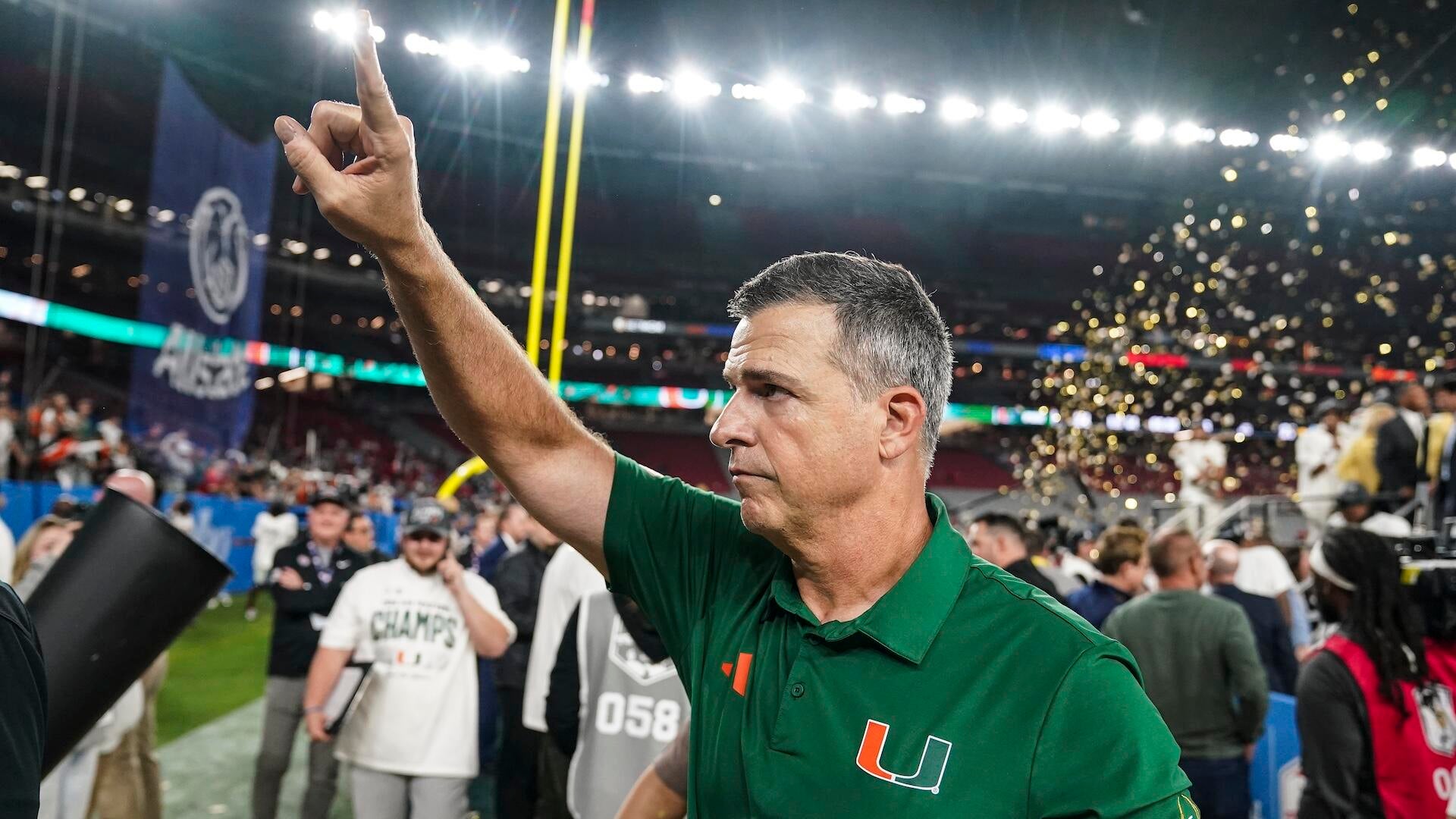
Distrust in Cristobal?
Cristobal has reshaped Miami's roster during his tenure into one of college football's most talented, but for much of the national media, discussions about the Hurricanes' leader inevitably circle back to a handful of high-profile game-management mistakes that have become synonymous with late-game worry.
The defining moment came in 2023 against Georgia Tech when Miami held a three-point lead with less than a minute remaining. The Yellow Jackets were out of timeouts and a victory formation from the Hurricanes away from losing the game. Instead, Miami ran the football, fumbled and watched Georgia Tech score the winning touchdown seconds later. Cristobal immediately owned up to the mistake, admitting afterward that he "made the wrong call."
What made the criticism even louder was that a similar situation had occurred during Cristobal's tenure at Oregon. During a 2018 loss to Stanford, the Ducks could have essentially ended the game by kneeling, but coughed up a possession after putting the ball on the turf, fumbling, and eventually losing in overtime. The parallels were impossible to overlook.
Then, during last season's loss at SMU, Cristobal elected to call a timeout with 1:08 to play, leading 20-17, as the Mustangs faced a fourth-and-9 near midfield with no timeouts remaining. The timeout was called just before the snap, and Miami edge rusher Marquise Lightfoot failed to stop his momentum after the whistle blew and was flagged for an unnecessary roughness penalty for hitting SMU quarterback Kevin Jennings.
The Mustangs used the free yardage to get into field-goal range to tie it before eventually winning in overtime, the program's first victory over a top-10 opponent at home in more than 50 years.
That's why the skepticism remains. Fair or not, media members tend to remember coaching decisions and stunning losses more than elite recruiting and program strengths. Cristobal is universally respected as an elite recruiter and program builder, but those fourth-quarter blunders have created a narrative he hasn't been able to shake as he enters every big season.
When analysts rank coaches or debate playoff contenders, they often ask whether Miami can trust its coach in the game's biggest moments, and Cristobal must wear that.
The reality is Cristobal has won a lot of football games -- 35-19 overall with the Hurricanes -- and elevated Miami back into national relevance. However, until he delivers a championship-caliber season free of those costly decisions, clock-management failures will remain part of his national reputation.
Miami's favorable path
Unlike many other programs capable of winning a national championship this season, Miami doesn't have to deal with the week-to-week grind that those in the Big Ten and SEC will experience. That means something in December, across multiple playoff games, when a team's health is paramount to success and moving on.
The Week 10 showdown at Notre Dame is Miami's season-defining matchup. A win against the Fighting Irish could put the Hurricanes at 9-0 entering the home stretch with the CFP's top seed up for grabs. Miami's my projected top seed in the 2026 CFP bracket for that very reason. I don't see a team on the Hurricanes' slate, aside from a potential slip-up in South Bend, that can slow down this new-look offense.
For all the questions about Miami's offensive and defensive fronts are losing several all-conference caliber starters, there's a four-game stretch to open the season that will allow the Hurricanes to tinker with their lineup and figure out their ideal rotation prior to playing Clemson on Oct. 3. And unless the Tigers rebound from last season's struggles or reigning ACC champion Duke is a surprise without Mensah and Barkate, Notre Dame will be the only ranked opponent the Hurricanes face prior to the postseason.
This was considered when filing my post-spring preseason top 25 ballot.
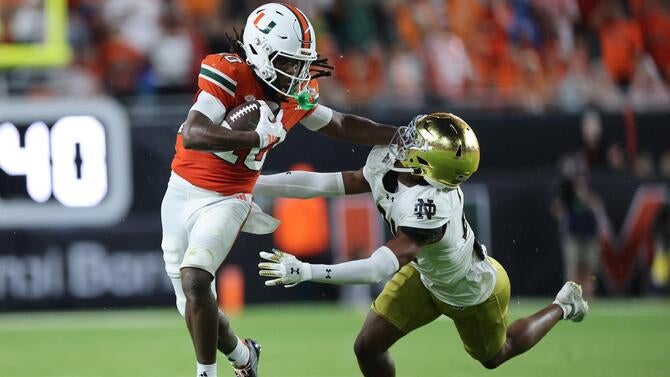 The Week 10 bout between Miami and Notre Dame could be the game of the year in college football. Getty Images
 Intel from Coral Gables
Those close to the program are aware of the perceived worry zones for this season's team at the line of scrimmage. That comes with the territory after Rueben Bain Jr. and Akheem Mesidor both went in the first round of the NFL Draft and helped Miami lead the ACC in sacks and tackles for losses in 2025.
That said, returning defensive tackles Ahmad Moten and Justin Scott are destined for stardom, while Lightfoot and Wilson should be quite a tandem at the edge. Linebackers Mo Toure and Chase Smith have a combined 12 years of experience between them, while the Hurricanes' secondary returns its four top corners along with safety starters Bryce Fitzgerald and Zechariah Poyser.
This unit could easily lead the ACC in scoring defense and total defense for the second straight season. And with Mensah being the most mobile of Miami's last three transfer quarterbacks, any anxiety over changes in pass protection should be eased by midseason.
When stacking contenders side by side, Miami has as strong a case as anyone to be considered college football's most complete team heading into the season. Compared to Texas, Ohio State, Oregon and several other teams ranked ahead of the Hurricanes in our post-spring top 25, Miami faces fewer obvious on-field hurdles as well.
Add CBS Sports on Google Join the Conversation comments