
 PA Media
Regional mayors could be given control of some tax revenue to spend on their local priorities, Chancellor Rachel Reeves has announced.
The plans, which will be detailed in the autumn Budget, would not increase taxes but instead hand control of some national tax income to those leaders, Reeves added.
At a lecture to business leaders, she said this, alongside following more EU rules and a £2.5bn investment in artificial intelligence (AI) and quantum computing, will help boost the UK's sluggish economy.
The Conservatives said the government "wanted to row back on Brexit" and criticised it for "blaming anyone but themselves for their economic failures".
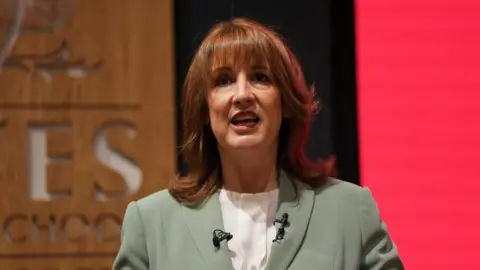
At her Mais Lecture at the Bayes Business School in the City of London, Reeves also said the student loans system needed fixing, but it was not "front of the queue" of political priorities.
She said Treasury officials were developing a road map which will set out how regional leaders can take control of "a share of some national taxes which have, for too long, been allocated by central government".
Treasury officials will work with regional mayors and businesses on the tax devolution plan, which will be published this year, the chancellor added.
"They will look at income tax alongside other taxes, with reforms initially targeted at those places that have the greatest capacity to deliver them and the greatest potential to benefit," she said.
The chancellor earlier told the BBC she wants to stop top British technology firms and scientists "drifting abroad" to make money.
She said she wants "the pattern to end", adding the government was investing in quantum computing and AI in the UK.
Quantum computing is considered much more powerful than regular computing because it can store many times more information, which is why some see it as the next big breakthrough in technology and key to economic growth.
Many tech firms that start in the UK end up moving their businesses overseas, often to the US.
Some of the suggested reasons for this are poor investment from the UK government and pension funds; the perceived weakness of the London Stock Exchange; and better tax breaks elsewhere.
Will quantum be bigger than AI?
In her Mais Lecture, Reeves promised to achieve "the fastest AI adoption in the G7" thanks in part to government investment in British tech. She said quantum computing was to create 100,000 UK jobs.
Sir Nick Clegg, the former deputy PM who recently joined the board of Nscale, which provides cloud platforms, told the BBC last week that AI would "create new jobs that we probably can't anticipate at the moment. It will create new companies that currently don't exist."
Iran war challenges growth plan
However, Reeves' growth plans could be challenged by the fallout from the US-Israel war with Iran.
Experts fear inflation could jump and the economy could sink due to the oil price surge since the conflict began, with some urging the UK government to drill for more oil in the North Sea in response.
Reeves told the BBC a decision on the controversial Rosebank and Jackdaw North Sea oil developments would come "soon".
Asked if the schemes should now be fast-tracked because of rising fuel prices, she said "those are decisions to be taken across government".
While she did not argue for new exploration, she said many countries were now looking to step up production.
"Every country has got to play their part in ensuring energy supplies are there when we need them… particularly at a time when the Strait of Hormuz is effectively closed," she said, and pointed to production increases in Canada and Norway.
She also said plans to reintegrate the UK into European energy markets, part of the post-Brexit reset, would also help keep energy prices down.
Reeves argued during her lecture that the UK should align in more areas of the economy with EU rules "where alignment is in the national interest, where it is good for business and good for jobs".
She said the UK should diverge from the EU's regulations in some cases but this "should be the exception, not the norm".
This is already planned to occur in food and farm standards to remove almost all post-Brexit red tape, but the chancellor's words could signal a wider plan to negotiate alignment in areas such as chemicals and manufacturing.
Shadow chancellor Sir Mel Stride said the lecture contained "more detail on Labour's plan to drag us closer to the EU".
"Under increasing pressure having mismanaged the economy, Reeves would rather point the finger at Brexit than accept their poor choices have been a disaster for our economy," he added.
Inside the sub-zero lair of the world's most powerful computer
Controversial UK oil field publishes full scale of climate impact
Potential emissions revealed for controversial Jackdaw gas field

Sign up for our Politics Essential newsletter to keep up with the inner workings of Westminster and beyond.
CompaniesRachel ReevesUK economyBrexit