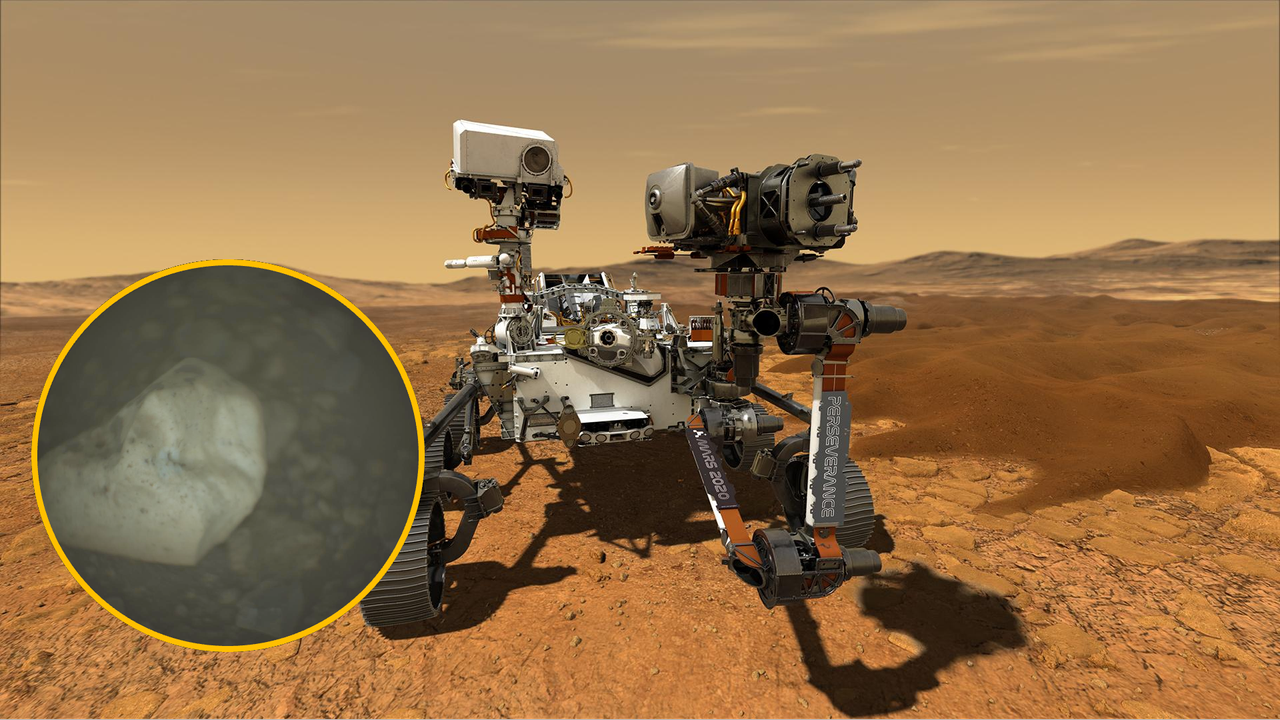
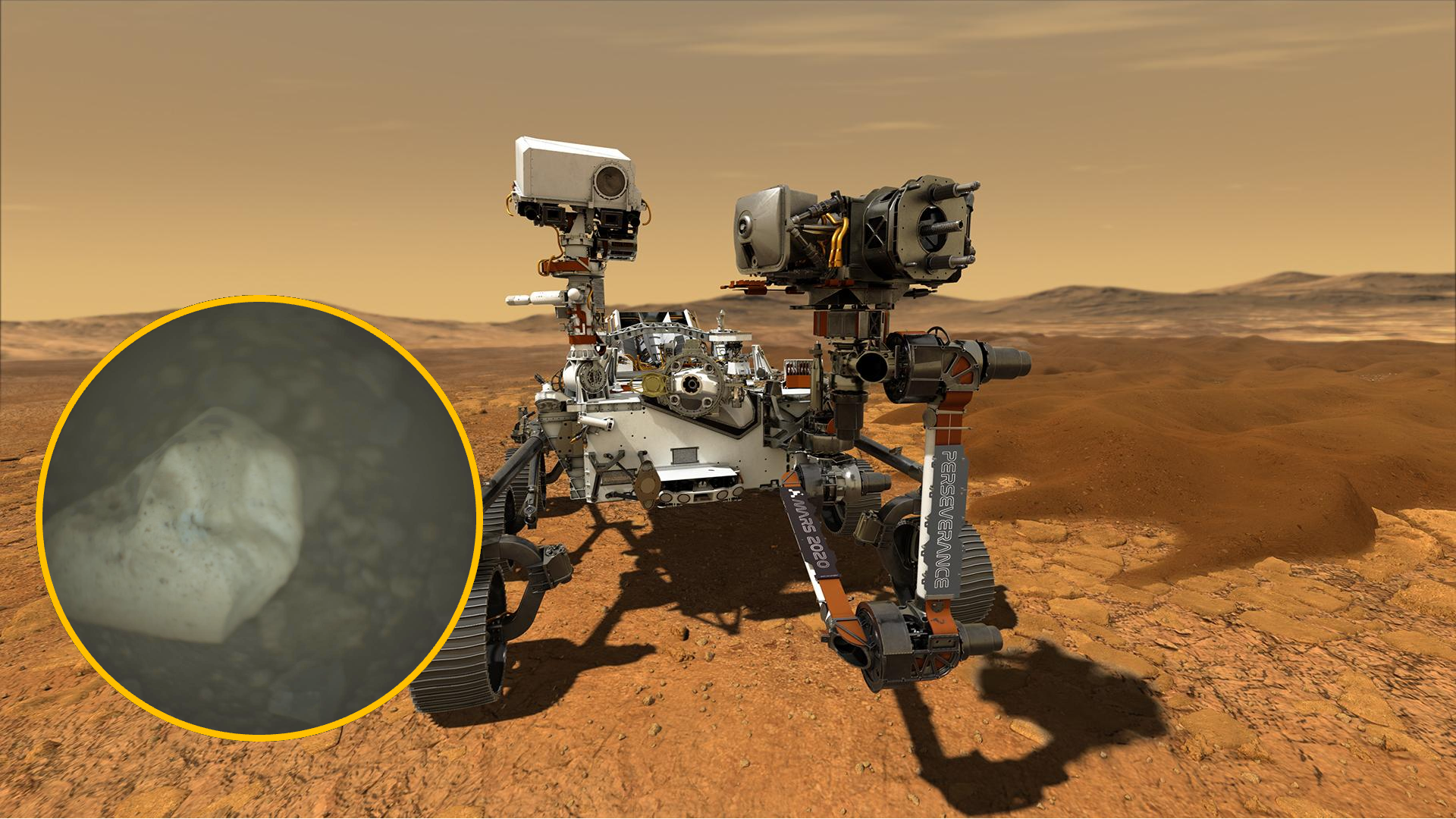
 NASA's Perseverance rover (illustrated in background) found evidence of ruby-like crystals in a rock named Coffee Cove (inset photo) along with two others — a gemological first on the Red Planet. (Image credit: NASA/JPL-Caltech/LANL/CNES/IRAP) Share this article 0 Join the conversation Follow us Add us as a preferred source on Google Newsletter Sign up for the Live Science daily newsletter now
 Get the world’s most fascinating discoveries delivered straight to your inbox.
Become a Member in Seconds
Unlock instant access to exclusive member features.
Contact me with news and offers from other Future brands Receive email from us on behalf of our trusted partners or sponsors By submitting your information you agree to the Terms & Conditions and Privacy Policy and are aged 16 or over.You are now subscribed
Your newsletter sign-up was successful
Want to add more newsletters?
Join the club
Get full access to premium articles, exclusive features and a growing list of member rewards.
Explore An account already exists for this email address, please log in. Subscribe to our newsletterMars is hiding a clutch of ruby-like crystals in its rocks, observations from the Perseverance rover suggest, and astronomers say other precious minerals, like sapphires, could exist across the Red Planet, too.
An international team of researchers presented the findings, based on observations from spring 2025, March 16 at the 57th Lunar and Planetary Science Conference in Texas. These findings are currently under peer review and will appear in the journal Geophysical Research Letters.
Article continues belowAs scientists often do when faced with a curious specimen, they blasted it with a laser — specifically, the green laser from the Perseverance rover's SuperCam, situated atop its mast. This laser excites minerals, causing them to emit light at specific wavelengths. And because every element and compound emits certain wavelengths of light, this reveals a sample's chemical composition.
The corundum conundrum
The analysis showed that three of the laser-blasted float rocks exhibited clear signatures of the mineral corundum, with inclusions of the element chromium — crystals that match the chemical description of rubies. However, because the crystals are too small to be seen by Perseverance's imager, and their exact chemical composition is uncertain, the researchers aren't sure whether they have truly found Martian rubies or perhaps some other type of corundum.
"The different types of corundum are based on the chemistry," study co-author Valerie Payré, a planetary geologist at the University of Iowa, told Live Science via email. "Although corundum is Al2O3, there are minor elements like chromium, titanium, and iron that can be present."
A Perseverance rover SuperCam image (left) of a Mars rock containing quartz. The graph on the right shows a spectroscopic reading of the rock, compared to hydrothermal quartz on Earth. The match is nearly identical. (Image credit: NASA/JPLCaltech/LANL/CNES/CNRS)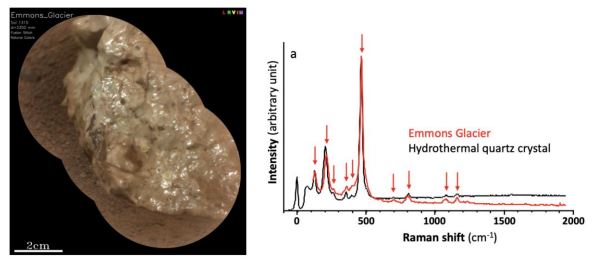
"These elements will provide the color to the mineral, and the name of it," Payré added. "We cannot quantify the amount of chromium, and other elements like iron and titanium might be present too. It is thus difficult to conclude whether they are rubies or other types of corundum [like sapphires]."
Sign up for the Live Science daily newsletter nowContact me with news and offers from other Future brandsReceive email from us on behalf of our trusted partners or sponsorsThe team ultimately classified the crystals as corundum and declined to guess about the variety without more chemical evidence.
Corundum is a mineral made of aluminum and oxygen. It is one of the hardest known natural substances, approaching the toughness of diamonds. Pure corundum is colorless, but microscopic impurities imbue it with brilliant hues. Iron or titanium inclusions yield brilliant blue sapphires, while chromium produces even rarer, resplendent rubies.
As of now, the corundum crystals were found in small pebbles that are coming from elsewhere, i.e., they are out of context. It is therefore difficult to constrain the full story,
Valerie Payré, planetary geologist at the University of Iowa
However, anyone holding out hope for a future Martian-gemstone-studded necklace may be disappointed. The corundum crystals found within the float rocks are tiny — less than 0.2 millimeters (0.008 inches) in diameter.
Could slightly larger Martian rubies exist? "Yes, possibly," study co-author Olivier Beyssac, a senior scientist at the French National Center for Scientific Research, told Live Science via email. "Anyway corundum is pretty rare on Earth and rarely present as big crystals so one could expect the same on Mars."
Cosmic impacts?
It's also likely that the crystals formed under different conditions than those on our planet. On Earth, corundum is created through metamorphic and igneous processes, in which intense heat and pressure, facilitated by tectonic activity, transform existing rocks into potential gemstones.
But because there is no conclusive evidence for plate tectonics on Mars, the researchers suggest that the ruby-like crystals on the Red Planet may have formed through cosmic impacts.
RELATED STORIES—Odd-looking rock on Mars is totally alien to the Red Planet, Perseverance rover finds
—NASA rover discovers out-of-place 'Skull' on Mars, and scientists are baffled
—Giant string of organic molecules on Mars may be one of the best signs of life yet
"The impacts provide high temperatures and high pressures, which can produce corundum. Hydrothermal fluids are also generated," Payré explained. Yet the researchers must find additional samples, at their origin, to describe their formation mechanism.
"As of now, the corundum crystals were found in small pebbles that are coming from elsewhere, i.e., they are out of context. It is therefore difficult to constrain the full story," Payré said.
Rubies are far from the only spectacular stones found at Jezero crater, and further research may reveal sapphire-like stones there as well. In the past, scientists also discovered signs of other potential gemstones elsewhere on Mars, including quartz and opal — suggesting that our red planetary neighbor is a gem laboratory.
Mars quiz: Is your knowledge of the Red Planet out of this world?
TOPICS Ivan FarkasLive Science ContributorIvan is a long-time writer who loves learning about technology, history, culture, and just about every major “ology” from “anthro” to “zoo.” Ivan also dabbles in internet comedy, marketing materials, and industry insight articles. An exercise science major, when Ivan isn’t staring at a book or screen he’s probably out in nature or lifting progressively heftier things off the ground. Ivan was born in sunny Romania and now resides in even-sunnier California.
View MoreYou must confirm your public display name before commenting
Please logout and then login again, you will then be prompted to enter your display name.
Logout LATEST ARTICLES 1Drought could fuel the rise of antibiotic-resistant superbugs as climate change worsens, new research suggests
- 2Massive Iron Age hoards discovered in England may be from funeral of powerful Celtic queen
- 3Cannonball-size meteorite crashes through roof of Texas home as multiple 'fireballs' rain down on the US
- 4Iran war has already released a staggering amount of CO2 — and the destruction of schools, homes and buildings is the biggest source
- 5A rare active volcano on Mars may be causing the whole planet to spin faster