 Image source, Getty ImagesImage caption,
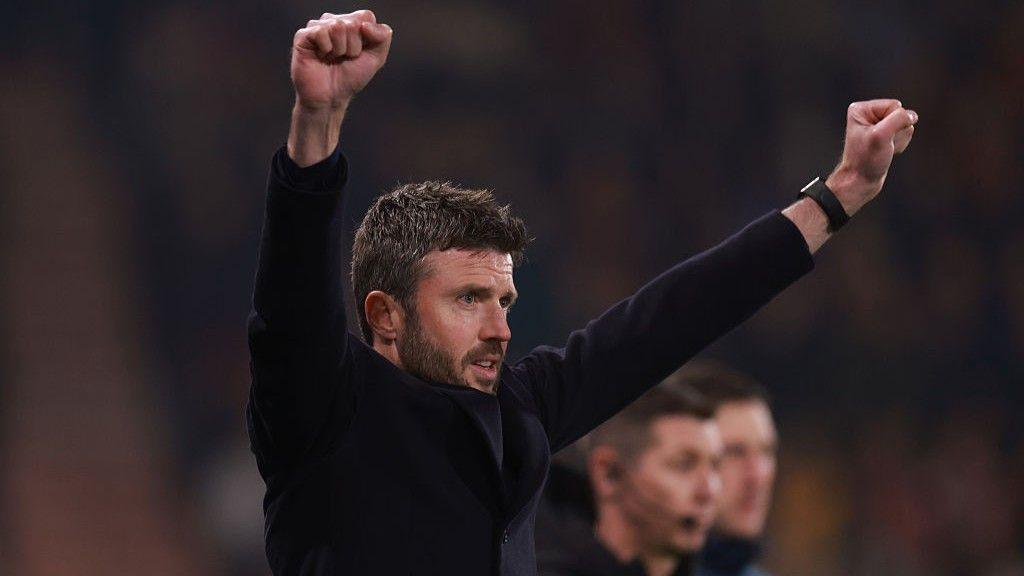
 Manchester United are top of the form table across Michael Carrick's 10 games in charge
BySimon StoneManchester United reporter- Published32 minutes ago
- 53 Comments
When Manchester United's director of football Jason Wilcox addressed the club's players after Ruben Amorim's dismissal on 5 January and told them the aim was Champions League qualification, he was sending out a message.
After all, internally in their financial planning, and externally in communication with supporters, the stated target from the previous summer had been a return to European competition, most likely through the Europa League.
Wilcox was choosing to reinforce a point that just because Amorim had been sacked and a caretaker boss was being sought, it did not mean the season was being written off.
The hierarchy making the big decisions might have changed, but the chaos Ralf Rangnick's short tenure descended into when he was picked to guide United to the end of the season following Ole Gunnar Solskjaer's dismissal in November 2021 were fresh in the memory.
Wilcox wanted focus and determination, not apathy and a lack of accountability.
United were not at rock bottom when Carrick replaced Darren Fletcher, who had spent two games as interim boss, on 13 January.
One defeat in nine in the Premier League. One point off fifth spot.
The problem was they had just drawn against three relegation candidates - Wolves, Leeds and Burnley, and their next two games were against title rivals Manchester City and Arsenal.
As United were only six points ahead of Bournemouth, who were 15th, the expectation was by the end of January, Carrick would be presiding over a team that had dropped back into the bottom half of the table.
Instead, when United resume their league programme against Leeds at Old Trafford on 13 April, they will do so knowing Champions League qualification is within reach.
Assuming England gets five spots, four wins and a draw from their final seven games will be enough to take United back into Europe's elite club competition after a two-season absence.
If they remain third, it would be only their fifth top-three finish in 13 seasons since Sir Alex Ferguson retired.
Managing Man Utd the 'ultimate role' - Carrick
- Published20 February
Carrick continues to make case for permanent Man Utd role
- Published15 March
Tactics, transfers and turmoil - inside the fall of Amorim
- Published5 January
How have they done it?
On the surface, it seems quite simple.
Carrick followed Fletcher's lead in ditching Amorim's three at the back formation, pushed skipper Bruno Fernandes into a more forward role, recalled Kobbie Mainoo to play alongside Casemiro and stuck with it.
Across his 10 games in charge, Carrick has made just six changes to his starting line-up.
Two of those were enforced - because of the injuries that continue to sideline Patrick Dorgu and Lisandro Martinez. Of the other four, two were bringing Benjamin Sesko in for Amad Diallo for the home win over Crystal Palace on 1 March, then swapping it back two games later after United had been beaten at Newcastle.
The final pair were Noussair Mazraoui coming in at full-back for Diogo Dalot at St James' Park, then Dalot returning one game later when Mazraoui was ruled out through injury.
Manuel Ugarte, Ayden Heaven and Joshua Zirkzee have all come on in four games or more. The same is also true of Sesko and Mazraoui.
United's relative lack of games - they are currently in a stretch of 23 days without one - means rotation is a choice rather than a necessity.
Yet Carrick's impact goes far deeper.
Club sources note the sense of calm that has settled across the club.
The 44-year-old is a relaxed individual - the epitome of someone who does not get carried away by success or overly despondent by failure.
In public, that comes across in his media briefings.
"I'm not going to sit here and get angry with you if that's what you're asking," was Carrick's response when he was asked before the 2-2 draw at Bournemouth if he ever used anger as a management tool.
The attitude is in stark contrast to Amorim, who admitted to getting emotional at the performances of his team. That led him to make ill-advised news conference comments.
Rather than being on edge, United's staff at their Carrington training complex feed off Carrick's attitude and the feeling is they are delivering more.
Meetings between the head coach and Wilcox are fewer now, it is said, because there are not as many day-to-day issues to address.
Sources who know Carrick say his intention has been to strip training back to basics. That has resulted in the shorter sessions critics have argued show the players are not being worked hard enough.
Carrick's view is if the basics are right and training hits the right levels, the intent provides more value than extended practice.
Sources close to the players say the squad are unified, happy and enjoying their work.
Understandably, coaches Jonathan Woodgate and Jonny Evans have focused their individual sessions on the defenders. Travis Binnion has focused on the forwards, among whom Sesko is a big fan.
Steve Holland's appointment is viewed as a masterstroke. His previous relationship with Carrick's brother Graeme through shared time spent working for the Football Association at St George's Park was particularly helpful, even if the final decision to bring Holland into the fold was the result of a unified plan.
Twenty-three points from 10 games since Carrick's appointment is the highest in the Premier League over that period.
Rather than those games against Manchester City and Arsenal being an awful start, they proved to be a springboard.
Victory over Mikel Arteta's side was the one that really resonated with Old Trafford bosses, proving that beating City - something United had done periodically under a number of managers - was not a one-off.
During this period, some of the alternatives to Carrick for the permanent role have either suffered reputational damage or become unavailable - Roberto de Zerbi would become the latest if he accepts the Tottenham job.
United's stance remains they do not want to be bounced into an appointment, and will take their time reaching a decision.
The reality is they are yet to speak to anyone else.
There are some elements of Carrick's management that cannot be answered this season - including how he copes with a 60-game campaign, compared to this one with its optimum preparation time, which has allowed Luke Shaw, Harry Maguire and Casemiro to play every game under him.
There is also the reality that after pushing for Amorim's appointment, Wilcox and chief executive Omar Berrada risk their own reputations if they get another major call wrong.
Nothing is certain until an appointment is made, but if United maintain their momentum and qualify for the Champions League, it is hard to imagine Carrick not being given the job.