
 The inquiry focused on events at the Countess of Chester hopsital linked to the actions of Lucy Letby, who was convicted for the murder and attempted murder of several babies. Photograph: Cheshire Constabulary/APThe inquiry focused on events at the Countess of Chester hopsital linked to the actions of Lucy Letby, who was convicted for the murder and attempted murder of several babies. Photograph: Cheshire Constabulary/APExplainerLucy Letby: will final report express view on nurse’s guilt and could it affect her case?
Final report from Lady Justice Thirlwall’s wide-ranging inquiry to be published on Tuesday
Lady Justice Thirlwall’s report from the Lucy Letby inquiry will be published on Tuesday after public and private hearings into the events at the Countess of Chester hospital linked to the nurse’s convictions for the murder and attempted murder of babies. Here we take a look at the inquiry and report.
What is the Thirlwall inquiry?
The Thirlwall inquiry was an independent public inquiry announced on 4 September 2023.
It focused on the events at the Countess of Chester hospital linked to the actions of the nurse Lucy Letby. On 21 August 2023 at Manchester crown court, Letby was sentenced to life imprisonment and a whole-life order after being convicted of seven counts of murder and six counts of attempted murder. She was later convicted at a retrial of a seventh attempted murder.
The inquiry’s objectives were to get answers for the victims’ families and ensure lessons were learned. The inquiry also looked at the wider circumstances, including the response and conduct of the NHS, its staff and its regulators.
What are the inquiry’s terms of reference?
The inquiry investigated three main areas:
-
Parental experiences: Examining what information parents received regarding their babies’ care, sudden deteriorations and safety concerns, alongside assessing the hospital’s candour throughout.
-
Hospital conduct and governance: Investigating operations from Letby’s arrival on 4 January 2012 onwards. This includes when concerns were raised, management responses, whistleblower treatment, reporting delays to police and regulatory bodies and internal governance failures.
-
Wider NHS framework: Assessing whether broader NHS management structures, executive accountability, regulation and hospital culture effectively protect babies in care settings.
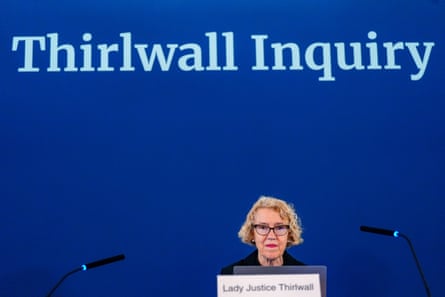 Lady Justice Thirlwall, whose inquiry was conducted on the basis of Letby being guilty of the offences for which she was convicted. Photograph: Peter Byrne/EPA
Will the report express a view on Letby’s guilt or conviction?
No. The inquiry was conducted entirely on the basis of Letby being guilty of the offences for which she was convicted. All attempts by Letby to appeal against the convictions were dismissed.
The Criminal Cases Review Commission (CCRC) is investigating her case to determine if there is a “real possibility” her convictions would not be upheld, which could trigger a referral back to the appeal courts.
Who was involved with the inquiry?
The inquiry is chaired by Thirlwall, a senior court of appeal judge. The counsel to the inquiry is Rachel Langdale KC. Langdale was the leading counsel for a core participant in the Mid-Staffordshire NHS foundation trust public inquiry and she has acted for local authorities and individuals in inquiries relating to safeguarding and children in care.
The core participants included the families of the children named on the indictment, who were represented by legal teams. Others included the Royal College of Paediatrics and Child Health, the Department of Health and Social Care, the Countess of Chester hospital NHS foundation trust, the Nursing and Midwifery Council, the Care Quality Commission and NHS England.
Will the Thirlwall inquiry report have any ramifications for Letby’s case?
The chair of the CCRC told the BBC the miscarriages of justice watchdog would be looking at the conclusions drawn by the Thirlwall inquiry. She said: “We will be looking at the report with interest to assess whether it has any bearing on our review of the case.”
The CCRC can use material, evidence and findings gathered by the public inquiry if it helps assess whether a conviction or sentence might be unsafe.
Explore more on these topicsShareReuse this content