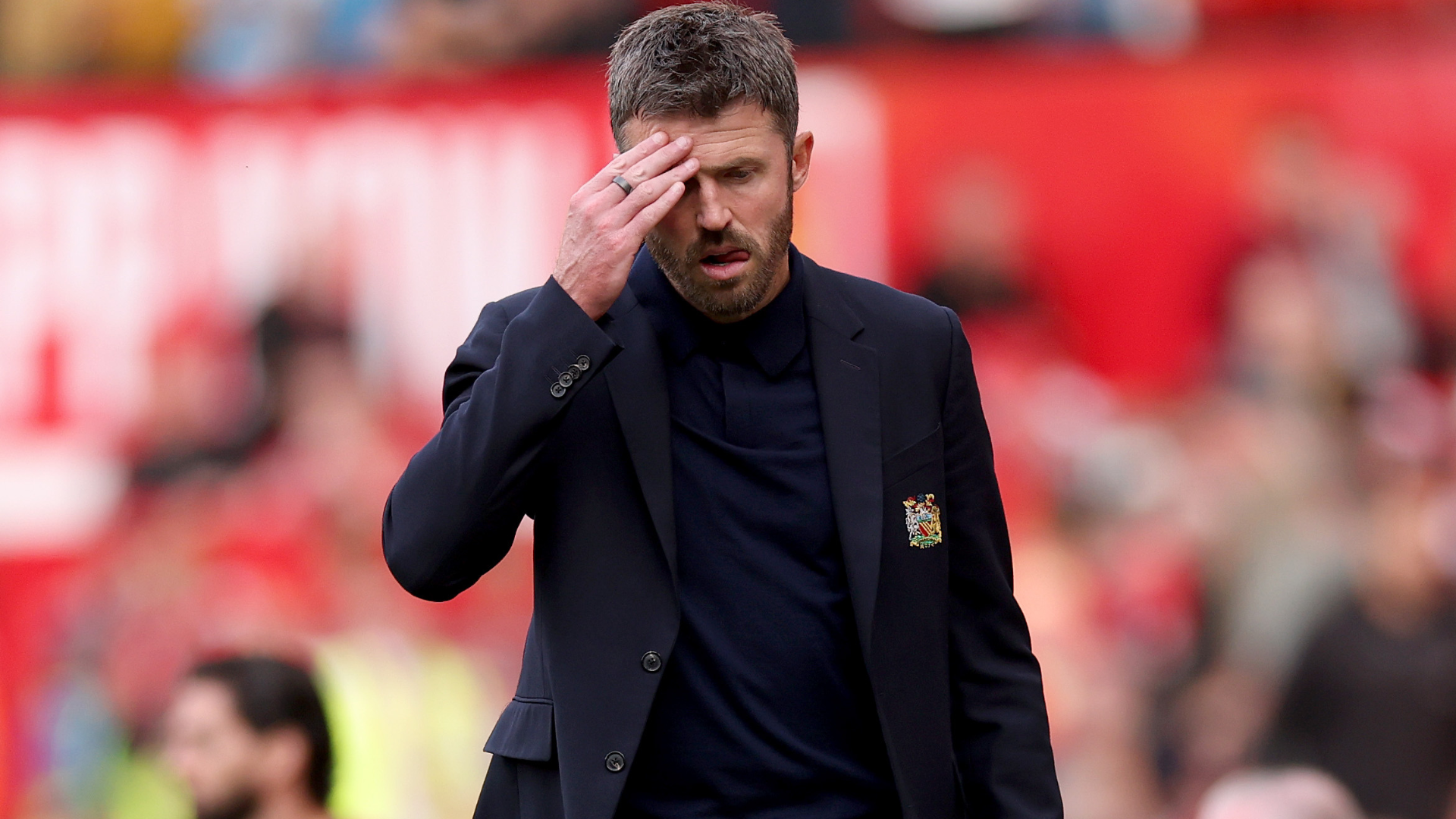
Now that the dust is beginning to settle on the Premier League's latest grand VAR melodrama, perhaps a clearer-eyed view of Manchester United can emerge. Were Matt Donohue and his assistant VAR Blake Antrobus a significant factor in Sunday's 1-0 defeat at home to Manchester City? Absolutely, but they were not the only ones, perhaps not even the decisive one.
Most profoundly of all the problems that emerged when United found themselves a man up with well over an hour to play were not new to them. If anything, they might be difficulties that are innate to playing football in the style that Michael Carrick wants it.
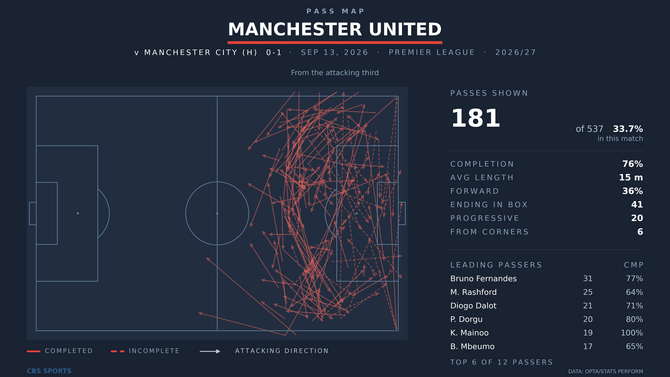
What is indisputable is that when put in an extremely advantageous position by Phil Foden's 23rd-minute red card, United were leaden-footed and guileless in attack, too slow in possession and without much in the way of ideas to prise open a low block. After the red card and before Erling Haaland scored, United had 105 final-third touches to City's 37 and yet produced only seven shots worth a combined 0.25 xG. Even after that contentious winner, there seemed to be no real sense for how this team might manufacture attacks when they did not have space to run into, their only real high-value opening coming when Bryan Mbeumo drew a 95th-minute save from Gianluigi Donnarumma.
Premier League referees very bad weekend: Manchester United get apology, Arsenal seek explanation James Benge
The lived experience of this Old Trafford defeat was not the same as United's other league games this season, in which a draw, a win and a defeat have combined to deliver this club its joint-worst start to a top flight season since 1992. Side bar, doesn't it feel like you hear that about United every year around September or October?
The City experience was different in that the hosts were thrust into a game state they might not reasonably have expected to be in come kickoff. Carrick's XI, with Youri Tielemans preferred in the deep role next to Kobbie Mainoo, looked to be one designed to spring quick forwards running at City's parlous transition defense. That goes out of the water when United gain a man advantage.
To hear Enzo Maresca explain it afterwards, it seems almost too easy to coach against United. "They love transition and space in behind, but the game became more difficult with us and them We just dropped, no space in behind and no more transition which is why the game was also more difficult for them."
 CBS Sports
 United have already proven this season that they have the players to be devastating on the counterattack, Bruno Fernandes brutally punishing Ipswich Town's errors on a trying day for the newly promoted side. Their issues lie in a possession game that reflects a pastiche of their manager's playing career. The (inaccurate) critique of Carrick the player was that he was too sideways a midfielder, controlling the game without ever providing the cut through that the Barcelona midfielders who were the game's yardstick delivered.
So far this season, his team are more like the caricature than Carrick ever was. In build-up, they seem to be growing ever slower. In the 20 league games Ruben Amorim managed last season, United attempted an average of 460 passes per game. In the 21 matches under Carrick they attempt 483 with significantly greater success. And yet, fewer passes go forward and fewer are considered progressive. The average possession sequence under Carrick lasts 10% longer than those of his predecessor, who had just begun to establish an improved attacking structure when he obliterated his relationship with his employers.
United's play has become significantly more involved since Carrick has had a preseason to work on his team. Last season the average Premier League possession lasted 24.4 seconds and 5.8 passes. Now those numbers are up at 30.5 and 7.6. Perhaps that is a reflection of the games this team has found themselves in, but it is also in keeping with how Carrick set his Middlesbrough sides up.
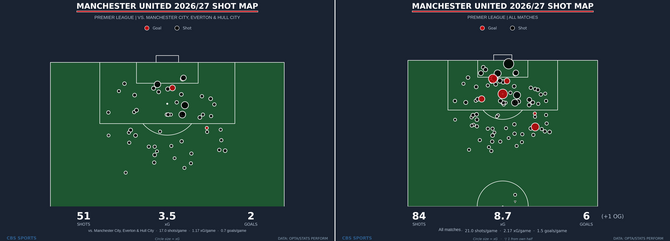
It may be off-meta, but there is nothing to necessarily say a tactical approach that covets steady possession cannot work in the Premier League in 2026-27. There are some hints that it is not necessarily working for United this season. Set aside the ludicrous 4.77 xG they rained down on shellshocked Ipswich and this is a team that has cleared a full xG only once and that when they were desperately chasing the game against newly promoted Hull City. The answer seems to be a lack of guile, an inability to create good shots. For as long as we have data (going back to the 2020-21 season) the average shot has an xG value of 0.11. So far this season United's is at an unimpressive 0.099. If we discount that game against Ipswich, which may prove to be a freak occurrence in retrospect, the mark is 0.069, 93rd out of 96 teams in Europe's top five leagues this season.
 CBS Sports
 That was not a problem last season, when United were right on the average mark for shot quality. Then again last season they had Bruno Fernandes operating as the best player in the league. At his peak he is the ideal counterbalance to the caution that emerged in possession under Carrick after brilliant early wins over Manchester City and Arsenal. You could build slowly safe in the knowledge that the minute the ball came to Fernandes he would inject jet fuel into your attack. In league matches under Carrick last season the Portuguese playmaker averaged an asist every 117 minutes, a remarkable tally that was the subject of a fair bit of overperformance compared to his xA but also reflected the fact that he was creating four and a half chances per 90 minutes.
Early on this season, Fernandes' output has dropped from comfortably the best in England, perhaps in the sport, to of a level with the likes of Rayan Cherki and Martin Odegaard. No wonder that again when you scrub that Ipswich game from the equation, United's attack looks overly cautious and quiet.
If all this seems overly doom-laden on Carrick, it is worth offering a counter perspective. After all, a bit of caution and quiet is exactly what United needed when Amorim's combustible reign came to an end. The then-interim manager turned the accrual of 39 points from 17 games, a record that over 38 games would have bettered champions Arsenal, and qualification for the Champions League into something of a non-event.
When so many of his predecessors might have blown their top over VAR officials failing to spot Enzo Fernandez in an offside position, Carrick was instead calling for his team to "move on". A bit of bland is no bad thing at a club whose first instinct has been to break into a sprint whenever they take two steps forward. The then-interim ensured that United never got too high when rising up the table, and it is notable that there has not been much anguished reaction over his status five games into the season.
In keeping with the player he was, Carrick demands a measured assessment. He had the big picture in his mind when on the field, now he is watching on from afar that picture looks, well, fine. Even after a slow start -- which, for all the discounting above, does actually include that rout of Ipswich -- United profile to be somewhere around the fourth or fifth best team in England. That will probably be enough to keep them in the Champions League, to keep things ticking over while they start the necessary task of building a title contender further down the road in a post-Fernandes era.
It may not be pretty, and it may lead to more promising situations wasted as frustratingly as they were against City on Saturday, but that does not mean that Carrick does not have them on the right path. It just might be that the journey is slower and more cautious than is always ideal.
How to watch Manchester United vs. Brighton, odds
Date: Tuesday, Sept. 16 | Time: 3 p.m. ET Location: Old Trafford -- Manchester, United Kingdom Live stream: Paramount+ Odds: Manchester United -133; Draw +280; Brighton +275
Add CBS Sports on Google Join the Conversation comments