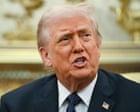
 Donald Trump at an event in the Oval Office in March. Photograph: Andrew Caballero-Reynolds/AFP/Getty ImagesDonald Trump at an event in the Oval Office in March. Photograph: Andrew Caballero-Reynolds/AFP/Getty ImagesAnalysisLooming Iran peace deal shows how Trump’s maximalist goals have shrunkRobert Tait
Sobering reality for president after three-month odyssey that threatens to take him back to where he started
After the hubristic beginnings came the reality.
The road travelled since the most momentous foreign policy decision of his presidency seems to have delivered Donald Trump to a sobering destination: that Iran has been the nemesis of several US presidents before him for a reason and is an adversary not to be taken lightly.
Trump claims to be on verge of approving peace deal with major Iranian concessionsRead moreIt is an oft-stated principle of warfare that hopes and plans optimistically hatched and trumpeted at its outbreak do not survive first contact with the enemy.
Yet even by that cautionary standard, Trump’s wildly diverging goals and narratives since embarking on war with Iran on 28 February amount to a bewildering odyssey that – in the end – threatens to take him back to where he started.
After weeks of stop-start negotiations, the US and Iran now reportedly stand on the verge of a deal to end the fighting, the most immediate and tangible consequence of which will be the reopening of the strait of Hormuz.
Iran’s closure of the strategically vital waterway – conduit of 20% of the world’s crude oil supplies before the war started – has had a baleful effect on the US and economy, sending gasoline prices soaring and leading to a shortage of fertilizer that threatens food supplies and prices.
The priority given by Trump to reopening it graphically illustrates the extra deterrent leverage gained by Tehran as a result of the conflict – a point further emphasized by the Trump administration’s decision to address the problem through negotiations rather than military force.
To put matters in perspective, shipping passed through the strait unimpeded before the war began.
The reported memorandum of understanding reached with the help of Pakistani and Qatari mediators would extend the current ceasefire for 60 days, during which negotiations would take place on the two-decades-old dispute over Iran’s nuclear program.
The specter of fudged compromise is in itself an illustration of how Trump’s maximalist goals have shrunk – and in the eyes of some commentators, been defeated.
In a recent Atlantic article, Robert Kagan, a foreign policy fellow at the Brookings Institution, wrote that “Trump’s endgame is surrender”, adding that the president “no doubt hopes that he can slip away without Americans noticing the magnitude of this defeat”.
“The financial markets may stabilize if it is clear that oil will eventually start flowing again through a reopened strait, even if under the new Iran-controlled system,” Kagan wrote. “A major strategic setback for the United States need not affect Wall Street.”
Yet many of Trump’s hawkish Republican supporters have recognized the scale of the incipient retreat from previous objectives and warned of the dangers of a deal on Iran’s uranium enrichment capability that may end up resembling that signed in 2015 by Barack Obama – the joint comprehensive plan of action (JCPOA) that Trump later scrapped during his first presidency.
In the past week, anti-Iranian Republican senators such as Lindsey Graham, Ted Cruz and Roger Wicker, chair of the Senate armed services committee, as well as Mike Pompeo, CIA director and secretary of state during Trump’s first administration, have all warned against an agreement which Trump last weekend said was “95% negotiated”.
Trump is to a large degree the author of his own pain, thanks to an extravagant basket of goals and claims voiced at the war’s outset – some of which he continues to make.
“Our objective is to defend the American people by eliminating imminent threats from the Iranian regime,” he announced in opening statement after authorizing the first US strikes on Iranian targets.
In the same address, he called on members of the Islamic Revolutionary Guard Corps, the armed forces and the police to “lay down your weapons” and spelled out regime change as a goal by urging the Iranian population to “take over your own government … this is the moment for action”.
He subsequently declared that only “unconditional surrender” would be acceptable, while several times declaring the war to be virtually won, insisting that Iran’s airforce, navy and overall military capacity had been effectively destroyed.
“Trump launched this war with these maximalist aims, very publicly stated, regime change, wanting an uprising, saying he got regime change, saying he wants to destroy their nuclear program, destroy their missile capability, their regional allies, or so-called proxies,” said Sina Toossi, an analyst with the Center for International Policy.
“Then we see that he ultimately acceded to a ceasefire. We know from all the reporting coming out since that Iran’s military capabilities were not reduced as much as the White House presented – something like potentially 70% of their ballistic missiles, 70-80% of the drones are intact.”
Contrary to Trump’s initial expectations – and despite the targeted assassinations at the hands of Israeli strikes of a large cadre of its leaders, including the supreme leader, Ayatollah Ali Khamenei – the Islamic regime remains intact.
And while the US president publicly proclaims successor leadership figures to be “more reasonable” than before, the regime appears to be more unyielding than ever. Mojtaba Khamenei, who succeeded his father as supreme leader but has yet to appear in public, was last week quoted as predicting that Israel would cease to exist by 2040.
With regime change apparently dismissed as an unattainable fantasy, Trump has shifted his primary goal to preventing Iran obtaining a nuclear weapon.
Yet that objective had supposedly been previously realized with last June’s bombing of three nuclear facilities at Fordow, Natanz and Isfahan, which Trump insisted at the time had “obliterated” its uranium stockpile.
In fact, Iran is still believed to possess about 970lb of highly enriched uranium – potentially enough to build 10 bombs – which is said to be dispersed at a number of underground locations.
Unflatteringly for Trump, critics point out that Iran was only able to accumulate the stockpile as a result of his 2018 abandonment of the JCPOA, the terms of which limited its enrichment activities and which international inspectors judged Tehran had been complying with.
The limited military success of his war of choice may now force Trump to address it by resorting to the pragmatic type of compromise that he and his rightwing allies once lambasted Obama for.
Robert Litwak, an international relations professor at George Washington University, said Trump was being forced to confront a “persistent tension” in US post-cold-war policy between “transformational” approaches meant to topple so-called rogue states, or “transactional” agreements intended to change their behavior.
“He’s in a box because a transformational outcome is not possible,” said Litwak.
“Trump is by circumstance being forced to embark on or implement a transactional deal that would be essentially a variant of the JCPOA, and indeed, he may not even get similar terms to the JCPOA because the Iranians have been adept at playing their hand.”
He added: “ I think the thing for Trump is how he will get popular support, or whatever support is necessary, for essentially a transactional deal that’s a variant of the JCPOA and may not even be as rigorous.
“[The JCPOA’s] very character made it the source of criticism by hardliners in the United States, who argued that … If you’re not going to change the character of the regime, then a transactional deal is inadequate.”
Perhaps to disguise the depth of his predicament, Trump has lately taken to setting some improbable conditions, including demanding that Iran and US allies such as Saudi Arabia, Egypt, Jordan and Turkey sign the Abraham accords, an agreement negotiated during his first presidency under which several Arab states formally recognized Israel.
For Iran’s vehemently anti-Zionist regime, the idea is a non-starter, while Saudi Arabia’s leaders have conditioned any recognition on a peace deal between Israel and the Palestinians, currently a distant prospect. For Egypt, which recognized Israel in the historic 1979 Camp David peace accords, the notion seems redundant.
Trump also last week threatened to “blow up” Oman – a US ally – if it reached any deal with Iran that imposed charges for passage through the strait of Hormuz. He accused Iran of trying to “outwait” him by stringing negotiations to November’s congressional midterms.
In fact, argued Vali Nasr, an international relations professor at Johns Hopkins University, Iranian reluctance stems from a suspicion that Trump may intend to use any peace deal as a preparation for future hostilities.
“He‘s trying to come up with reasons why the Iranians don’t sign on [but] the reason they don’t is because they don’t trust him,” Nasr said. “It has nothing to do with ideology or fractured leadership or the midterms. It’s because of his record. One thing is agreed with the Pakistanis and then he comes out on Truth Social and walks it all back again.
“They say it in public in Iran – that all he wants is to get Iran to relax and for the leadership to come out of the ground for them to be assassinated again.
“So their strategy is kind of a trust and verify. Yes, we’re willing to sign this agreement, provided you show you can do a ceasefire in Lebanon and release our assets. And then we’ll watch you remove your troops from the scene of battle, we will watch you gradually lift the blockade, and in tandem with that, we open the strait, and then step by step, if this works, then we’ll sit down and negotiate about the nuclear issue.
“But the problem with Trump is that he floats these shiny objects, such as the Abraham accords, to continuously divert attention. All the focus shifts to that, but the reality is, as the man who was known for the art of the deal, can he close the deal?”
Explore more on these topicsShareReuse this content