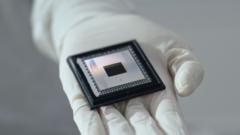

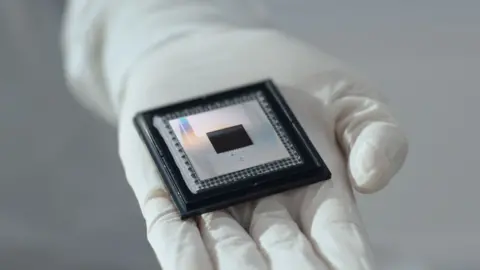
 GoogleGoogle's Willow chip
Scientists from King's College London have become the first UK academic research team to gain access to Google's cutting-edge quantum computer chip Willow as part of a scheme launched with the UK's national quantum lab last year.
Quantum computers can in theory solve problems which the most powerful conventional computers cannot.
Google says Willow can solve a theoretical problem in five minutes which would take the world's current fastest super computers ten septillion - or 10,000,000,000,000,000,000,000,000 - years to complete.
King's lead for the project Dr Eleanor Crane said its use of Willow would "light a torch" for research to answer questions about the most important natural processes.
"It would be useful if society could understand how plants transform sunlight into energy, find materials which transport electricity quickly, or how molecules bind to each other," said Crane, who will co-lead the research team alongside Dr Alexander Schuckert from ENS Paris.
These natural processes rely on the interactions between many fundamental particles which made up the building blocks of life.
But some questions are really hard to answer with the computers or even supercomputers we currently use.
"If we could get to grips with these processes, then we could use this understanding to create better solar cells, more efficient energy grid systems, and discover drugs for previously untreatable diseases," she said.
Explained: How quantum computers workThe science which explains the way in which physical particles behave is called quantum mechanics and it's the basis on which quantum computers work - making them much better placed to solve these problems.
While much of this field is still theoretical, Google says Willow incorporates key "breakthroughs" and "paves the way to a useful, large-scale quantum computer".
Crane said in the UK, Europe, the US, China, and elsewhere, there have been "huge developments" in this direction.
"Quantum computers are being built. They are quickly progressing towards useful tasks for society," she said.
The Kings team will carry out research on Willow designed to help develop techniques that will be needed to enable a quantum computer to model natural systems - such as photosynthesis - and answer questions about them.
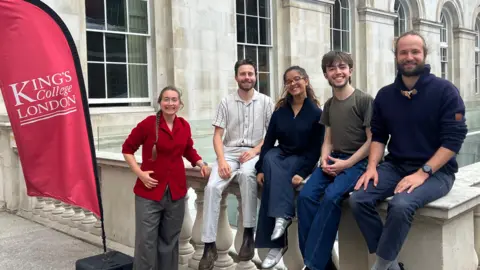 King's College LondonDr Eleanor Crane (left) with the King's College research team
Google Quantum AI and the National Quantum Computing Centre (NQCC), Britain's national quantum computing laboratory, invited proposals from UK research teams to use Willow last year.
Kings had "made a compelling research proposal," according to Charina Chou, chief operating officer of Google Quantum.
NQCC Director Dr Michael Cuthbert said the initiative reflected the UK's commitment to fostering world-class quantum research.
The UK government has promised £2bn in funding quantum research, and Cuthbert argued new industry partnerships with UK institutions also demonstrated the health of the field.
Cambridge University recently announced its largest ever corporate partnership with American quantum tech firm IonQ to host what it claimed would be the UK's most powerful quantum computer.
The BBC's Faisal Islam visits Google's quantum lab and the chandelier-like cooling system which houses the Willow chipQuantum computers will not supersede existing machines, as there are many tasks they are not suited to.
But if they live up to the hype, they promise a raft of valuable solutions to problems we cannot currently crack.
Earlier this year, Sir Peter Knight, Chair of the National Quantum Technology Programmes Strategy Advisory Board, told the BBC Willow broke new ground, opening the door for machines that were of real practical value.
However, Google faces strong competition from rivals with a strong track record in quantum research such as IBM.
Current projects face significant technical hurdles before they can scale the largely experimental devices of today into machines capable of a wide range of commercially valuable practical applications.
Dr Crane is optimistic. In an additional BBC interview on the Today programme, she said that by 2028 or 2030 there might already be ways in which quantum computers could solve "extremely useful problems".
Not every application of quantum computing is unambiguously positive. Soon quantum machines may be able to break the encryption which protects everything from cryptocurrency transactions to private messages.
And some tech and finance companies have already taken steps to protect their systems from the quantum-powered spies and hackers of the future.
Will quantum be bigger than AI?
Inside the sub-zero lair of the world's most powerful computer

Sign up for our Tech Decoded newsletter to follow the world's top tech stories and trends. Outside the UK? Sign up here.
Quantum computingGoogleKing's College LondonComputing