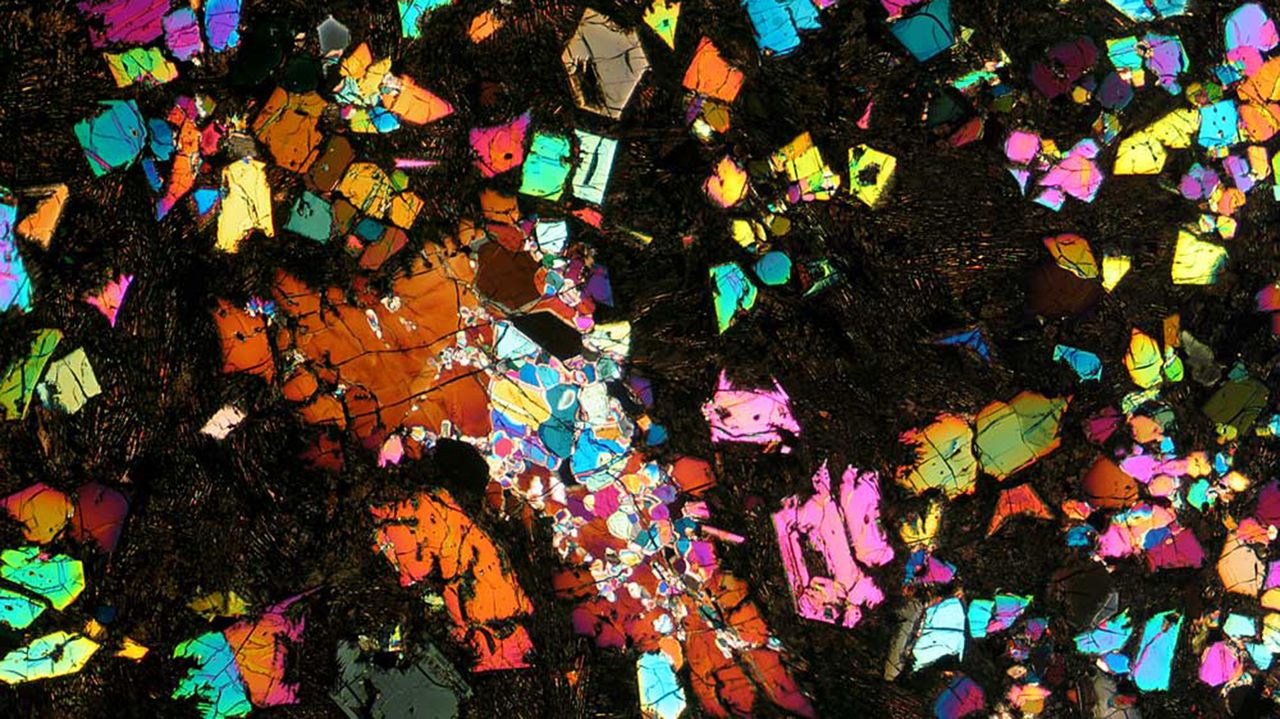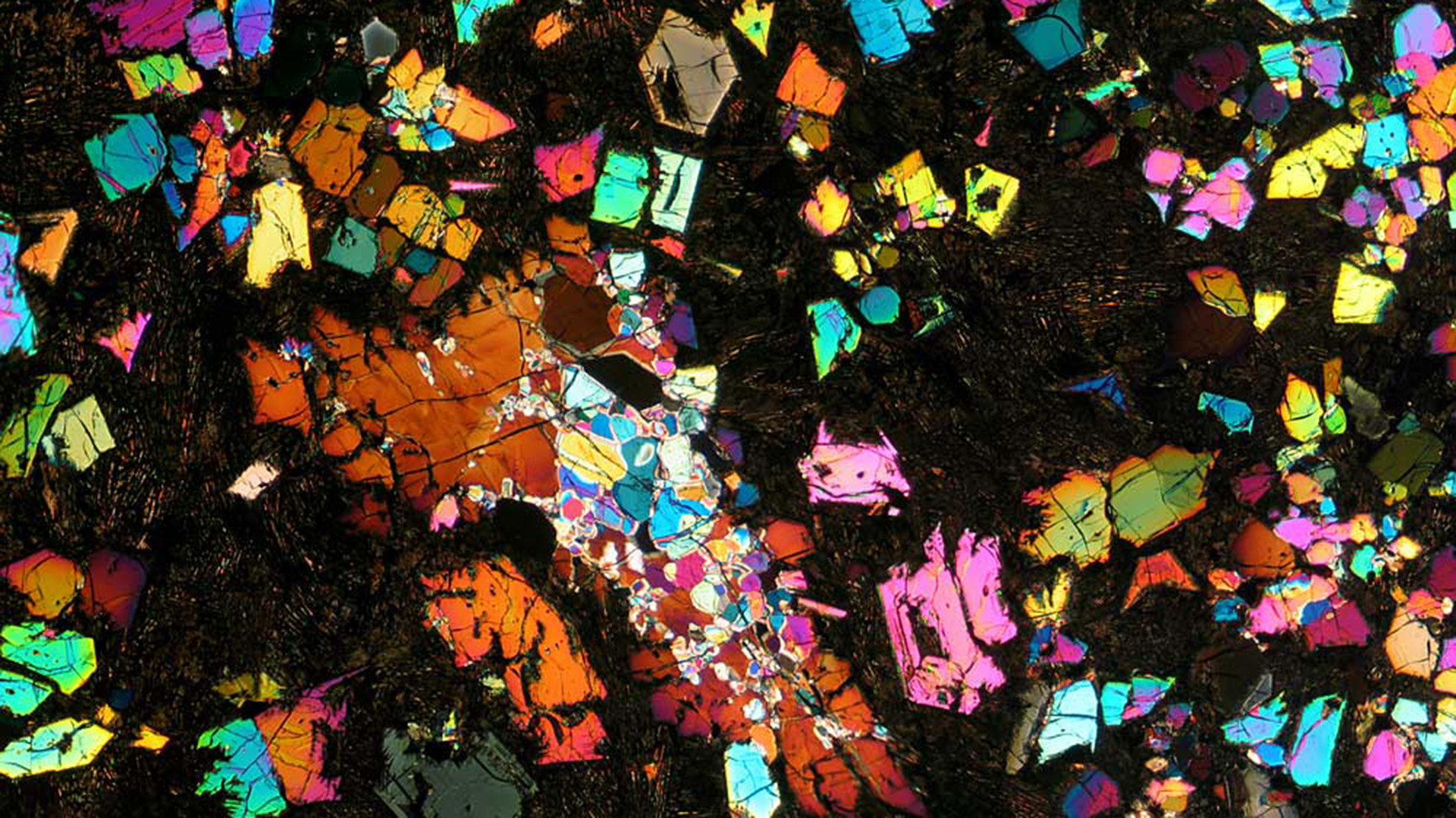
When imaged with cross-polarized light the angrite meteorite NWA 12774 shimmers like a rainbow kaleidoscope. A new study suggests that the space rock, first discovered in 2019, could be a fragment from a long-lost protoplanet from the early solar system. (Image credit: CU Boulder/John Kashuba)
Share this article Join the conversation
Follow us Add us as a preferred source on Google Newsletter Subscribe to our newsletter Quick facts
What it is: NWA 12774, a 16-ounce (454 grams) angrite meteorite
Where it was found: The Sahara Desert, Northwest Africa
When it was shared: June 1, 2026
Throughout its history, Earth has been bombarded with countless meteorites. About 80,000 have been found so far, but one specific group is exceedingly rare — and scientists now think they could be evidence for a long-dead proto-world that used to orbit the sun.
That rare group is the "angrites," which account for just 0.09% of all meteorites. They’re among the oldest known rocks in the solar system, forming within just a few million years after the solar system began 4.56 billion years ago. They also contain exceptionally low levels of silica (silicon dioxide), which is a key ingredient of most asteroids and rocky planets.
One angrite meteorite, dubbed NWA 12774, (pictured here in cross-polarized light) was discovered in the Sahara Desert in 2019. And a new study into this space rock suggests that it could be the first definitive evidence of a long-lost protoplanet that once existed in the early solar system. (NWA stands for Northwest Africa, a designation given to every meteorite found in this region.)
The findings, published July 1 in the journal Earth and Planetary Science Letters, hint that this “planetary embryo” — if it existed — was made of angrite and may have been as big as the moon or even Mars. It’s thought to have orbited the sun before crashing into another celestial body and shattering into rubble billions of years ago; cue angrite meteorites falling to Earth.
In addition to its low silica content, NWA 12774 contains clinopyroxene, a mineral commonly found in Earth’s crust and mantle. This clinopyroxene is also unusually rich in aluminum, indicating that it formed under extremely high pressure — possibly a high-energy collision.
Such pressures could not have existed inside a small asteroid, hinting that the parent body of the angrites must have had a radius of at least 621 miles (1,000 kilometers), the researchers wrote. The sharp edges on NWA 12774 further suggest it formed near the surface, implying the parent body was even larger — with a radius of up to 1,118 miles (1,800 km). For comparison, Earth’s moon has a radius of 1,080 miles (1,737 km), and Mars has 2,106 miles (3,390 km).
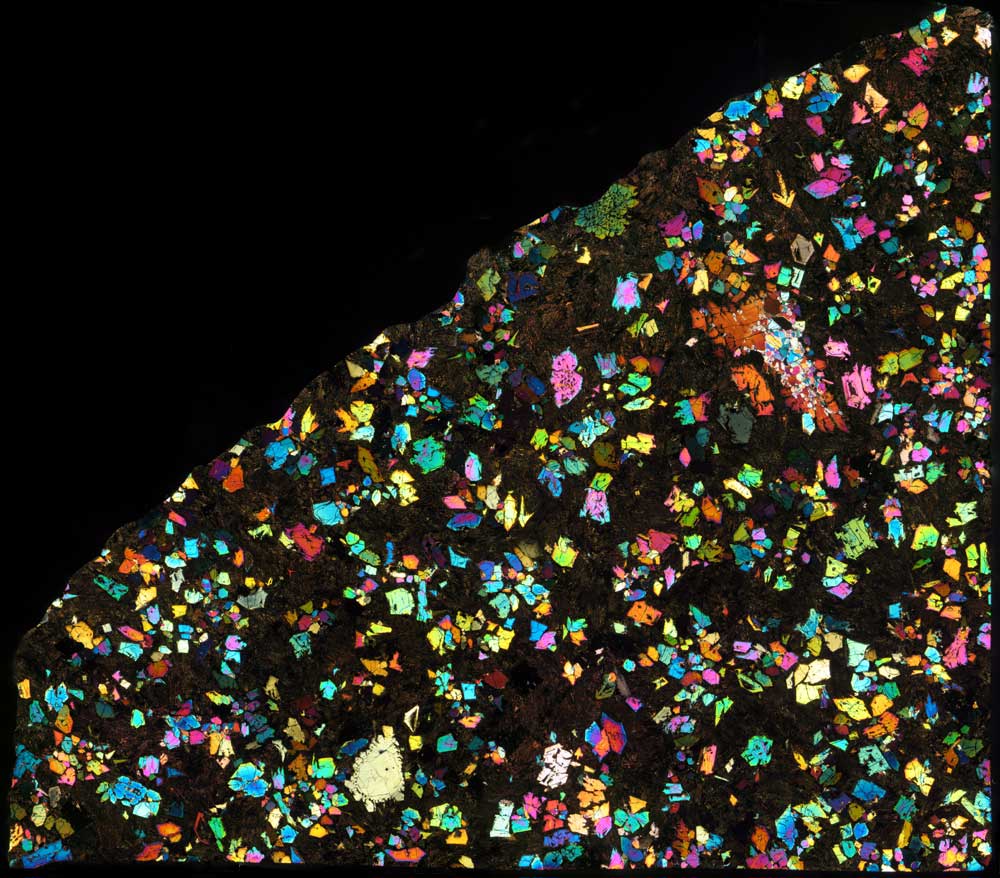
Another view of the angrite meteorite NWA 12774.
(Image credit: CU Boulder/John Kashuba)
“It’s incredible to think there was once [another] world this large,” study first author Aaron Bell, a petrologist at the University of Colorado Boulder, said in a statement. “We only know it existed because a few fragments of it happened to land on Earth. These meteorites preserved evidence of a completely different pathway through which early planets developed.”
Sign up for the Live Science daily newsletter now
Get the world’s most fascinating discoveries delivered straight to your inbox.
Contact me with news and offers from other Future brandsReceive email from us on behalf of our trusted partners or sponsors
Due to the lack of silica in the angrites, scientists had previously theorized that these meteorites originated from small asteroids. But the new findings challenge that view.
Related stories
If they did originate from a protoplanet, then the world that could have formed from this "embryo" would have likely looked much different than the rocky planets we see today.
“The materials that formed the angrite parent body are fundamentally different from the ingredients of Earth and Mars,” said Bell. “It points to a distinct and separate evolutionary path in planetary formation in the early history of our solar system.”
It is unclear exactly what happened to the lost protoplanet. However, the researchers speculate that some of its fragments may have become the building blocks of other terrestrial planets, including Earth.
Article Sources
Bell, A. S., Waters, L., & Ghiorso, M. (2026). High-pressure clinopyroxene in Northwest Africa 12774 and new geobarometric evidence for a planetary embryo-sized angrite parent body. Earth and Planetary Science Letters, 685, 120029. https://doi.org/10.1016/j.epsl.2026.120029
 'Human minds should not go through this'
The Artemis II crew recalls the unreal moment when Earth disappeared
 Hidden structure in 1st Vera Rubin image
First-light images from the Vera C. Rubin Observatory reveal a 163,000-light-year stream of stars emanating from a nearby galaxy.
 JWST peeps the 'Eye of God'
A spectacular James Webb telescope image reveals intricate structures inside the Helix Nebula.
TOPICS
 Jamie Carter
Live Science contributor
Jamie Carter is a Cardiff, U.K.-based freelance science journalist and a regular contributor to Live Science. He is the author of A Stargazing Program For Beginners and co-author of The Eclipse Effect, and leads international stargazing and eclipse-chasing tours. His work appears regularly in Space.com, Forbes, New Scientist, BBC Sky at Night, Sky & Telescope, and other major science and astronomy publications. He is also the editor of WhenIsTheNextEclipse.com.
View More
You must confirm your public display name before commenting
Please logout and then login again, you will then be prompted to enter your display name.
Logout