
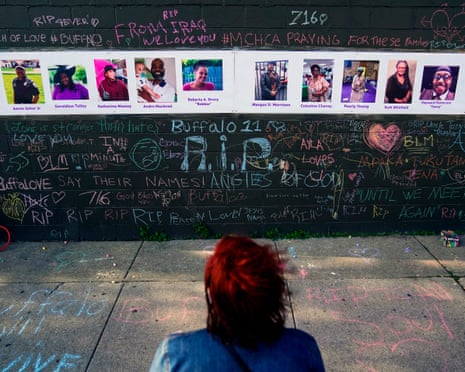
 A person visits a makeshift memorial near the supermarket in Buffalo, New York, in May 2022. Photograph: Matt Rourke/APA person visits a makeshift memorial near the supermarket in Buffalo, New York, in May 2022. Photograph: Matt Rourke/APJury selection begins in hate crimes trial for Buffalo supermarket gunman
Trial could see white supremacist who killed 10 people in New York state store get the death penalty
Jury selection is set to begin Tuesday in the trial that could see the white supremacist who killed 10 people in a 2022 Buffalo supermarket get the death penalty.
The attack is believed to be the deadliest shooting targeting Black people in modern history.
Payton Gendron is facing more than two dozen federal hate crime charges – and over a dozen firearms charges. He is already spending life in prison on state murder charges.
Families of the victims and survivors differ on whether Gendron should be sentenced to death. His defense team is not going to dispute his guilt and instead focus on arguing that he should be spared execution.
“Nothing will change the fact that Payton Gendron will die in prison,” the federal public defender office said in a statement. “At trial, we will offer mitigating evidence about Payton that the jury needs to consider in making its decision. Nothing we say or do is intended to be disrespectful or insensitive to the victims, the survivors, or their loved ones.”
Some victims’ family members, however, are not totally against the death penalty.
“I’ve never been like out here like, ‘Yay! Go for the death penalty.’ That’s never been me,” said Buffalo common council member Zeneta Everhart, who ran for office over a year after her son, Zaire, survived the shooting. “Ten people died that day in an egregious way and in an awful, terrible, traumatic way.”
Her son, now 25, and the two other survivors have had their lives irrevocably altered, she added.
Gendron drove more than 200 miles (320 kilometers) from his home in Conklin, a predominantly white and rural town, to Buffalo on 14 May 2022. Then 18, he fired around 60 shots from a semiautomatic rifle at employees and shoppers at the Tops Friendly Markets grocery store on Jefferson Avenue.
Video revealed Gendron apologized to a white store worker after shooting him in the leg. He surrendered to police as he exited the supermarket.
Investigators found past social media posts and other writings by Gendron dedicated to planning an attack to frighten people who were non-white and non-Christian into leaving the US. He also promoted a baseless “great replacement theory” that people of color will replace white people through higher birth rates and immigration.
The victims who were killed were all Black and between ages 32 and 86. Besides Chaney, they included Geraldine Talley, Katherine Massey, Pearl Young, Andre Mackneil, church deacon Heyward Patterson, Ruth Whitfield, Roberta Drury, Margus Morrison and Aaron Salter, a retired Buffalo police officer who was working as a security guard.
Beside being one of the deadliest acts of anti-Black violence in modern US history, the 2022 Tops mass murder reflects a grim reality represented in national bias crime statistics.
Black people have comprised the “number one numerical target” annually since the FBI began collecting data in 1991, according to hate crime analyst Brian Levin, of the California Association of Human Relations Organizations. The record high was 3,670 anti-Black bias incidents in 1996.
According to FBI data released in August, law enforcement agencies reported over 2,800 anti-Black hate crime incidents in 2025, nearly three times the number targeting Latinos. The FBI also reported a 7% decline in hate crime incidents from 2024 to 2025.
The Buffalo shooting and the 2015 Charleston, South Carolina, church shooting, in which a white gunman killed nine Black churchgoers, show how online radicalization makes this a terrorism matter as well.
“Unfortunately, [Gendron] fits the pattern of young, mostly white males undertaking targeted massacres which are then justified by manifestos, which are also part of a continuing chain that references prior attacks often but seeks to encourage future ones,” Levin said.
Explore more on these topicsShareReuse this content