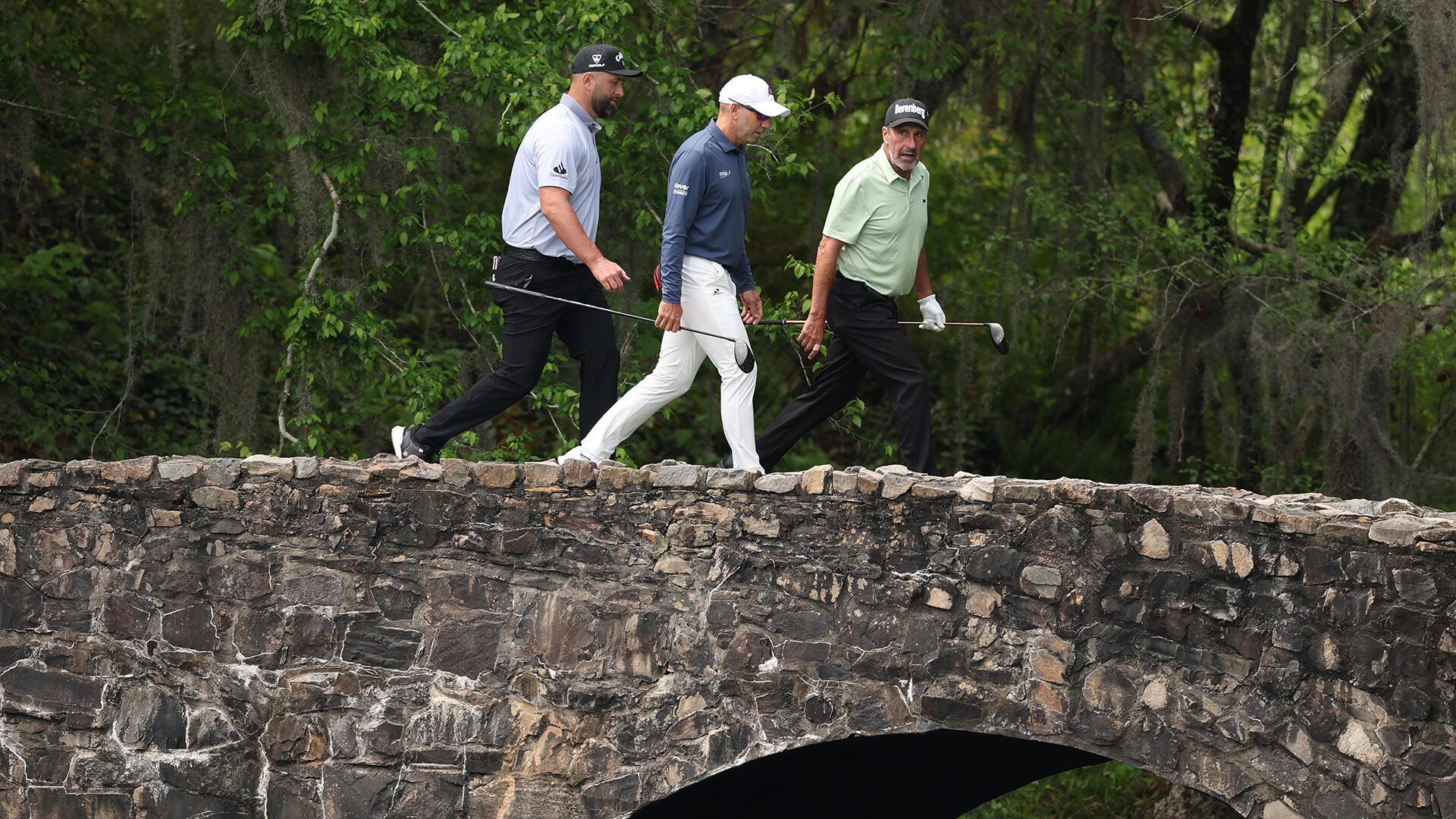
Olazábal moved slower, shot shorter and still played far better than the rest of his grouping in Round 1 of the 2026 Masters
 By Patrick McDonald Apr 9, 2026 at 3:25 pm ET • 5 min read
  Getty Images
 AUGUSTA, Ga. -- Aldrich Potgieter and Rasmus Neergaard-Petersen stood still for nearly 5 minutes, waiting for the final member of their grouping to arrive at the first tee on Thursday morning at the 2026 Masters. So brisk that fists were required to be clenched and any motionless moment was met with a shiver, the early temperatures in Augusta, Georgia, made an already uneasy opening tee shot that much more uncomfortable.
Potgieter pondered his circumstances as he was about to make his second Masters start, while Neergaard-Petersen kept his eyes fixed forward, knowing the pressure was on as he stood among a talented crop of debutants. They waited and waited until, just a couple of minutes before their tee time was scheduled to start, their last finally joined.
He would be making his 37th Masters appearance, and before a ball was even pegged, his experience was already evident.
When groupings were released Tuesday afternoon, a through line was drawn between a handful of them that immediately caught the eye. These were not the featured groups -- consisting of Masters contenders like Xander Schauffele, Bryson DeChambeau and Matt Fitzpatrick or defending champion Rory McIlroy alongside U.S. Amateur champion Mason Howell and Players Championship winner Cameron Young. Rather, they were the groupings that were made up of champions of the past and potential power players of the future.
It felt almost like a message, even more so following Augusta National Golf Club chairman Fred Ridley's comments on the golf ball rollback the day prior.
"Until recent years, golf has been a game of imagination, creativity and variety," Ridley said Wednesday. "The game has become much more one-dimensional. As players drive the ball prodigious distances and routinely hit short irons into par 4s and even some par 5s, this issue goes beyond competitive impacts."
The question of just how much experience matters at Augusta National received a definitive answer in Round 1. The new wave of talent, primed with the confidence of recent success, was paired with the old-school hoopers who rarely tee it up these days. Which would win out -- the efficiency of the present or the effectiveness of the past?
José María Olazábal, 60, was happy to provide the evidence to a pair of golfers more than 30 years his junior.
In continuous motion to stay limber, the two-time Masters champion pulled out every stretch in the book before he led the grouping off, while the others stood still. Olazábal split the fairway on No. 1 with a drive that one patron described as "sounding mediocre," which felt disrespectful in the moment but was perhaps accurate upon further review. It traveled just 215 yards.
Unable to see the putting surface as his ball did not crest the hill, the Spaniard summoned a fairway wood, leaving his third in the correct position to chip from. Meanwhile, Potgieter punched out from the right trees and left his third in the worst spot imaginable. On a morning where feel was hard to come by, the young South African felt the full wrath of Augusta National early and often as he clunked his third over the green en route to an opening double bogey. His PGA Tour-leading ball speed was of no help.
"I told my caddie, Brian, on the first … [Olazábal] had hit it over the green," Neergaard-Petersen said. "I'm like, 'OK, this is just perfect.' [His short game] was brilliant all day. I love it."
Olazábal cleaned up for par in a relatively stress-free manner, and the game within the game officially kicked off. Olazábal layered one correct shot after another, leading to birdies on Nos. 2-3 to climb to the top of the manned leaderboard, bettering more than just his playing partners.
Perhaps most telling, though, was not that Olazábal was getting his ball in the hole quicker than the two youngsters. It was that he was making his decisions almost immediately upon arriving at his golf ball. Walking 20 yards ahead of his counterparts at some points in the round, Olazábal examined every variable before he came to his next shot, or he had already considered them in Masters of the past.
It was a short conversation with his caddie, a club selection and a pulled trigger. If not for some rulings for Potgieter on Nos. 1 and 8, the latter of which caused Neergaard-Petersen's caddie to point to his wrist, Olazábal could have strolled around Augusta National in two-and-a-half hours by himself. Instead, that was the time it took for him to play his first nine.
Olazábal's bag man forecaddied on No. 7, furthering this point on a hole that displayed the subtle difference between the past and the present. Both greenside in the bunker, Potgieter and Olazábal faced similar shots toward a hole location that was running away from them on the far side of the green. Neergaard-Petersen had learned the hard way with his approach shot.
You could see the worry on the face of the big-hitting right-hander -- anything long of this hole would be funneling off the green. He decided to play a chunk and run, which did more chunk than run, leaving him on the incorrect side of the ridge that dissects the green and leading to a double bogey.
Olazábal went up top, took the ridge out of play, made an aggressive swing and saw his third take a couple of bounces and stop below the hole. Another scrambling par was his, and a quote from Justin Rose immediately sprang to mind.
"As a player, that's kind of a personal commitment choice is to go how do you play knowing all the variables? You've got to go all-in," Rose said. "You've got to be completely committed. You've got to be ruthless to the shot that you want to hit, so be front-footed … you might be playing safe, but you've got to be playing safe in the right way. That's the dance that you do with knowledge for sure."
By the time group No. 3 made the turn, it was clear that only one member was playing aggressively, even more so when being conservative was required. The past champion sauntered up to the ninth green, eyeing another up-and-down attempt as the past champion was starting his title defense. Patrons were going bananas for Rory McIlroy, unaware of what was occurring behind their backs.
Olazábal clipped Potgieter by 10 strokes on the first nine with scores of 34 and 44 between the two. A masterclass on how to golf -- properly golf -- had just taken place. Although Olazábal stumbled coming home with a bogey-double bogey-bogey stretch in the middle of his second nine, the lesson was already taught.
Potgieter scored an 84 on the test, Neergaard-Petersen a 77, Olazábal a 74 =-- proving imagination, creativity and variability still have a place in the game, even if only for weeks like this at Augusta National.
Join the Conversation comments