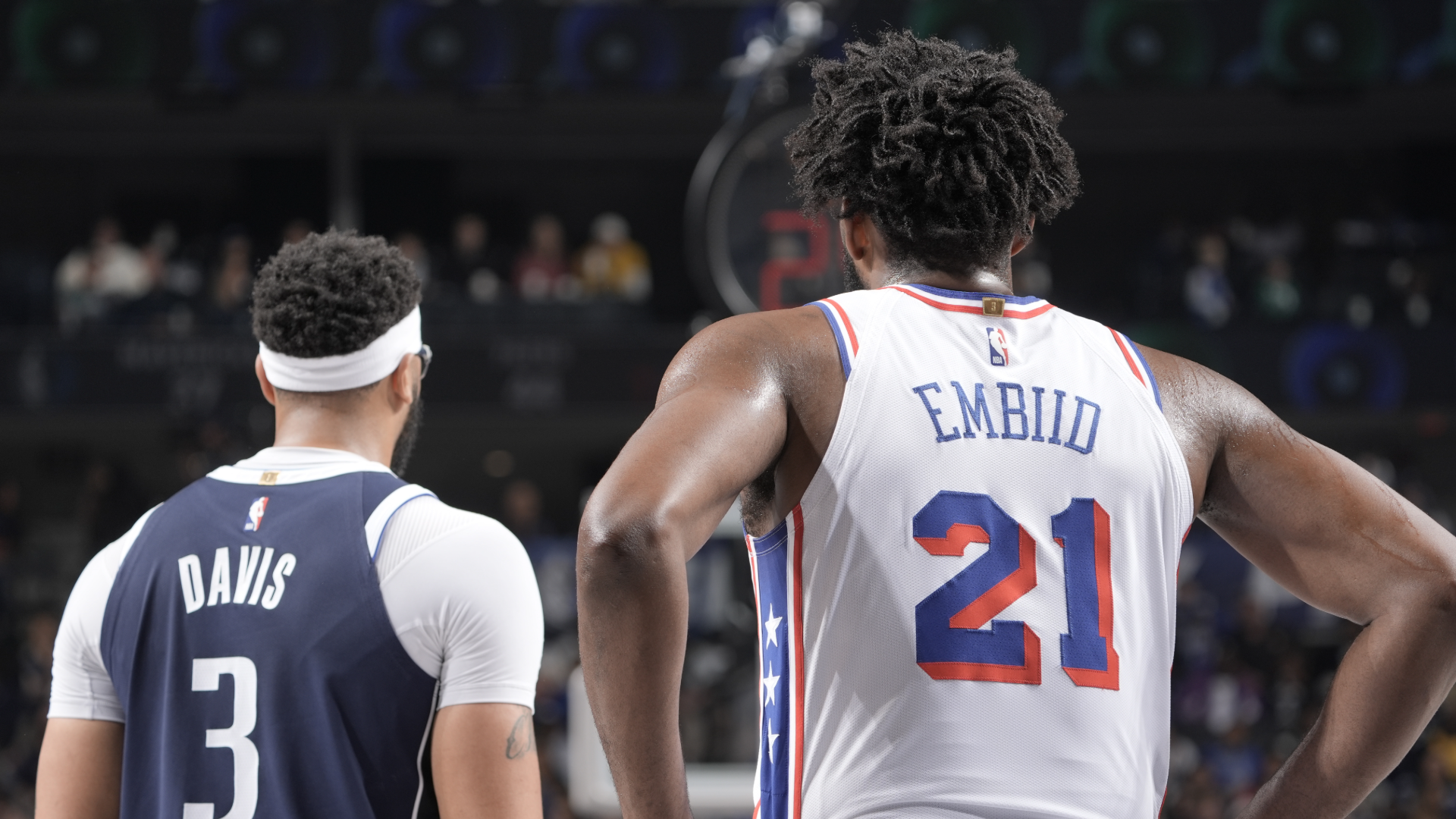
One of the most persistent rumors of the LeBron James sweepstakes was that he wanted to use his final decision as a means to reunite with one of his best former teammates. Kyrie Irving's name appeared briefly in the rumor mill, but far more prominently involved was Anthony Davis, who was frequently linked to the Golden State Warriors, but theoretically could have been dealt to several teams in the James sweepstakes.
Well, James made up his mind without a Davis trade. He is now a member of the Philadelphia 76ers. Conveniently enough, those same 76ers happen to employ another star center whose supermax contract pays him almost exactly the same amount that Davis is currently earning: Joel Embiid. It didn't take long for the Twitter-verse to start speculating on a possible Davis-for-Embiid swap, and hey, at least it makes basketball sense.
While Embiid was the superior player in the brief moments either were on the court last season, his mobility is all but gone at this stage. Defensively, with the 42-year-old James at power forward, Davis would seem to be a far safer bet. Embiid and Jaylen Brown tend to operate within similar areas of the court offensively as mid-range shooters. Davis does some of that as well, but not nearly as much. His lob gravity on a team with this much scoring would be enormously valuable.
Davis and James are both represented by Rich Paul and Klutch Sports. Embiid is not. Current 76ers executive Bob Myers ran the Golden State Warriors throughout their dynasty. They were frequently linked to Davis in previous transaction cycles. The speculation is coming from a reasonable place.
Yet for the time being, a deal seems fairly unlikely. There's a straightforward explanation for why: the Washington Wizards, by all accounts, don't want to trade Davis. It takes two to tango, and if the Wizards don't cooperate, there's nothing the Sixers can do about it.
We could wrap this up and call it a story from there. Yet the Davis and Embiid situations, for some overlapping reasons and some unique ones, both warrant further exploration because they're both sensible trade candidates. So let's take a closer look at each of them and attempt to figure out where exactly they stand with their existing rosters.

What's going on between Davis and the Wizards?
All of the reporting on Davis and the Wizards has been aligned on one thing: Washington does not want to trade him. Of course, that is hardly binding. Teams use the media to send messages all the time. If Washington did plan to trade Davis, they'd still want the world believing they intended to keep him if only to drive up the price. Getting Deandre Ayton at least gave them a playable replacement in mid-July, which is part of what drove these rumors.
If that were the case here, though, the Wizards missed the obvious window. The time to maximize Davis' trade value was before James signed with his new team. Think of the value the Oklahoma City Thunder extracted for Paul George in 2019. They were able to get the historic haul they got because they were functionally trading the Los Angeles Clippers George and Kawhi Leonard. If the Wizards wanted to maximize their return on a possible Davis trade, the move was to play the 76ers, the Warriors and potentially even the Cleveland Cavaliers against one another by dangling the carrot of James on a minimum contract alongside him.
That they didn't do so suggests that they really do intend to keep Davis. The next question for the two sides comes on Aug. 6, when Davis is eligible for a four-year, $275 million contract extension. Throw those numbers out the window. Davis is 33, injury-prone, already owed around $121 million over the next two years, and didn't play at an All-Star level in his brief appearances last season. He's not getting $275 million. But he reportedly wants an extension of some kind, and the Wizards have hinted at the prospect of giving him one.
We can't say whether an extension would be wise without knowing the final numbers, but in all likelihood, it would lower Davis' trade value. Remember, Davis was dealt for a pittance at the deadline in part because of all of those red flags we just raised above. It's hard to imagine many teams eager to pay him even more than the Wizards are already slated to. That is especially true for the 76ers, whose books, despite being quite top-heavy, are designed pretty intentionally.
As it stands, Embiid, Jaylen Brown, Tyrese Maxey and VJ Edgecombe will all see their contracts expire in 2029. At the very least, Edgecombe will presumably get a big raise from his rookie-scale amount to a market-value extension. There's a chance that Maxey jumps from his 25% max contract up to a 35% max contract, and if he doesn't, a 30% standard max deal for a player with his experience is still quite expensive. Philadelphia can abide these new deals because they know they won't have to pay Embiid (and possibly Brown) when they arrive. If the 76ers replace the Embiid salary slot with Davis on an extension that drags into the 2029-30 season, that complicates their long-term finances significantly.
We should point out here that Davis has not yet played a game for the Wizards, and that Washington's circumstances have changed a great deal since his acquisition. The Wizards didn't know they'd win the lottery when they got him. They probably didn't know they'd have to pay Trae Young the max to retain him either. If Washington elects not to offer Davis a substantial extension, it's possible that a trade gets revisited during the season.
Of course, even that would introduce quite a few variables into the equation. If Embiid is healthy and productive, for instance, Philadelphia might not be all that motivated to make a deal. If the 76ers struggle as a team, they might determine that sacrificing their limited remaining draft capital for Davis isn't worthwhile. Remember, while James may only be there for a year or two, Maxey, Edgecombe and potentially Brown have a long window ahead of them. Giving up, say, the right to swap first-round picks with the Clippers in 2029, or their own unprotected pick in 2033, is no small thing. Those are assets that could build the next version of the team, which will be a priority if this one isn't working out. Meanwhile, one more Davis injury likely scuttles the notion of paying major assets to get him.
The narrow scenario in which a trade seemingly makes sense for all parties would be the one in which Davis is healthy, productive and unextended, Embiid is not, but the 76ers are still winning anyway. That's not impossible. It's just a lot of variables. Never say never, but it probably isn't something we should be expecting, especially since James clearly did not make a Davis acquisition a necessity for his signature.

What is Embiid's future in Philadelphia?
Joel Embiid probably has the worst contract in the NBA, and it has nothing to do with his productivity on the court. As we saw in the Boston series, he's still capable of greatness. He was a top 10 per-minute scorer in the NBA last season, arguably playing at an All-NBA level when available. It's just that the words "when available" have loomed over his entire career. Embiid is owed three years of supermax money. He's played 93 games in the last three regular seasons. The 76ers have reached the second round six times in his career. He has never made it through both rounds without missing at least one game. He just can't be trusted to stay on the floor physically.
The hope for Philadelphia would be that Embiid simply stays healthy. That's their upside, and working in his favor is the sheer flukiness of some of his injuries. It's not as though you can get appendicitis twice. Maybe with so many other creators on the roster, the 76ers can manage him carefully enough to get him through the 82-game grind in one piece. The basic premise of this team is that it can just out-talent anyone it faces in the postseason. Embiid is central to that concept.
But if the Sixers are at all worried about his health, it would be irresponsible of them not to explore the market, and the sort of teams that make any sense for Embiid are the ones who can tolerate three years of supermax money squatting on their books, potentially without generating on-court value. The Wizards aren't that sort of team. Promising youngsters Alex Sarr, Kyshawn George and Bilal Coulibaly will all need to be paid real money before Embiid's contract expires, and with Young making the max, that's a pretty narrow financial needle to thread.
So, what are the sensible Embiid teams? Ideally, we want a rebuilder with relatively clean long-term books that has at least one starting-level center available to send to Philadelphia. It's hard to imagine a trade like this coming before the deadline. Philadelphia will want to give it a real shot with Embiid before taking the nuclear option. Whatever they do, it will cost assets to move him. But there are six teams that make any degree of sense, at least as they sit now, for a deadline deal:

The Milwaukee Bucks are in post-Giannis Antetokounmpo purgatory. They don't control their own first-round pick again until 2031, and the best assets they got from the Miami Heat in that deal were picks in the 2030s. There's no reason they can't take on Embiid for assets in the interim, and he might even help sell some tickets during an otherwise unremarkable period in the team's history. Myles Turner could be Philadelphia's replacement center, and the Bucks have plenty of bad money to send between Kyle Kuzma and Gary Trent. Depending on the assets involved, maybe the Sixers could even do a bit better and nab a valuable role player like an A.J. Green.

The Chicago Bulls have a replacement center in Nic Claxton, and they probably wouldn't mind foisting Patrick Williams on another team. The advantage Chicago has is that its franchise player, Caleb Wilson, hasn't even played yet. He still, therefore, has four cheap, cost-controlled seasons left on his deal, meaning Embiid's contract would expire before Wilson earns market-value money. They could still take advantage of Wilson's cheap deal even after landing Embiid.

The Brooklyn Nets don't have a starting-level replacement center, but Day'Ron Sharpe is a high-level backup at least, and their books are clean enough that taking on Embiid probably wouldn't impede them too much. In all likelihood, a deal like this would involve Julius Randle going to a third team and a center going to Philadelphia. This, ironically, would have been far easier when they had Claxton instead of Randle.

The Dallas Mavericks have one of the best collections of players that Philadelphia could pursue. Daniel Gafford and P.J. Washington are both still valuable, but they are Nico Harrison holdovers on big extensions, and the Mavericks have such limited draft capital that getting picks to take on Embiid could help refill the coffers. The downside here is that getting Embiid would all but eliminate their financial flexibility during Cooper Flagg's rookie deal, as his rookie extension would kick in right as Embiid's contract expires. Sacrificing 2028 cap space, when Luka Dončić, Deni Avdija and others could be available, would represent a huge opportunity cost.

It would do little to boost their defense, but there's a pretty straightforward Embiid-and-Anfernee-Simons-for-Domantas-Sabonis-and-Malik-Malik Monk swap to be made with the Sacramento Kings, assuming Philadelphia would put some draft capital on the table. If nothing else, aside from last season, Sabonis has historically been relatively available.

And here we reach the bonkers stage of the Joel Embiid fake trade exercise: Embiid for Draymond Green, Kristaps Porziņģis and Moses Moody. It would presumably take basically all of Philadelphia's remaining draft capital and perhaps even rookie Labaron Philon, but it would net them two high-level bigs and a usable wing. If Golden State is really more concerned with building for what comes after Stephen Curry than maximizing the end of his prime, this is a way to cash in on their relatively clean books beyond next season. And who knows? Embiid and Jimmy Butler thrived together in Philadelphia. Maybe they could both be healthy in the 2027-28 season and give Curry a respectable roster.
The first few trades aren't very encouraging. The last few trades are less likely to be available and would certainly cost more even if they were. That's the difficulty of trading a contract like Embiid's. The 2023 CBA tightened belts around the entire NBA. The notion of paying three years of supermax money to someone you can't even trust to stay on the floor is more terrifying than it has ever been. If the Wizards were eager to do it, they probably would have done so by now.
For now, the expectation should be that Embiid opens the season with the 76ers and, just based on the difficulty involved in trading him, probably ends the season there as well. The degree to which Philadelphia explores alternatives will depend on how the first few months of the season play out, but even if a trade proves necessary, there are still too many hurdles to treat a Davis swap as at all likely.
Add CBS Sports on Google Join the Conversation comments


