
 Joanne Young, who was subjected to years of drugging and rape by her husband, who invited other men to assault her, waived her anonymity to speak out. Photograph: Jack Taylor/ReutersJoanne Young, who was subjected to years of drugging and rape by her husband, who invited other men to assault her, waived her anonymity to speak out. Photograph: Jack Taylor/ReutersAnalysisJoanne Young’s faith in justice system is sign of real change, but courts are still catching upAlexandra Topping Political correspondent
Young’s abusers were convicted through suspect-centric prosecution, though much more needs to be done for victims
Hope can be found in the darkest of places. Joanne Young stood outside Winchester crown court on Thursday and said she was relieved – not just for herself and her family – but for women in the future.
Young, who was subjected to years of drugging and rape by her husband, who invited other men to assault her, waived her anonymity to speak out.
She said she hoped her case meant those who had experienced similar abuse could have more faith in the criminal justice system, and that all women and girls who had been abused by men would hear the message that they could be believed and understood.
Given the powerful dignity of Young’s address, it was easy to miss the significance of another remarkable statement, made on the same day by a prosecutor in the case.
 3:17‘Silence is not an option’: Joanne Young makes statement outside court – video
“By building the case with a suspect-centric approach, we could prove to a jury that Philip Young could not provide consent on the victim’s behalf and each defendant played a part in this horrific sexual abuse,” said James Foster, a specialist prosecutor in the Crown Prosecution Service’s Wessex complex casework unit.
Suspect-centric. The fact that a criminal investigation and prosecution is focused on the suspect of the crime should, of course, be unremarkable. But, until quite recently, in cases of rape, sexual assault and domestic abuse, that was rarely the case.
There are some signs, some small green shoots of optimism, that suggest the lumbering criminal justice system is moving in the right direction. Those words from a regional prosecutor indicate a shift that was unimaginable a decade ago, and for people who have spent their lives trying to reform the criminal justice system, it is a sign that change is possible.
In 2018 the Guardian ran a series of stories about a sharp drop in the number of cases that CPS prosecutors were willing to take to trial, prompting concerns about the de facto decriminalisation of rape. Prosecutions fell 60% from 5,190 in 2016-17 to 2,102 in 2019-20, even as the number of incidents reported to police increased.
At a time when the issue was getting little coverage, the Guardian revealed how the CPS held training events for prosecutors, advising they “take the weak cases out of the system” to boost the conviction rate.
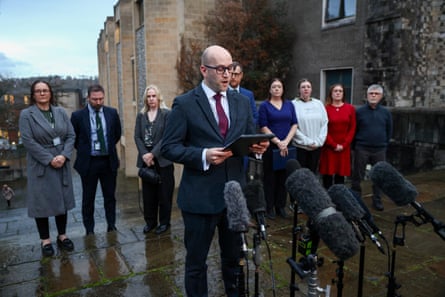 James Foster, a specialist prosecutor, said the case was built with a ‘suspect-centric approach’. Photograph: Jack Taylor/Reuters
In March 2019, Theresa May’s government launched a review into rape investigations. When it reported in 2021, the conclusion was stark: victims were not only being let down, but made to feel as if they were the ones under investigation.
The Conservative administration – which had inflicted budget cuts resulting in a 30% reduction in CPS staff and the loss of about 20,000 police officers – issued an unusually frank mea culpa. The policing and crime minister at the time, Kit Malthouse, said “it simply has not been good enough”. The then justice secretary, Robert Buckland, said he was “deeply sorry”.
The response to the review was radical. The Home Office funded Operation Soteria Bluestone, under the leadership of academics and criminology experts Betsy Stanko and Katrin Hohl, to review a number of forces’ cases and unflinchingly reveal their failures.
Police officers and prosecutors were told to change in six key areas by focusing investigations on suspects, disrupting repeat offenders and engaging with victims, and by improving learning and development, officer wellbeing and the use of data and digital forensics.
skip past newsletter promotionafter newsletter promotion
They were also told to stop indiscriminately trawling victims’ personal data, and instead request only information that was relevant and proportionate.
It is clear that in many forces, things have changed – pushed and encouraged by Sarah Crew, the clear-eyed police lead for rape in England and Wales, a role newly created in 2021. Police referrals and CPS charges for rape were back up to 2016 levels by 2024, with the change hailed by independent sexual violence advisers such as Rape Crisis England & Wales.
Nevertheless, charities have continued to warn against complacency: despite the recovery, about 97% of reported rapes never make it to court.
Two courtrooms, one celebrity: how did the Russell Brand case compare with the rape trial next door?Read moreFears have also been raised that process of change could stall. The courts backlog means rape survivors and complainants are waiting an average of 423 days for trial, with many waiting far longer.
Experts argue that the use of rape myths is still prevalent in courts, noting that during the trial of Russell Brand – in which the celebrity was sentenced to more than 10 years in prison after he was found guilty of raping one woman and sexually assaulting three others – his barrister, Ian Winter, said Brand’s accusers had not “resisted or screamed or even tried to leave”.
Hohl, now the government’s independent adviser on rape, worries that as the police and the CPS move in the right direction, the courts system is being left behind. Last month, she published a report suggesting sexual assault cases prepared under the improved standards come up against a “cliff edge” once they get to trial.
Despite the horror of her experience, Young has shown us a sliver of light in a criminal justice system that has failed too many victims for too long. But the work to fully transform it is far from complete.
Explore more on these topics- Rape and sexual assault
- Violence against women and girls
- UK criminal justice
- Crown Prosecution Service
- Crime
- England
- Police
- news