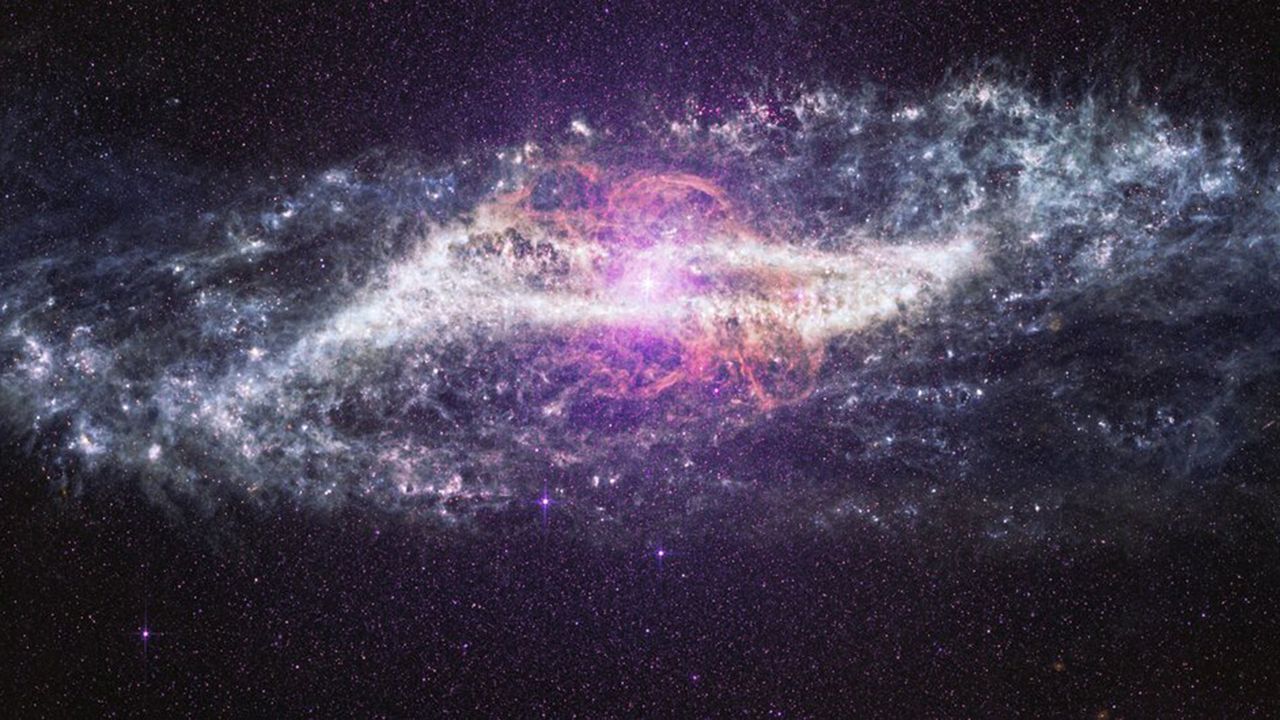
What it is: Centaurus A galaxy (NGC 5128)
Where it is: 11 million light-years away, in the constellation Centaurus
When it was shared: July 6, 2026
This image from the James Webb Space Telescope (JWST) offers a rare look at the hidden workings of Centaurus A, one of the most unusual and active galaxies relatively near Earth. JWST detected wavelengths of light humans cannot see, revealing a galaxy shaped by violence and chaos.
Centaurus A is relatively close to the Milky Way, which enabled JWST to study the strange galaxy in remarkable detail. It's no quiet, ordinary galaxy; it's the aftermath of a major cosmic collision. At its heart is an actively feeding supermassive black hole, surrounded by vast clouds of dust that trace the galaxy's turbulent history.
In visible light — such as images from the European Southern Observatory's La Silla Observatory and Very Large Telescope in Chile — thick dust lanes obscure Centaurus A's center, blocking part of the story. The Hubble and Spitzer space telescopes, both of which can see in near-infrared wavelengths, previously imaged Centaurus A, but they also saw mainly dust. But infrared light can pass through that dust, which enabled JWST's Mid-Infrared Instrument to see the galaxy's center glowing in white and pale pink, revealing filaments, loops and clouds of warm dust stretching across the scene.
Scientists believe Centaurus A collided with another galaxy roughly 2 billion years ago. That ancient merger left visible scars, which JWST captured in striking detail. Evidence of a galaxy pulled, stirred and reshaped over immense timescales appears throughout the image, from the warped gray-and-white parallelogram-shaped structure cutting across the galaxy, to the pink and lavender ribbons curving above and below it in an S shape. The image reveals how galaxy mergers rearrange dust and gas, trigger star formation and influence galaxy growth over time.
Hubble’s view of Centaurus A is heavily obscured by dust, blocking the view of its turbulent core. (Image credit: NASA, ESA, and the Hubble Heritage (STScI/AURA)-ESA/Hubble Collaboration. Acknowledgment: R. O’Connell (University of Virginia) and the WFC3 Scientific Oversight Committee)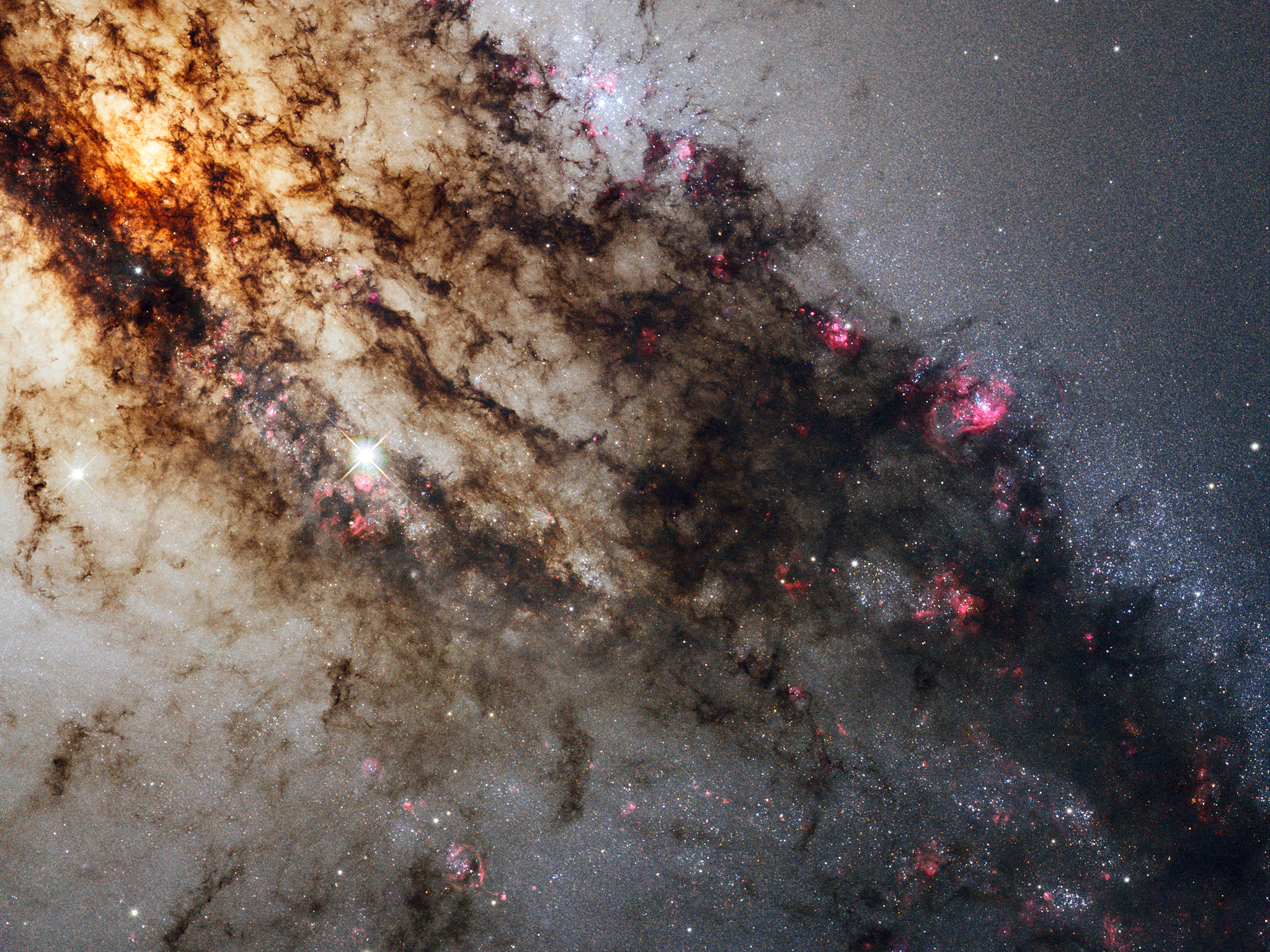
The image also shows how a nearby supermassive black hole can both fuel and limit the birth of stars. As material falls toward the black hole at the center of Centaurus A, it releases enormous energy and launches powerful jets that shape the surrounding gas and dust.
The image comes near the end of JWST's fourth year of science operations, which began with the release of spectacular images in July 2022. The telescope launched on Dec. 25, 2021, and is predicted to operate for about 20 years.
See how much you know about the world's most powerful telescope with our James Webb Space Telescope quiz!


