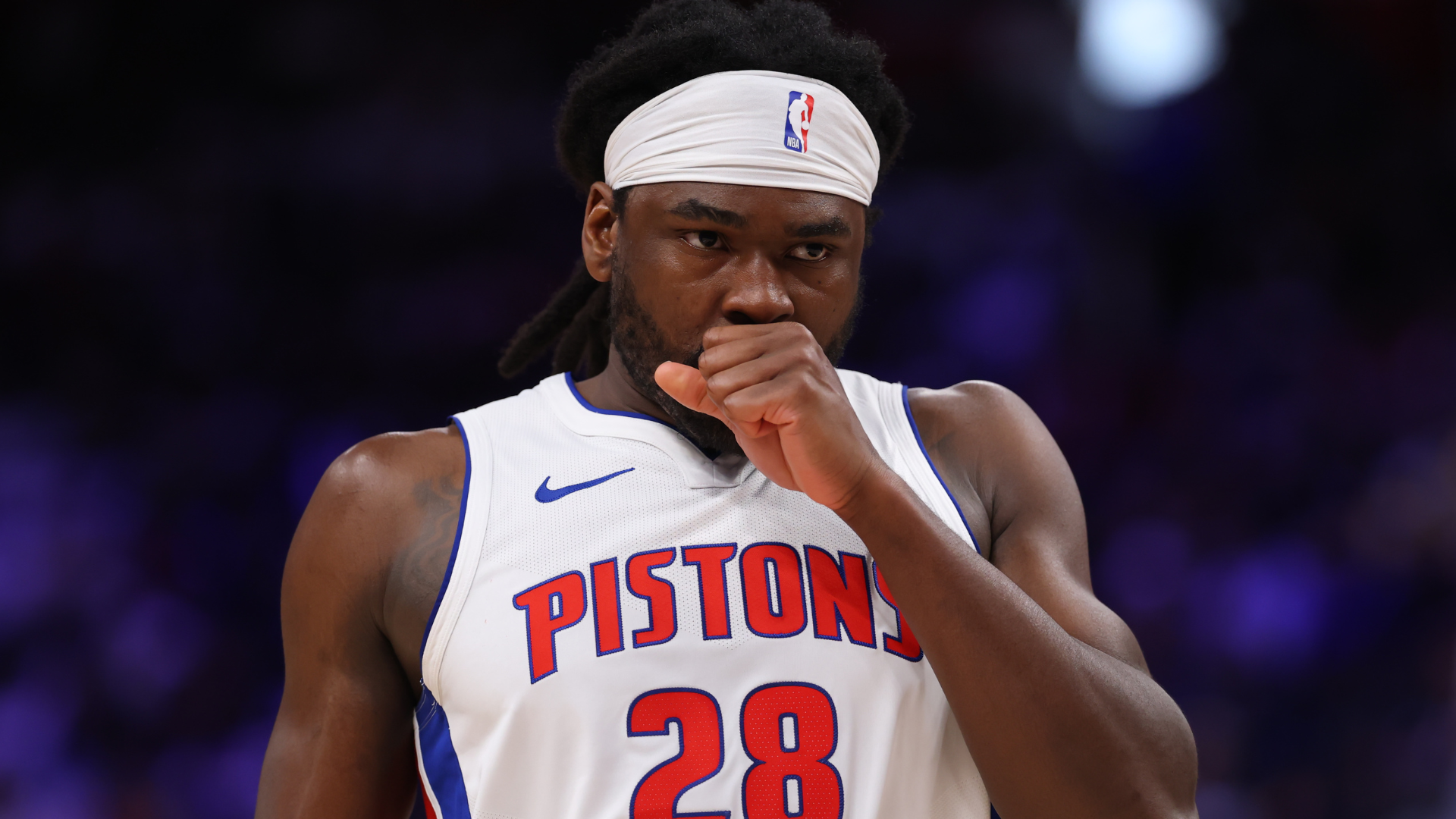
We got our first and only trade involving a veteran player in the 2026 NBA Draft on Tuesday night. After making it through the entire first round on Tuesday without a known commodity getting dealt, the Grizzlies and Pistons finally made a trade involving a player when Detroit sent backup center Isaiah Stewart to Memphis. The trade, ironically enough, involves the very same second-round picks that Detroit sent Memphis on Tuesday to move up from No. 21 to No. 17 in the first round, according to Jake Fischer.
Isaiah Stewart trade details
- Grizzlies receive: Isaiah Stewart
- Pistons receive: 2029 second-round pick (most favorable of Knicks, Pistons, Bucks), 2031 second-round pick (via Mavericks), 2032 second-round pick (via Pistons).
So, what was the rationale behind this deal? Let's grade the trade and find out.

Memphis Grizzlies: B
The Grizzlies are remaking their roster this offseason, and they're starting that process in the front court. They drafted Cameron Boozer No. 3 overall on Tuesday, and then surprisingly used their second first-round pick, No. 21 after two trades, on another power forward in Karim Lopez. GG Jackson and Santi Aldama are both still on the roster, and of course, recent No. 9 overall pick Zach Edey is a foundational piece in Memphis.
So, why add Stewart? Because front-court depth is important, especially to Memphis. Head coach Tuomas Iisalo prefers to use his players for shorter bursts and get them multiple rests per half so they can play at maximum effort while they're on the floor. Jaren Jackson Jr., who has already been traded to Utah, and Ja Morant, whom the Grizzlies are currently trying to trade, are the only two players on last year's Grizzlies aside from their end-of-season fliers who played more than 28 minutes per game last season. If Memphis is going to sit its best players this much, it needs strong backups.
That is especially important with Edey at center. He played only 11 games last season, and across his 66 total NBA appearances, he has averaged just 22.1 minutes per game. At 7-3 with a listed weight above 300 pounds, the Grizzlies have to be cautious with Edey's workload, which means investing quite a bit in front-court players for the bench.
So, what kind of player are the Grizzlies getting in Stewart? One of the best rim-protecting backups in the NBA. Even at 6-foot-8, Stewart was a defensive force as Detroit's backup center last season. Opponents shot just 49.6% within six feet of the basket with Stewart as their primary defender last season, according to NBA.com. That's the best figure on Detroit's No. 2-ranked defense. The 0.95 points per shot he allowed that the rim ranked in the 93rd percentile among all defenders last season, according to Synergy Sports.
Offensively, Stewart was at one time a somewhat interesting stretch big prospect. In his fourth NBA season two years ago, he took almost four 3-pointers per game and made over 38% of them. Those shooting numbers have plummeted since JB Bickerstaff took over in Detroit, but perhaps a change of scenery reopens that door. His offense is otherwise problematic. Part of Detroit's rationale for trading him was its inability to score with him on the floor in the playoffs.
Those offensive questions make Stewart a questionable long-term play at major money, but he has a $15 million team option for the 2027-28 season. This is a relatively minor commitment for Memphis on a player who hung around the fringes of the Sixth Man of the Year conversation. Stewart is still only 25 and could stick around longer if the fit works out. It's hard to do much better for three second-round picks.

Detroit Pistons: B
Detroit's center rotation was cheap last season. It will not be cheap next season, with Jalen Duren presumably getting a big contract in restricted free agency this offseason. When Duren was on a rookie contract, the Pistons could afford to pay multiple backup centers. Now that he's about to make market rate, they had to choose: Stewart, or Paul Reed? The Pistons ultimately landed on Reed, whose offense made him more reliable in the playoffs.
Offense was Detroit's problem in the playoffs. They scored just 90.5 points per play in the half-court across their two seven-game series, according to Cleaning the Glass. Cade Cunningham was Detroit's only reliable creator in the playoffs, and he had to generate shots with minimal spacing because two of Detroit's best players, Duren and Ausar Thompson, are non-shooting threats. The Pistons had to get better on offense. They'll now have the means to do so.
By renouncing their own free agents (most notably, Tobias Harris and the partially-guaranteed Duncan Robinson), the Pistons can now get to around $33 million in cap space this summer with Stewart's $15 million off of their books, according to Yossi Gozlan. If they prefer to keep Harris and Robinson, they could instead operate above the cap and expand the Stewart trade to take back up to $24 million in salary while then having the ability to use the mid-level exception. Getting Stewart off of their books opens up more room below the first-apron hard cap that using the non-taxpayer mid-level exception would create.
Detroit apparently plans to be aggressive with this newfound flexibility. ESPN's Brian Windhorst said on the draft broadcast that the Pistons are going "big-game hunting" here, and even mentioned LeBron James and Kawhi Leonard as possible targets with the money they opened up. Even if they don't land a true star, there's plenty of offense out there for them to pursue this summer.
The Pistons have been linked to just about every available guard this offseason, and now they can control the market. If they want to pursue Norman Powell in free agency, they're the obvious cap space fit for him. They were linked to Tyler Herro during the Giannis Antetokounmpo trade saga. Well, he makes $33 million the dot, so the Pistons could potentially absorb him without forcing the Bucks to take on money they don't want.
Detroit has even reportedly showed interest in Zach LaVine, sitting on an enormous $49 million expiring salary. They'd probably prefer to chase him on a buyout, but perhaps now they could construct a trade with Caris LeVert as the primary outgoing salary. Considering such a move would take the Kings out of the luxury tax and save them an enormous amount of money, they might even be able to convince Sacramento to surrender some draft capital in the process. Maybe LaVine would even extend on team-friendly terms for the chance to play for a winner.
The possibilities aren't quite endless. Their best shot at a young, max-quality scorer went up in flames on Wednesday when Austin Reaves re-signed with the Lakers. It's going to be an uphill battle to convince players like James and Leonard to spend a winter in Detroit.
But the Pistons could go in a lot of interesting directions after getting off of Stewart's contract. They'll now presumably chase the shooting and secondary creation they so lacked next to Cunningham in the playoffs, and with Reed taking on full-time backup center duties, Detroit is taking real steps towards balancing offense and defense on their up-and-coming roster.
Add CBS Sports on Google Join the Conversation comments