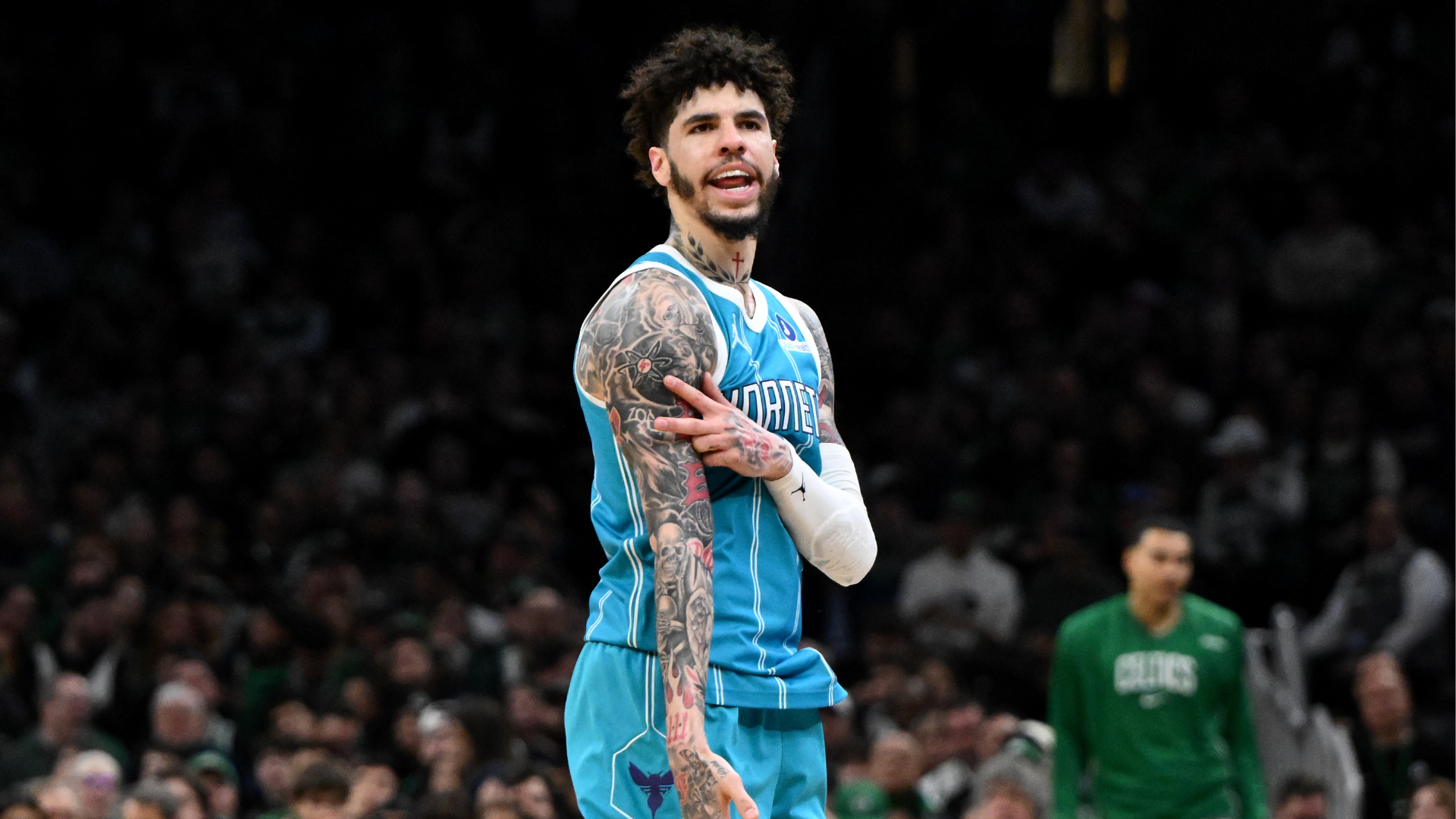
There are two ways to look at LaMelo Ball's 2025-26 season, a season when he played both the best basketball of his life and the most basketball of his life, logging a career-high 72 games. Either you think it was an anomaly, and the oft-injured circus act we all watched through the majority of his first five seasons is the truer depiction of the player the Charlotte Hornets just smartly sold at the top of his market.
Or, you think it was just the start of something. Once Ball got some real talent around him, he turned the corner from an immensely talented and entertaining player to an actual winning player and the sky is the limit from here. The Timberwolves, after trading for Ball on Thursday morning, are betting on the latter.
It's a huge bet with franchise-altering implications, but it's one the Wolves had to make. Give Tim Connelly, Minnesota's director of basketball operations, credit for recognizing the reality in front of him and acting aggressively. It's the only way he knows to operate. Nuggets fans love Aaron Gordon. Connelly is the guy who traded for him before he took the Wolves job. Denver does not have a championship without that move.
LaMelo Ball trade grades: Timberwolves get 'B+' for high-risk, high-reward move, Hornets take the long view Sam Quinn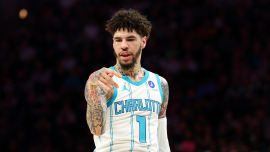
Once in Minnesota, Connelly wasted no time in going big again. In the summer of 2022, he shipped a 10-asset package (five players, one of which was Walker Kessler, four first-round picks and a pick swap) to the Jazz for Rudy Gobert. People openly laughed at that trade. Some called it the worst move in NBA history (this was before the Luka Dončić deal, of course).
But Connelly sensed that anchoring a rim-protecting big like Gobert to budding superstar Anthony Edwards and stretch-shooting Karl-Anthony Towns would make for a contending trio, and he was right. Minnesota reached the 2024 Western Conference Finals, then promptly traded Towns to the Knicks a few months later.
When other GMs are happy with surprise conference finals appearances and decide to rest on their laurels (hello, Travis Schlenk and the 2021 Atlanta Hawks), Connelly has always been willing to be honest with himself when he believes a team has hit its ceiling.
He did it by trading Towns, and after a second straight West Finals appearance in 2025 and an upset of the Nuggets in the first round of this past year's postseason, he's done it again this summer by first moving on from Julius Randle and now trading for Ball.
Timberwolves receive
Hornets receive
LaMelo Ball
Naz Reid
2033 first-round pick
Three first-round pick swaps (2028-30)
Three second-round picks (2029, 2032, 2033)
In addition to the future draft capital, Ball has cost the Wolves Naz Reid, who they signed to a $125 million deal last summer. That's a big loss. Stretch-shooting centers are almost a must in today's game. But Connelly knows he's on the clock to keep Edwards happy and believing he has a chance to compete against the Spurs and Thunder.
In a Western Conference this deep, not getting better is the same thing as getting worse. And at his best, Ball makes the Wolves better. They have needed a point guard since Mike Conley aged out, and Jaden McDaniels is an overtasked second scorer at the highest levels of the league. To truly compete for a title in today's game, you need multiple go-to scorers.
Start going down the list of past champions. Jalen Brunson and Towns in New York. Shai Gilgeous-Alexander and Jalen Williams in Oklahoma City. Jayson Tatum and Jaylen Brown in Boston. Nikola Jokic and Jamal Murray in Denver. Giannis Antetokounmpo and Khris Middleton in Milwaukee. LeBron James and Anthony Davis in Los Angeles. Stephen Curry and Kevin Durant with Golden State. LeBron and Kyrie Irving in Cleveland. Kobe and Shaq. Jordan and Pippen. Magic and Kareem. Bird and McHale.
With few exceptions, the two-star tandem has been the foundation of just about every championship formula, and since the Wolves moved off Towns, they have been in pursuit of their second part of their championship duo next to Edwards.
Ball has the potential to end that search. But will he? That's the million-dollar question.
What LaMelo Ball can bring to the Timberwolves
The first thing Ball has to do is stay healthy, which he's managed to do in just two of his six NBA seasons and one of the last four. He has to commit to the defensive end and continue to be more disciplined with his offensive approach.
That said, Ball's razzle-dazzle is a big part of what makes him so stressful to defend. He always has his foot on the gas, applying constant downhill and step-back creative pressure in the half-court while always pushing the pace in transition. He puts the kind of energy into the ball that collectively ignites offenses, which should take a lot of the one-on-one burden off Edwards while slotting McDaniels back into his best role as a secondary scorer able to attack against shifting defenses.
LaMelo Ball trade winners and losers: Timberwolves get Anthony Edwards the best backcourt mate of his career Jack Maloney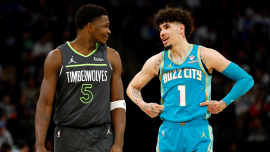
For Gobert to thrive as a roller, you need a bunch of shooters around him to open the runway. The Wolves now have Edwards, Ball, McDaniels, Donte DiVincenzo (when he returns from injury) and the recently re-signed Ayo Dosunmu to provide proper spacing, which was sometimes a problem when Randle shared the court with Gobert. Terrence Shannon Jr. could be in for a big leap with all the opportunities he should have to get downhill after Ball has put a defense into a scramble drill.
Most importantly, the Wolves -- with Gobert anchoring the paint while Edwards and McDaniels lead the perimeter charge -- have the defensive infrastructure to not only insulate Ball, but hopefully inspire him to use his size and instincts to become the best defensive version of himself.
Why this was a necessary move for Minnesota
In a best-case scenario, Ball clearly raises the ceiling that the Wolves knew they had run up against. They are more explosive than they were yesterday. And certainly, if nothing else, more fun. It's not a sure-thing move by any stretch, but it's one the Wolves had to make. Given their limited assets after draining so much on Gobert, Ball was about as good a player with about as much upside as they could've hoped to get.
For years, Ball has been saddled with the "good stats, bad team" label. But last season, his sixth in Charlotte, the Hornets were a legitimately good team (one of the best over the second half, in fact). They were 10 points better per 100 possessions with Ball on the floor, per Cleaning the Glass, and he led a starting lineup that consistently destroyed its opponents. The year before, the Hornets were 9.5 points better per 100 possessions with Ball on the floor. And in the two years before that, they were better with him on than off.
He's a far more positive player than his playground reputation suggests, and that trend has been solidified recently. But doing it in Charlotte, where a highly successful season would've been just making the playoffs (the Hornets have an NBA-worst 10-year playoff drought), and doing it for a Wolves team that is bringing you in to compete for and win a championship is two very different things.
It's a huge bet by the Wolves, and a huge opportunity for Ball to prove he can use his considerable abilities to do more than just put on a good show, that he can lead a winner.
In Charlotte, he always had the excuse of limited talent around him. Not anymore. The Wolves are serious, and Ball better be ready to perform accordingly.
Add CBS Sports on Google Join the Conversation comments