
 Image source, Getty ImagesImage caption,
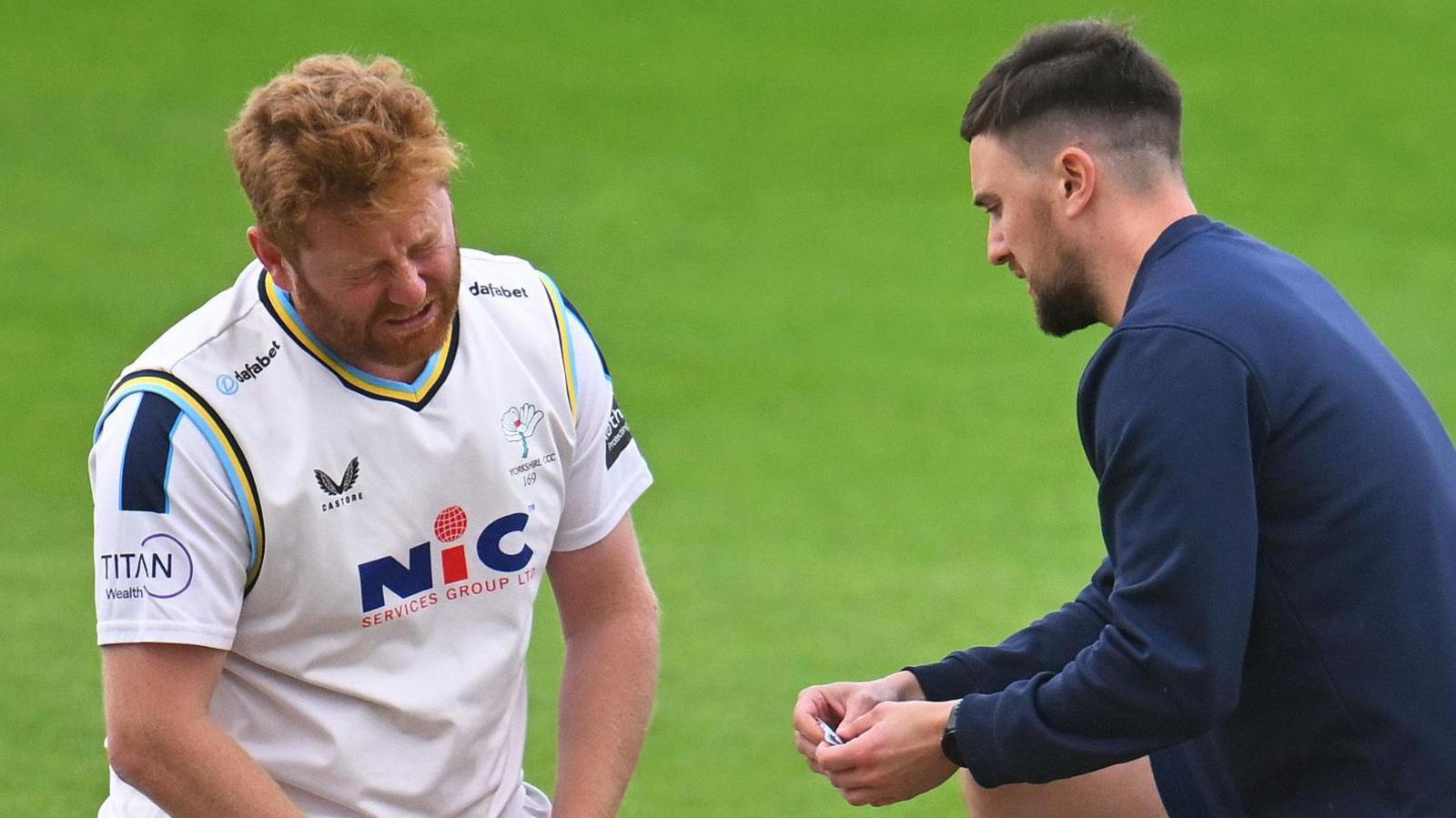
 Jonny Bairstow is among the players to have been replaced this season
ByMatthew HenryBBC Sport Journalist- Published47 minutes ago
- 20 Comments
After only two rounds of matches, the use of substitutes in county cricket is already causing plenty of debate.
Nottinghamshire coach Peter Moores is one of those to have benefited from the change, but admits the laws need "tightening".
Glamorgan captain Kiran Carlson rued the impact on his side - Notts brought in all-rounder Lyndon James for injured seamer Fergus O'Neill on the final morning and he took two wickets in a 192-run win - but says he would have done the same as his opponents.
"A guy who hadn't played cricket for three days to then come in and bowl, obviously that's an advantage," Carlson said.
"The thinking behind bringing in the rule is sound, but I think it has to be ironed out in terms of the way it does get done."
How have we got here and what change might be needed?
What has happened so far?
The trial follows similar experiments in domestic cricket in India, Australia and South Africa after the International Cricket Council asked members to test the use of fully participating substitutes with a view to an introduction in Tests, something previously only allowed for concussion and Covid-19.
The England and Wales Cricket Board (ECB) has taken the trial a step further than those countries by allowing replacements for "significant life events", such as bereavements or the birth of a child, as well as injury and illness.
Replacements can come into the match at any point from after the first ball to before the last.
In the case of injuries, replacements must be signed off by the match referee in conjunction with the club medical staff. Replacements for life events - not used so far - have to be agreed by the county chief executives of the two teams.
The ECB anticipated there would be injury replacements in about 25% of matches, and there have been instances in five of 18 matches so far (28%), although in three of those matches the rule was used twice.
In total there have been nine replacements in 18 matches, including Worcestershire's Adam Finch, whose absence through concussion would have been allowed under the previous regulations.
What are the complaints?
Most complaints have been around the strictness of the rules, rather than the principle itself or specific cases.
Somerset coach Jason Kerr said Tom Kohler-Cadmore was unable to hold a bat and Lewis Goldsworthy had a severe hamstring tear after their injuries last weekend; Moores said O'Neill was unable to bowl on the final day against Glamorgan but was already down on pace the previous day; and Yorkshire coach Anthony McGrath said Jhye Richardson and Jack White had food poisoning - all seemingly valid cases.
The ECB has implemented more relaxed restrictions than other nations, however.
It wants to keep the quality of cricket high by not having players with serious injuries struggling through matches - as seen with England's Chris Woakes in the fifth Test against India last summer.
In Australia the 'stand-down period' – the period a replaced player is then unavailable for – during the most recent season was 12 days, but in the UK it is only eight.
There is also no stand-down period for players whose team do not play in the next round of fixtures – as is the case with Nottinghamshire, Glamorgan and Yorkshire this week – or for the final round in a season.
The Australian laws also only allowed one substitute per match and ruled that any change had to be made before the end of day two, thus reducing the advantage of a fresh player coming into a four-day match late on.
When explaining the rules last month, ECB head of cricket operations Alan Fordham said the governing body would be relying on the co-operation of the counties in not pushing the rules to gain an advantage.
"If teams are going to start pushing at the edges of the regulation then it risks the chance we will have to backpedal," he said.
The possible tweaks - what has been said?
Former England wicketkeeper Sam Billings, who is currently playing in the Pakistan Super League, has been the most stinging in his criticism, calling the law "ridiculous".
Glamorgan's Carlson said his complaints were "no slight on Notts whatsoever".
Former England coach Moores said he expects the laws will be refined at the end of the season, agreeing that players coming into a match late is an issue.
"There will need to be some tweaks to make sure it is tight," Moores said.
"To have two in this game, we want to make sure that it doesn't become a focus for the season when we want it to be on the cricket.
"There is a case for a tightening what point in the game can it be done."
Kerr said: "If someone is genuinely injured and they can't do the job they are selected to do, it is a good thing.
"You could find ways to manipulate the system and use it to your advantage, and that does concern me. I won't be doing that."
Kerr said replacements for illness or soft issues injuries may need to be "tweaked".
"I can think of games last year where we didn't select players because their partner was expecting," he said.
"It means they missed the game and there were times the baby didn't arrive.
"If you can mitigate that and replace them, that looks like a win-win that is common sense - similar from a bereavement point of view."
Related topics
Get cricket news sent straight to your phone
- Published16 August 2025