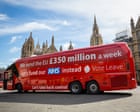
 Vote Leave was reprimanded by the UK Statistics Authority in 2016 for its claim that Britain’s EU membership cost £350m a week. Photograph: Jack Taylor/Getty ImagesVote Leave was reprimanded by the UK Statistics Authority in 2016 for its claim that Britain’s EU membership cost £350m a week. Photograph: Jack Taylor/Getty ImagesExplainerIs £750m a week the real cost of rejoining the EU – or the Brexit bus myth all over again?
A new analysis from some of the architects of the Vote Leave campaign is very selective with its figures
A new analysis from some of the architects of the Vote Leave campaign has claimed rejoining the EU would cost Britain £750m a week. How did they arrive at these figures – and are they any more reliable than the ones on the side of the bus?
What is behind Stay Out’s claim that rejoining the EU would cost '£750m a week'?
Stay Out calculates that it would cost £750m a week to rejoin the EU (rounded down from £756m).
The campaign group has based its analysis on the European Commission’s proposed long-term EU budget, worth €2tn (£1.66tn) over 2028-34. The group assumes that Britain rejoining the EU would increase the budget and the UK would make a contribution commensurate with its size and wealth.
The £750m is a gross figure, excluding funds that would return to Britain, such as farm subsidy payments and scientific grants.
It follows the method of Vote Leave, which was reprimanded by the UK Statistics Authority in 2016 for its “misleading” claim that Britain’s EU membership cost £350m a week. That statistic, emblazoned on the side of a campaign bus, did not count the British rebate or EU funds that flowed to the UK.
Stay Out’s headline statistic could be seen as repeating the same trick. While its workings document states the £750m is a gross figure, that is not made clear in a campaign video likely to have far greater reach. “£750m a week: that is what the EU will charge us to rejoin” claims the video, replete with portentous music and images of streets on fire.
What does it miss out?
Like the Vote Leave campaign, Stay Out emphasises the costs of payments to the EU budget, overlooking the wider economic impact of better trading links with Britain’s biggest trading partner.
John Springford, of the Centre for European Reform (CER), finds the Stay Out figure “misleading” because of its focus on the UK’s potential gross contribution to the EU budget, overlooking returns from EU funds but also the broad economic losses associated with Brexit or potential gains of rejoining.
According to his calculations, based on two different studies on the cost of Brexit, the cost of the UK being outside the EU in lost national income adds up to between £3bn to £3.5bn a week, with an additional loss of £1bn-£1.3bn in tax revenue that could have been earned on that lost economic activity.
But is £750m correct on its own terms?
It is impossible to give a definitive answer, but the figure looks too high. It is based on a number of assumptions: the fair, the bad and the highly questionable.
It assumes that the British rebate – the reduction on membership fees negotiated by Margaret Thatcher in 1984 – is not coming back. That is a fair assumption, as senior EU officials, including most recently the former Brexit negotiator Michel Barnier, have made this point – although some net payers, such as Germany and the Netherlands, still get a rebate, highlighting the complexity of EU budget realities.
Other assumptions that underpin the Stay Out calculation are more doubtful. The EU long-term budget 2028-34 is still being negotiated and the final version will almost certainly be lower than the commission’s maximalist €2tn proposal. EU countries are debating a €1.62tn compromise devised by Ireland, the current holder of the EU rotating presidency, although this has not been accepted.
One of Stay Out’s more questionable assumptions is that the UK would be obliged to repay the EU’s pandemic recovery loans, which will cost €24bn a year from 2028 – EU borrowing that happened after the UK had left the EU. The Brexit negotiations set a useful precedent for any British government seeking to return to the EU: a government was liable for costs and benefits incurred as a member state. While any negotiation would be unpredictable, any British negotiating team would surely challenge being asked to fund costs incurred during its absence.
Are there other estimates of rejoining?
Economists have been more preoccupied with counting the cost of Brexit than the gains of rejoining the EU.
The Office for Budget Responsibility, the UK’s independent fiscal watchdog, calculated that the British economy would be 4% less productive in the long run because of Brexit. Springford at the CER devised a doppelganger model, which compared British economic performance with a counterfactual British-style economy inside the EU, and found a 5.5% reduction in GDP. The National Bureau of Economic Research concluded Brexit had resulted in a 6-8% hit to GDP by 2025.
Rejoining the EU does not mean an automatic snapback to 2016 or even 2020. Some UK production that served the EU market may have gone permanently. Investors may remain nervous about any British commitment to staying in the EU.
Springford thinks it is plausible that the UK will not recoup all the loss of Brexit, but points out overall losses are high and far exceed the cost of the UK contribution to the EU budget. Focusing on the gross contribution, he told the Guardian, while “deliberately and completely ignoring” the costs of Brexit and gains of rejoining, “means that you completely miss out on the broad economic gains that would come from rejoining and also the increases in tax revenues which would be substantially larger than the net contribution that the UK would make to the EU”.
Explore more on these topicsShareReuse this content