
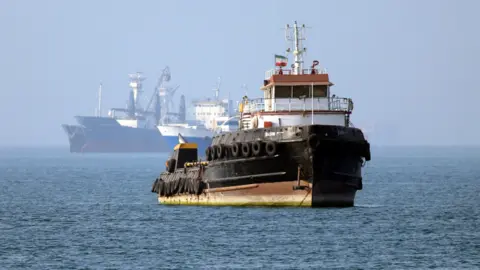
 AFP via Getty ImagesTraffic through the Strait of Hormuz, a vital route for oil and gas, has largely stopped
Iran has warned its Gulf neighbours that complying with US sanctions would lead to their ships face difficulties crossing the Strait of Hormuz.
Military spokesman Mohammad Akraminia said vessels passing through the vital trade route would face "severe consequences" if they did not co-operate with Tehran first, Iran's state-run news agency IRNA reported.
Meanwhile, a commercial vessel has been hit by an unknown projectile off the coast of Qatar, and both the United Arab Emirates and Kuwait have reported foiled drone attacks.
The incidents come two days after a clash between Iran and US naval destroyers trying to enforce a blockade of Iranian ports.
US President Donald Trump has insisted a ceasefire reached last month remained in place, while Iran says is considering a White House proposal to end the war.
Akraminia said in his warning to regional states on Sunday: "The Americans will never be able to turn this vast expanse in the northern Indian Ocean into a real blockade by covering it with their fleet."
He added: "Our maritime trade continues to flow smoothly."
Earlier, the UK's Maritime Trade Operations Centre (UKMTO) - which monitors international shipping routes - said a bulk carrier had been "hit by an unknown projectile" about 23 nautical miles (43km) north-east of Doha in Qatar, causing a small fire but no casualties.
Iran's Fars news agency later cited an unidentified source as saying that vessel had been "sailing under the US flag and belonged to the United States".
Also on Sunday, Kuwait said drones had entered its airspace and that the military had "dealt with them".
Hours later, the UAE said its air defences had intercepted two drones coming from Iran.
The US has a significant military presence across the Gulf, with bases in Qatar, Bahrain, Kuwait, the UAE, Saudi Arabia and Oman.
In Friday's incidents, the US said Iran had launched missiles, drones and small boats against three of its warships, in what it called an "unprovoked attack".
Iran's top military command, meanwhile, alleged the US had targeted an Iranian oil tanker and another vessel approaching the Strait of Hormuz and carried out "aerial attacks" on several coastal areas.
Tehran has leveraged its effective control over the waterway - through which around a fifth of the world's oil and natural gas usually flows - in the war, which began with US and Israeli strikes on 28 February.
Both the US and Iran have attempted to implement rival blockades in the strait, as negotiations on ending the conflict have so far failed to reach a resolution.
As well as blockading Iranian ports, the US has told other nations not to pay a toll imposed by Iran for safe passage through the strait.
Defence ministers from more than 40 nations will meet on Monday to discuss UK-led plans to protect shipping in the strait.
John Healey and his French counterpart Catherine Vautrin will co-chair the meeting, where the coalition partners are expected to outline how they might police maritime traffic once hostilities cease.
Trump wrote in a Truth Social post on 6 May that if Iran did not agree to a deal, "the bombing starts, and it will be, sadly, at a much higher level and intensity than it was before".
But despite the recent rise in tensions, he has sounded positive about the prospects of peace. He told a French reporter on Saturday that he "expects to hear very soon" from the Iranians.
Last week, the Iranian foreign ministry said the latest US proposal was being considered and that Tehran would share its views with Pakistani mediators.
Iran's nuclear programme has been one of the key sticking points between the two sides.