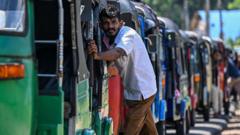

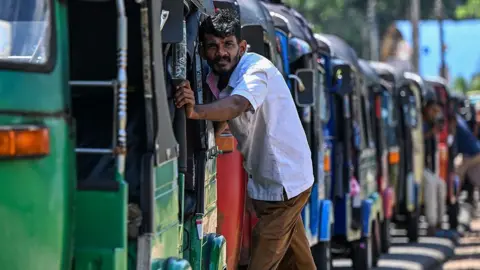
 AFP via Getty ImagesThe Iran war has pushed prices up and caused long queues for fuel in Sri Lanka
After floods devastated their village, Indrani Ravichandran and her family are back in their house, living in the only section that is still standing.
They are among the many victims of Cyclone Ditwah that ravaged the country last November.
The scale of the storm - and the destruction it wreaked - was unprecedented.
Over just three days, parts of Sri Lanka's central uplands saw up to 500mm of rain - roughly the average of two months - causing catastrophic floods and landslides that swept away homes, businesses and entire settlements.
The human cost was devastating – 643 people were killed and another 173 went missing.
Indrani describes how she and her family ran for their lives in the dark as raging flood waters swept away parts of her home in Kudugalhena village in Kandy district.
"The water level rose swiftly. We rushed out and hardly had any time to pick up anything from the house.
"It was pitch dark and the rain was lashing down, the slopes were slippery and we were also terrified of treading on any poisonous animals as we ran. But we were lucky to survive."
"It was the first time in 30 years we witnessed such ferocious floods," Indrani's husband Ravichandran added.
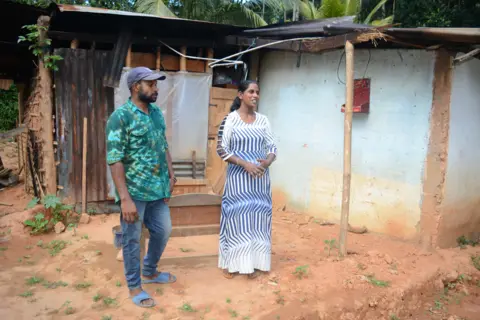 BBC/ Ranjan Arun PrasadIndrani and Ravichandran were lucky to escape - now they're back in what's left of their house
The floods are reported to have caused more destruction in Sri Lanka than the 2004 tsunami, one of the deadliest natural disasters in recorded history.
"Compared to the 2004 tsunami, the loss of human lives was not that much. But in terms of damage to infrastructure, Ditwah caused even more harm than the tsunami," Dr Ganeshan Wignaraja, a visiting senior fellow at ODI Global Institute in London, told the BBC.
'A triple shock'
The US and Israel's war against Iran - and its impact on the global economy - could not have come at a worse time for Sri Lanka, which is already reeling from these devastating floods and an unprecedented economic crisis from 2022.
This picturesque South Asian island, once celebrated for its economic development and high ratings on human development indices, has found itself in dire straits once again.
"It's a triple shock. First, the devastating floods late last year, now soaring fuel prices and then there's an impending drought in some areas," Wignaraja said.
In the last few weeks alone, the government has had to ration fuel and raise prices, introduce a four-day working week, increase electricity costs by up to 40% and impose water and power cuts to compensate for dwindling resources.
Fuel and cooking gas shortages have resulted in panic buying across the country, raising memories from 2022 when it ran out of foreign currency and defaulted on its foreign debt, leading to shortages of essential items like cooking gas, medicine and food items as well as crippling power cuts of up to 13 hours.
The resulting widespread protests led to then president Gotabaya Rajapaksa being ousted.
Now, concerns have grown that the country may not be able to stave off another economic crisis.
The cash-strapped Sri Lankan government had taken a number of measures to try to get the economy back on track, including removing subsidies on electricity and hiking income tax rates to as much as 36%.
Things seemed to be getting better - until Ditwah struck.
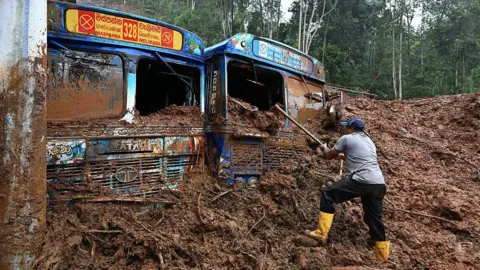 AFP via Getty ImagesCyclone Ditwah swept away houses and entombed vehicles in metres of mud
The World Bank said the cyclone, among the most intense and destructive in Sri Lanka's recent history, severely affected close to two million people and 500,000 families across all 25 districts, disrupting livelihoods, essential services and the broader economy.
The UN and other agencies estimate the total damage at around $4bn – equivalent to 4% of Sri Lanka's GDP.
President Anura Kumara Dissanayake called it the country's worst-ever economic disaster. Soon after the calamity, he announced wide-ranging financial help to those who had lost their loved ones, properties and businesses.
Indrani's family said they had received the government's promised 50,000 rupees ($325; £240) help to carry out repairs in a part of the house that's still standing. They were also given additional financial help for those with young children.
The government also promised to provide up to five million rupees for homes that were completely destroyed. It has also announced about a million rupees for the families of those killed.
However, months after the cyclone, more than 165,000 people still remain displaced, living with their relatives, host families or in temporary shelters waiting for the government to provide alternative housing and livelihoods.
And now the strain on the economy brought about by the Iran war has made their prospects even bleaker.
'Friend across the sea'
The government has altogether received barely a fifth of the funds it needs for reconstruction and rehabilitation – around $750m in total.
Although the cyclone's devastation surpassed the impact of the 2004 tsunami, international assistance was not immediately forthcoming. In 2004, horrified at the disaster, donors pledged billions of dollars of aid. But this time the response was muted.
Sri Lanka's closest neighbour India was the only country that responded immediately. It launched a rapid humanitarian assistance and relief mission named Operation Sagar Bandhu, translating from Hindi as "friend across the sea".
It deployed two warships, including an aircraft carrier, for relief operations. Indian air force helicopters flew several sorties rescuing hundreds of people, including foreign nationals.
Indian rescue teams set up field hospitals, helped to restore essential infrastructure, and delivered more than 1,000 tonnes of critical supplies. It also provided $450m in grants and aid to Sri Lanka - making it by far the largest contributor.
In contrast China, one of Sri Lanka's major investors and a long-standing ally, offered only minimal support, providing less than $2m in aid and around 100 tonnes of supplies.
In January, the Sri Lankan government formally requested Beijing to help rebuild key infrastructure damaged by Cyclone Ditwah.
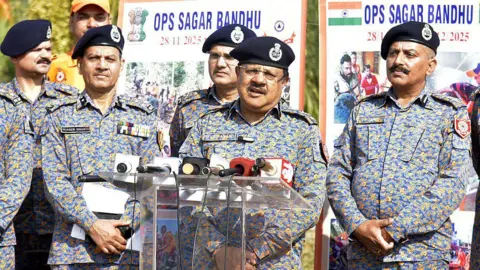 AFP via Getty ImagesIndia's disaster response force was quick to respond to Sri Lanka's floods
The Sri Lankan government says it has provided relief to most residents whose houses were partially damaged, enabling them to carry out repairs.
However, it acknowledges delays in compensating families who lost their entire homes or businesses in the cyclone.
"We are in the process of identifying suitable and safe land to build new houses. Once the areas are identified, the government will provide the aid," said KG Dharmathilake, a senior official in the disaster management division.
Officials argue that rather than rushing through relief efforts, the priority is to "build back better" so that new homes and businesses are resilient enough to withstand future disasters.
Responding to criticism over delays in providing financial assistance to those affected, Dharmathilake insisted that more than 80% of affected residents had already received financial help to repair damaged houses.
Sri Lanka's current foreign reserves stand at around $7bn. Economists like Wignaraja say the government should just about be able to tide over the flood crisis and the fuel price hike with effective fiscal management.
"But they will be in difficulty if the fallout of the Middle East crisis continues for a while," he says.
With the financial situation already strained, the government is also worried that they will lose foreign exchange inflows due to the Gulf war.
Sri Lanka last year received about $7bn in remittances from workers abroad – mainly from Gulf countries. Though there haven't been any massive layoffs in those countries yet, there are concerns over new employment opportunities for Sri Lankans.
How the government confronts the enormous reconstruction work and the economic challenges due to the Gulf war may ultimately become the defining test of President Dissanayake's leadership.
Additional reporting by Ranjan Arun Prasad, BBC Tamil Service in Kandy
AsiaIran warSri Lanka