 ‘You push people back into poverty. That’s the most heartbreaking element,’ said the administrator of the UNDP. Photograph: Anton Alexander/The Guardian‘You push people back into poverty. That’s the most heartbreaking element,’ said the administrator of the UNDP. Photograph: Anton Alexander/The GuardianIran war could plunge 32 million into poverty, says United Nations
‘Development in reverse’ taking place involving rising energy and food costs and weaker economic growth
More than 32 million people worldwide could be plunged into poverty by the economic fallout from the Iran war, with developing countries expected to be hit hardest.
In a report issued amid doubts over a fragile ceasefire, the United Nations Development Programme (UNDP) said the world was facing a “triple shock” involving energy, food and weaker economic growth.
The agency tasked with tackling poverty said the conflict was reversing gains in international development, with the impact expected be felt unevenly across regions.
Alexander De Croo, administrator of the UNDP and former prime minister of Belgium, said: “A conflict like this is development in reverse. Even if the war stops, and a ceasefire is obviously very very welcome. But the impact is already there.
“You will see an enduring impact, especially in the poorer countries, where you push people back into poverty. That’s the most heartbreaking element. The people being pushed into poverty are very often the people who used to be in poverty, got out of it, and are now being pushed back.”
Energy prices have surged in the six weeks since the first US-Israeli airstrikes on Tehran, as Iran’s closure of the strait of Hormuz chokes oil and gas supplies to the world economy. With a knock-on impact on fertiliser supplies and global shipping, experts warn that a “food security timebomb” has been set for the developing world.
Even if a durable peace in the Middle East can be sustained, the head of the International Monetary Fund has said the “scarring effects” from the conflict have permanently damaged the global economy.
Publishing its report as world leaders gather in Washington for the IMF’s spring meetings, the UNDP said a global response was required to support countries hardest hit by the economic fallout.
It said targeted and temporary cash transfers were needed to protect the most vulnerable households in developing nations, at a cost of about $6bn to neutralise the shocks for those falling below the poverty line.
De Croo said international agencies and development banks could provide the financial support. “There is a positive economic payout for giving short-term cash transfers to avoid people getting back into poverty,” he said. Second-best interventions could include temporary subsidies or vouchers for electricity or cooking gas.
However, the UNDP warned against blanket subsidies because they would unnecessarily support wealthier households, and would be financially unsustainable over time.
Setting out three scenarios for the war, it found that in the worst-case – involving six weeks of major disruption to oil and gas production and eight months of lingering higher costs – as many as 32.5 million people globally would fall into poverty.
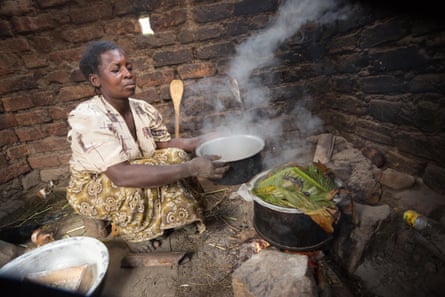 A woman cooks food in Kasese district, Uganda, east Africa. Photograph: Jake Lyell/Alamy
The report used the upper-middle-income poverty line, an international standard calculated by the World Bank, which is defined as income below $8.30 per person per day.
Half of the global poverty increase would be concentrated in the group of 37 net energy-importing countries: in the Gulf region, Africa, Asia and small island developing states.
The UNDP said that while rich countries were in a stronger position to cushion the economic fallout from the war, nations in the global south had a weaker starting position and already had severe financial constraints.
The news comes as western governments, including the US, Germany, France and the UK, cut their aid spending amid elevated borrowing and debt levels across advanced economies and a clamour to increase defence spending.
Figures from the Organisation for Economic Co-operation and Development, published last week, showed countries in its development assistance committee cut aid spending by $174.3bn in 2025, almost a quarter lower than 2024’s figure.
De Croo said that he understood the pressures facing rich countries but that aid cuts would have longer-term negative consequences. “Investments in development, to say it in military terms, they are the ultimate pre-emptive strike. Why you do a pre-emptive strike? You do it to avoid a conflict starting. That is what development does,” he said.
“If you invest in poverty reduction, in strong institutions, in mitigating and adapting to climate change; these are elements that will help you to stabilise the world.”
Explore more on these topics- Poverty
- United Nations
- International Monetary Fund (IMF)
- Economics
- Access to energy
- US-Israel war on Iran
- Inequality
- news