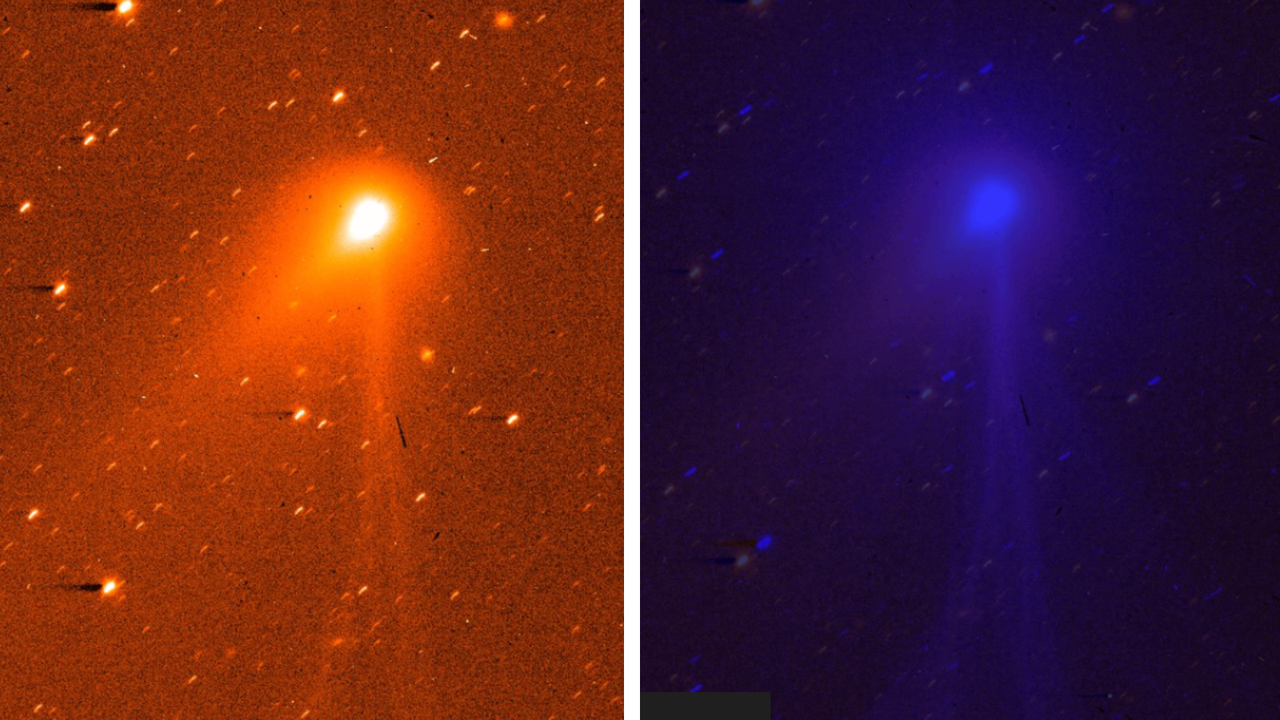
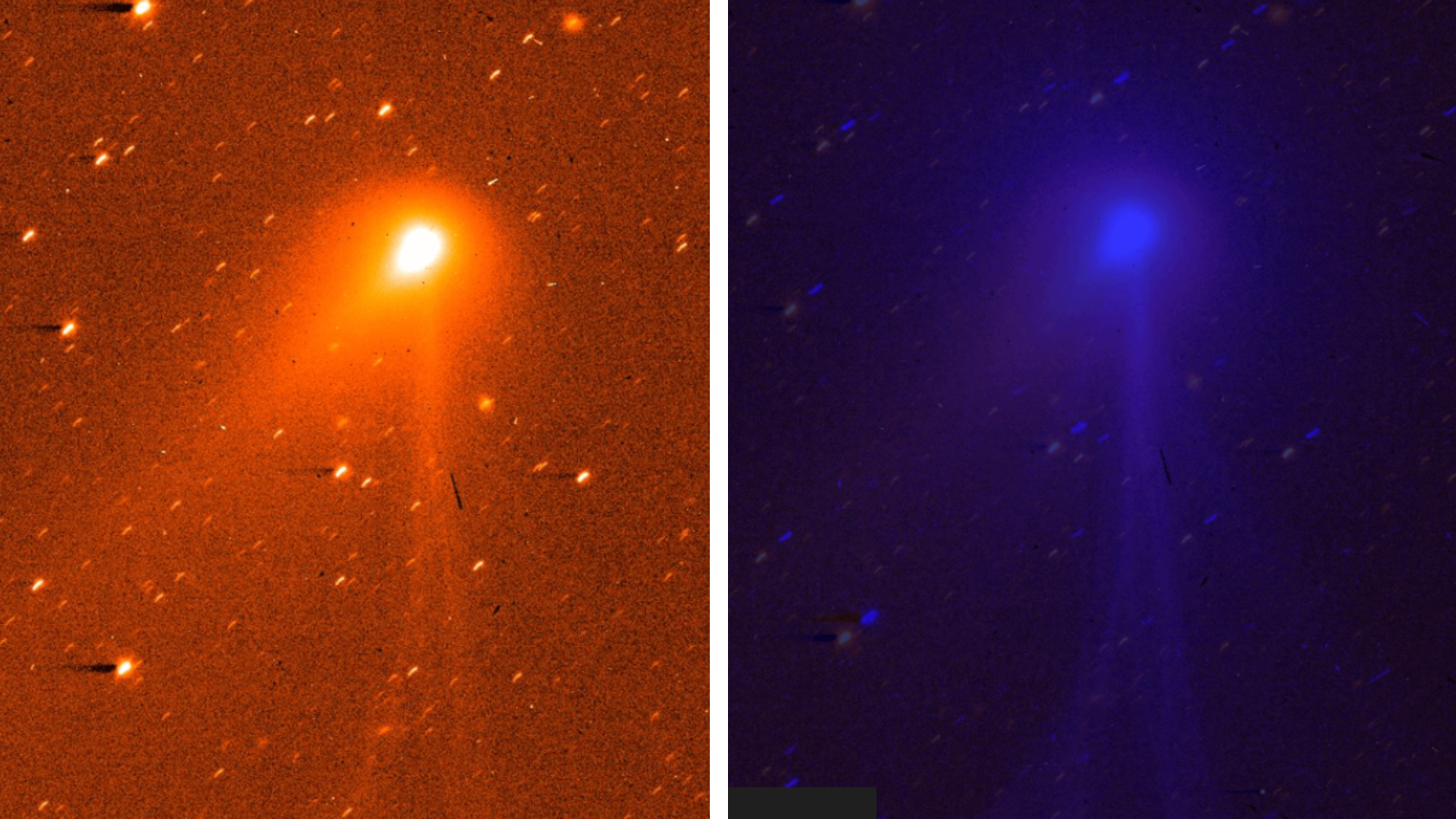
 (Image credit: ESA/Juice/MAJIS) Share this article 0 Join the conversation Follow us Add us as a preferred source on Google Newsletter Get the Space.com Newsletter
 Breaking space news, the latest updates on rocket launches, skywatching events and more!
Contact me with news and offers from other Future brands Receive email from us on behalf of our trusted partners or sponsors By submitting your information you agree to the Terms & Conditions and Privacy Policy and are aged 16 or over.You are now subscribed
Your newsletter sign-up was successful
Want to add more newsletters?
An account already exists for this email address, please log in. Subscribe to our newsletterThe interstellar invader comet 3I/ATLAS is spraying enough water into space to fill 70 Olympic swimming pools each day. The discovery gives scientists a remarkable opportunity to study the elements present during the formation of planets around other stars, potentially much older than the sun. The discovery was made by the European Space Agency (ESA) mission Jupiter Icy Moons Explorer (Juice), which is currently heading towards Jupiter and its icy moons. JUICE observed 3I/ATLAS, which is just the third object found passing through the solar system from beyond its boundaries, in November, 2025, using its MAJIS (Moons And Jupiter Imaging Spectrometer) and JANUS (Jovis, Amorum ac Natorum Undique Scrutator) instruments. Like comets native to the solar system, 3I/ATLAS began expelling material when it passed close to the sun, with solar radiation heating its icy heart, causing solid ice to transform immediately into gas, a process called sublimation. As this gas makes its explosive escape, it forms the coma and tail that are characteristic of comets. This is accompanied by a brightening of the comet, but 3I/ATLAS brightened even more than expected.
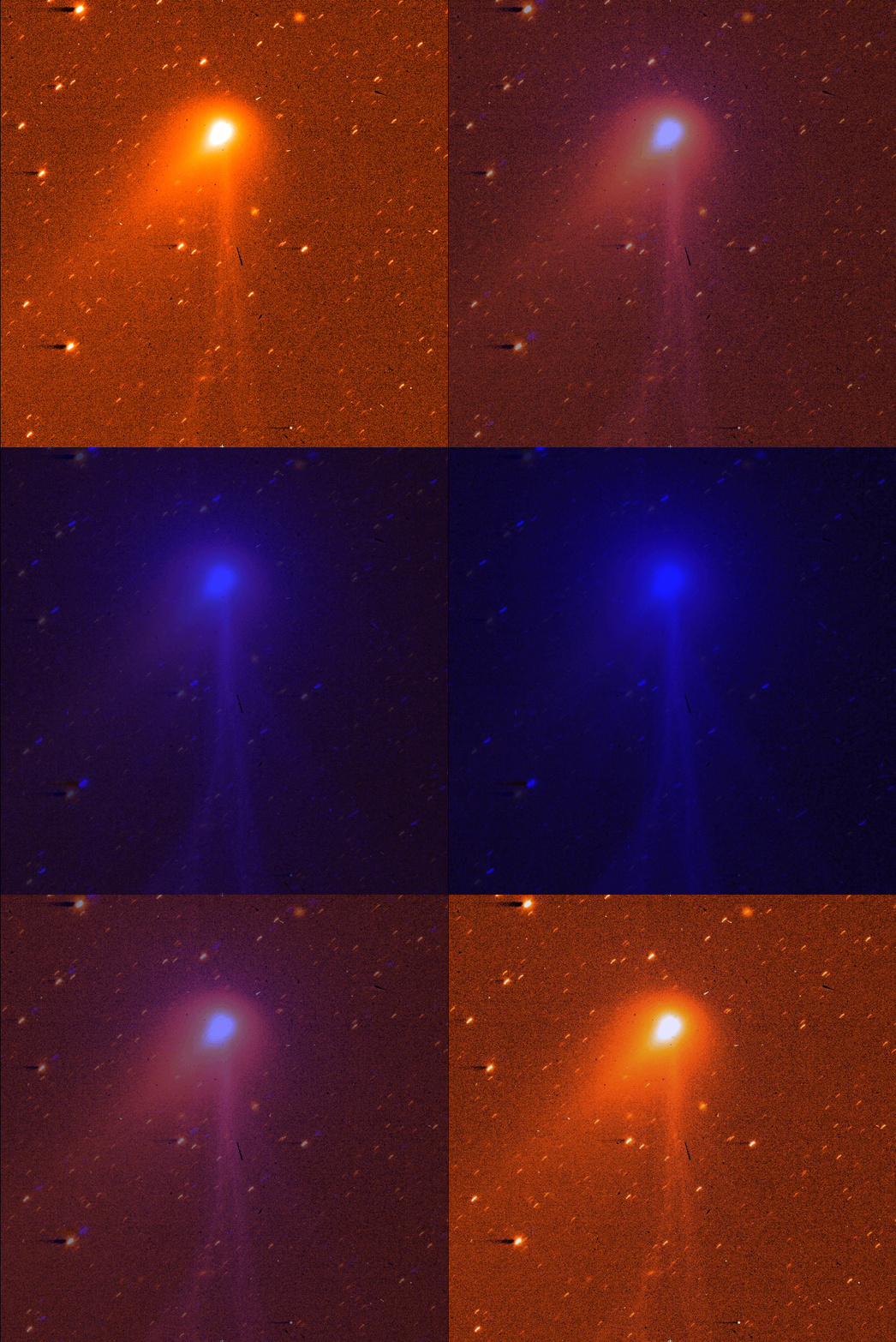
The JUICE observations of 3I/ATLAS were more extraordinary because they were unplanned, only occurring to the team after the discovery of 3I/ATLAS on July 1, 2025. The observations were challenging due to the short periods of time JUICE had to spot 3I/ATLAS and how faint the interstellar comet's emissions were. These observations were followed by a prolonged wait, with the data only reaching Earth in February 2026. "We waited a long time, but it was truly worth it," team member Pasquale Palumbo, an INAF researcher and principal investigator of JANUS, said. "The wonderful images collected reveal for the first time the comet's intense activity right around perihelion. 3I/ATLAS showed an extended coma, a tail, and various morphological structures, such as rays, jets, and filaments. The data collected will allow us to study the morphological structures, light intensity, and evolution of the comet's coma and tail on short and medium timescales. "We are very pleased with the performance JANUS has provided us; it is an excellent preview of what it will be able to do when it operates around Jupiter and its icy moons, the final destination of the JUICE mission."
Get the Space.com NewsletterContact me with news and offers from other Future brandsReceive email from us on behalf of our trusted partners or sponsors Robert LeaSenior Writer
Robert Lea is a science journalist in the U.K. whose articles have been published in Physics World, New Scientist, Astronomy Magazine, All About Space, Newsweek and ZME Science. He also writes about science communication for Elsevier and the European Journal of Physics. Rob holds a bachelor of science degree in physics and astronomy from the U.K.’s Open University. Follow him on Twitter @sciencef1rst.
View MoreYou must confirm your public display name before commenting
Please logout and then login again, you will then be prompted to enter your display name.
Logout MORE FROM SPACE... 1Go behind the scenes of NASA's Artemis 2 moon mission with NOVA's 'Return to the Moon' documentary tonight (interview)
- 2Solar wind travels up to 4 times faster than expected, eclipse spacecraft reveals
- 3See Comet PanSTARRS glow above a false dawn in stunning new photo
- 4A worst-case solar storm could trigger panic buying and public unrest, report warns
- 5SpaceX launches two Starlink satellite groups 19 hours apart


