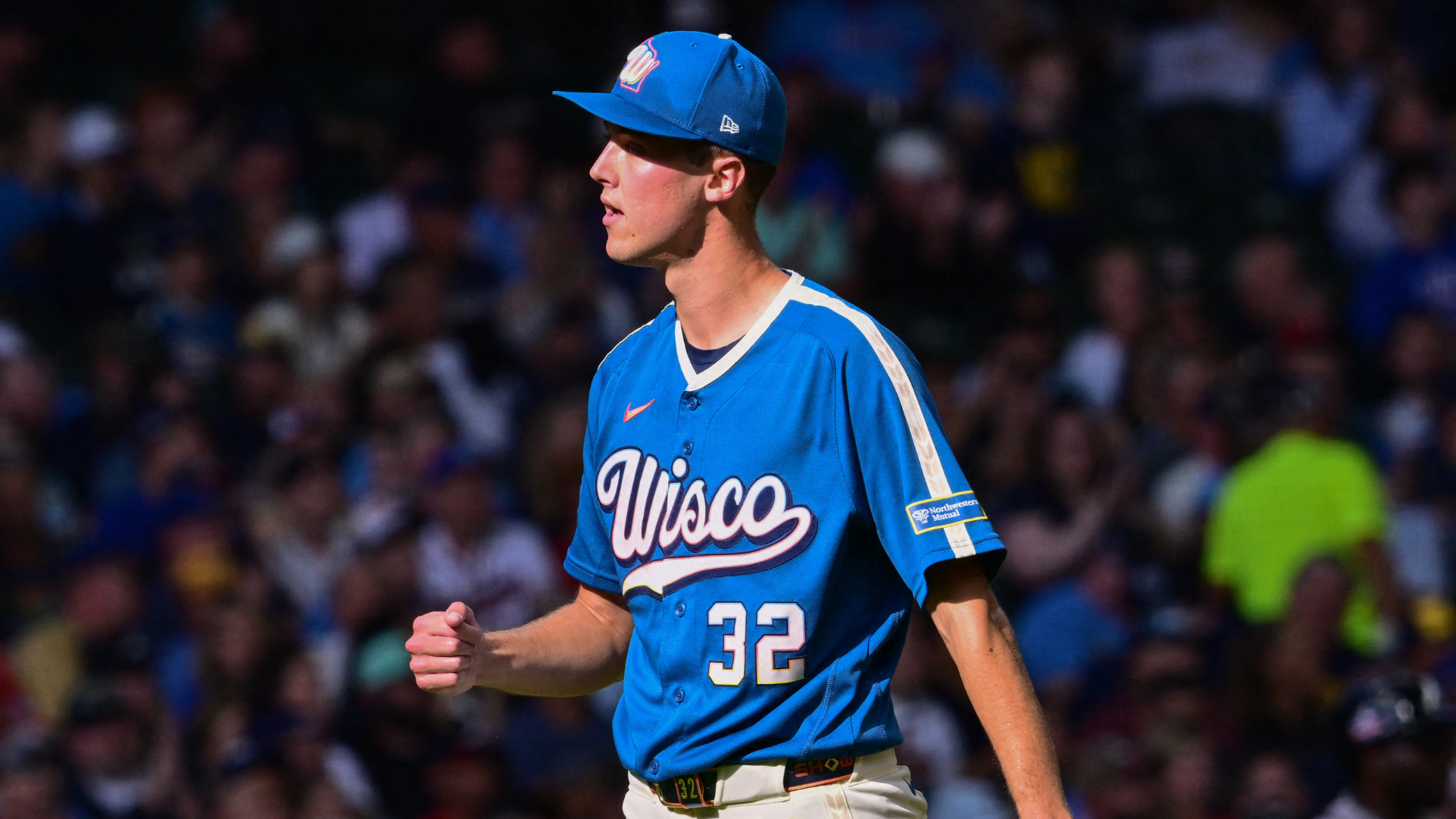
MILWAUKEE – The greatest show on the sand, silt, and clay of the pitcher's mound these days is Milwaukee Brewers right-handed force of nature Jacob Misiorowski. The 24-year-old is not just the best pitcher in the world in 2026, he's also the most viscerally overwhelming pitcher in the world.
Misiorowski on Friday at the Brewers' home yard squared off against Chris Sale, one of the best at his craft and a pitcher some 13 years Misiorowski's senior. It was not only a clash of aces, it was also a duel between two of the best teams in baseball. The 40,130 in attendance -- marking the 16th Milwaukee sell-out of the season (and this one on weekday afternoon) – surely knew it meant a little more than most August games do.
Beyond the importance of the outcome -- Milwaukee won 2-1 -- and what it meant to a Brewers team trying to fend off the Cubs and secure top seed throughout the postseason and a Braves team angling to secure a bye, it was a Misiorowski start. No matter the opponent, that's appointment viewing these days. If you were watching, here's what you saw.
First inning
Working from the first base side of the rubber, Misiorowski opens with a 101.8 mph fastball to greet Braves leadoff hitter Ronald Acuña Jr. It's a ball inside. Misiorowski will go to the fastball with all five pitches that Acuña sees -- all triple digits, and four of them out of the zone. Acuña flicks away the only strike, one on the outside sliver of the zone, and works a walk.
With most starting pitchers, we'd note that they'd now be working from the stretch. Misirowski, though, is unusual among starting pitchers in that he always works from the stretch. Perhaps, with his long levers and maxed-out stuff, keeping it simple is the soundest approach. It's certainly impossible to argue with the results, just as it's impossible to argue with the Brewers' faculties when it comes to pitching development.
On Misiorowski's sixth pitch of the game, he finally departs from the fastball and presents Drake Baldwin with a 98-mph cutter. Two offerings later, he goes to the slider for the first time on Friday. It's not his fully gassed-up slider. He's touched 98 with his slider this season, although when his slide-piece is at those levels, it might be more of a cutter than a true slider. If you call it a true slider, then Misiorowski has thrown 49 of the 50 fastest sliders on record. Is a 98-mph slider more impressive than his occasional 104-mph fastball? It might be, if, of course, it's a slider in the genuine sense and not a cutter or the infelicitously named slutter. We know that his fastball is a fastball, though, so it's fine to direct your amazement there, as you likely already were.
Misiorowski gets his first strikeout of the game on a 101.6 mph fastball that catches the outside edge at Baldwin's expense.
Speaking of the typical purpose of pitching from the stretch -- to hold runners -- preventing the steal is a skill of Misiorowski's that gets overlooked. On that note:
This was a delayed steal on the part of Acuña, so the out was more an instance of poor decision-making running headlong into William Contreras' powerful throwing arm. Contreras is among the game's best when it comes to controlling the running game, but let's note that Misiorowski has allowed only one stolen base this season – the fewest among qualifiers alongside Ryan Weathers.
Not long after, Misiorowski ends the frame with a backfoot slider to Matt Olson that he whiffs on. He throws the slider about three times as often to right-handed batters, but, as Olson will surely attest, he can back-foot it to left-handed batters as a putaway pitch. This one was 91.8 mph, so, yes, it's a true slider.
Second inning
It seems like the merest matter of time before Misiorowski eventually authors a no-hitter, but it won't be today. With two out, Mauricio Dubón lines an 0-2 fastball to right for a single. At 103.1 mph, the pitch is Misiorowski's hastiest of the day and the first pitch we've seen enter what's informally known as "Miz Velo Country."
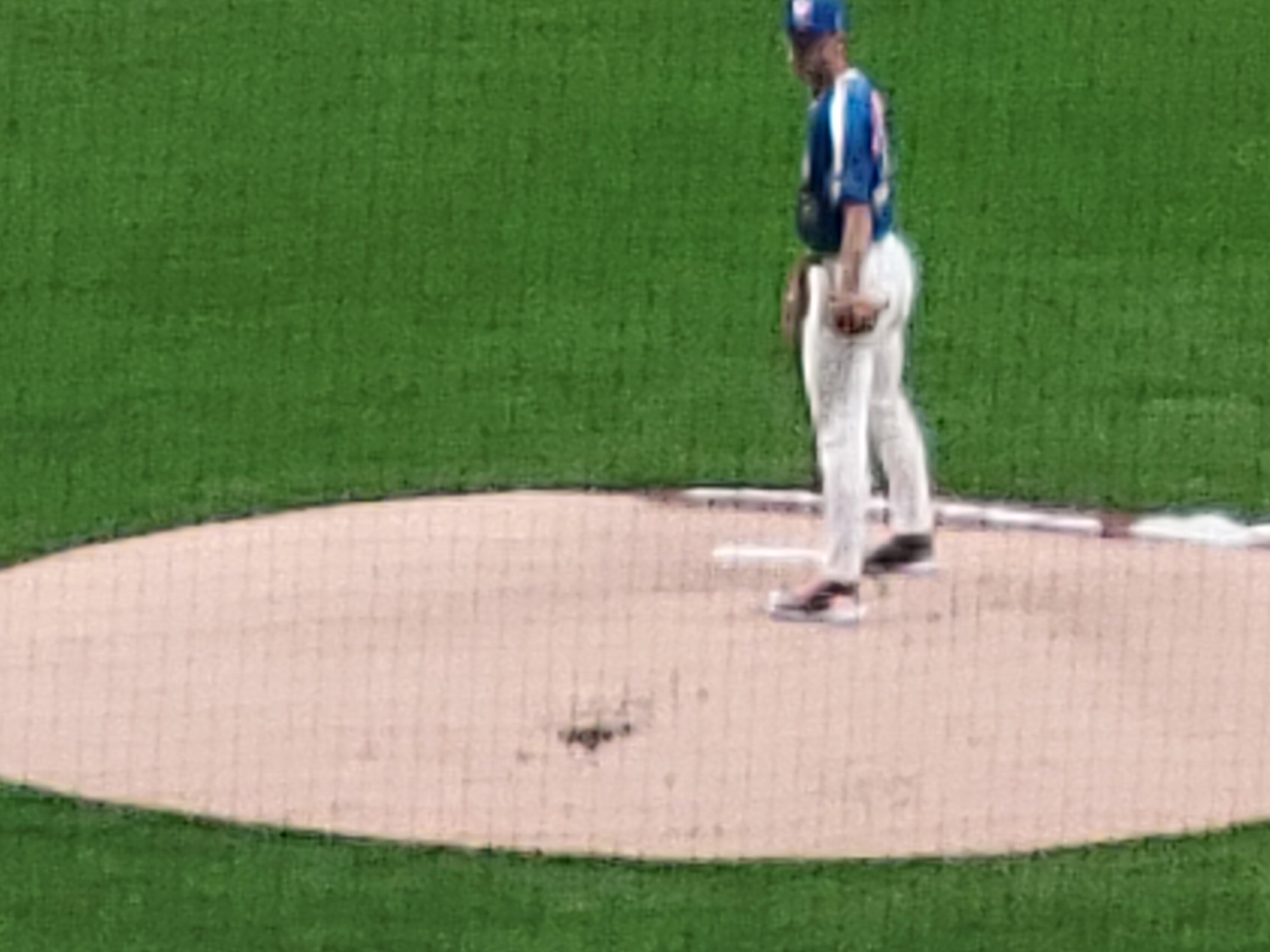
It's not particularly fair to throw that hard as a starting pitcher, and what makes it even less fair from the Misiorowski standpoint is how close to the plate he releases the ball. The 6-foot-7 Misiorowski gets, on average, an absurd 7.6 feet of extension off the rubber and toward the plate. That puts him in the 99th percentile in extension among big league hurlers.
Take a look at Misiorowski's first inning landing spot, as amateurishly captured from the American Family Field press box:
And here's how it looked in the fourth inning after Sale has put his spikes on the mound:
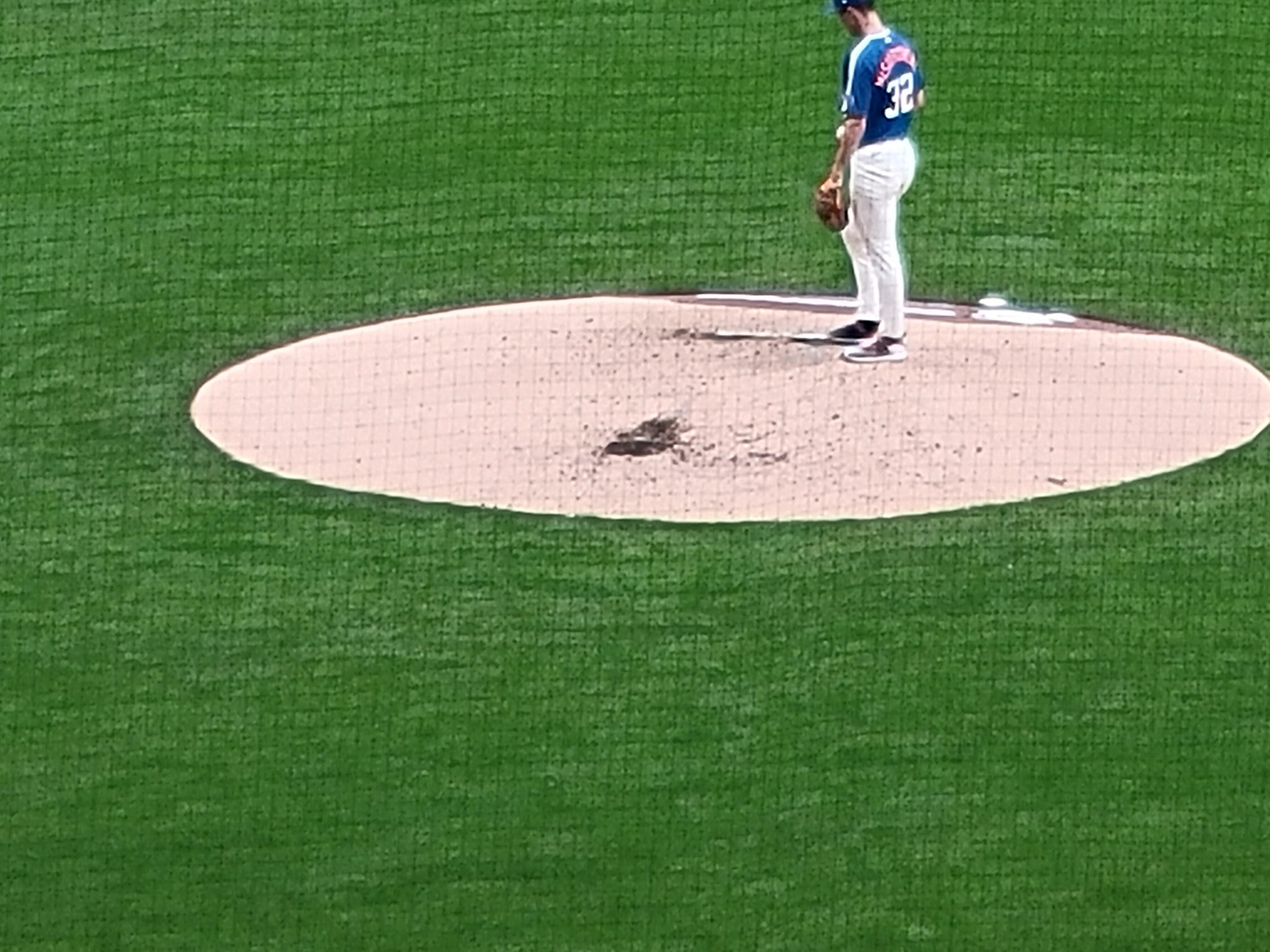
As you can see, the 6-foot-6 Sale had been planting well behind Misirowski. Sale gets his six-and-a-half feet in extension, on average, and that puts him in the 59th percentile, but thanks to his crossfire delivery he doesn't get down the hill as much as Misiorowski does.
That's where the notion of effective velocity comes into play. The hitter obviously has vanishingly little time to react to Misiorowski's fastball, and because he releases the ball so close to the hitter, it's even less time than you might think. Misiorowski this season has averaged 100.6 mph with his fastball, but his average effective velocity -- meaning what the pitch feels like to the hitter -- is 103.1 mph thanks to his elite extension. He has a high leg lift, with the knee basically coming in line with the jersey lettering when he's going into his delivery, and that sets him up to stride deep toward the plate.
When we talk about Miz's fastball, we'll often couch it in terms like "fastest by a starting pitcher" when talking about Aroldis Chapman in historical terms or Mason Miller on the contemporary front. Miller indeed does best Misiorowski on the radar gun, with an average four-seamer of 101.5 mph. In effective velocity, though, Miller comes in at 102.4 mph because he gets less extension than Misiorowski. Miller may throw harder, but most hitters would probably tell you that Miz seems like he throws hardest of all.
He induced a 2-1 fly-out from Dom Smith to strand Dubón and end the inning.
Third inning
The third frame, in which after the first two batters Misiorowski gets into the Atlanta lineup for the second time, sees him take a slider-heavy approach. Of his 11 pitches in the inning, just three are fastballs. He goes to the four-seamer more than 60% of the time overall, which is a point of distinction these days, so this is a brief departure for Misiorowski. Like most teams, the Braves are less effective against breaking stuff than fastballs, and Misiorowski is getting deeper into his secondaries a bit early, since he probably won't go extremely deep into this game even if the zeroes continue to stack up. He's pitching on extra rest, as is custom with him lately, as his workload continues to mount and as the Brewers increasingly operate with a focus on a deep October run.
Misiorowski whiffs Austin Riley on a fastball after feeding him three straight sliders. Against the Braves No. 9 hitter, Mike Yastrzemski, he throws a curve for the first time. The curve is actually Miz's best pitch in terms of whiff rate, but this one lands a bit too middle-in, and Yastrzemski lines it to right for a single. First pitch ground-outs to Acuña and Baldwin end the frame.
Fourth inning
Freshly staked to a 2-0 lead, Misirowski benefits from the first ABS challenge of the day by Contreras, who flips a called ball into a called strike at the top of the zone to put Olson in an 0-1 count. He's back to a fastball-heavy approach in this inning and throws three straight balls to Olson before retiring him on back-to-back swinging strikes at the fastball. With a 2-1 count, Harris stings a 99.7 mph high fastball – it's the first hard-hit ball that Misiorowski has permitted on this day – but center fielder Luis Lara makes a nifty ranging catch to prevent extra bases. The 16-pitch perfect frame ends on an Ozzie Albies fly-out.
Fifth inning
For a pitcher like Misiorowski, who doesn't throw a sinker and leans so heavily on a four-seamer he likes to spot high in the zone, you wouldn't expect strong groundball tendencies. But Misiorowski has a ground-ball percentage of 45.1, which puts him in the 64th percentile among MLB hurlers. This is because his secondaries all get more grounders than you'd expect given their traits and types. The fifth provides a reminder, and Dubón leads off the inning by grounding out to Brice Turang at second on a Miz cutter. The pitch was at the very top of the zone, but because of the late natural sink it dipped under the barrel and registered a -3 degree launch angle.
Another ground ball followed, but this one off the bat of Smith (with a -17 degree launch angle) sneaked into right field for a hit. Facing Riley for the second time, Misiorowski flipped his approach and went fastballs broken up by a slider. He earned a whiff. The Braves brought the potential tying run to the plate when Yastrzemski earned a four-pitch walk -- not a common occurrence for Misiorowski. Yes, his stuff is electricity set on fire, but it's all harnessed and commanded. He's walked just 6% of opposing batters, which is figure that puts him among the league's top control artists (a descriptor that, even so, will never be applied to him). This walk meant Misiorowski would face the perilous Acuña for the third time on Friday in a crucial spot. With a 1-2 count, he fed the former MVP a fastball above the zone followed by a slider at the very bottom of it. One -17 degree launch angle later, a 6-3 putout ended the threat.
Sixth inning
Improbably, Misiorowski this season has permitted a .122/.230/.194 line when facing an opposing lineup for the third time in a start. Still, in-game familiarity benefits the hitter, and the theory holds even when a pitcher like Misiorowski is defying it. The sixth indeed occasioned danger for the Milwaukee ace.
To start, he freezes Baldwin for a punchout on the sixth pitch of their encounter. Next was Olson, and Misiorowski got ahead 0-2 thanks to two different brands of sliders – one back door and one back foot. Olson evens the count at 2-2 and then bruises a high fastball, 104.8 mph off the bat, to center. Lara, though, is on the case:
The ball off Olson's bat had an expected batting average of .770, but in truth that figure turned out to be .000. Two pitches later, Harris smoked a double to right off a slider, and a mound visit followed. An Albies fly-out put an end to the inning. With a pitch count of 96 Misiorowski's day was probably already done, but the Brewers no doubt noted that against Albies he threw his slowest four-seamer at 97.2 mph and his slowest cutter at 94.7 mph. The Fatigued state is when mechanics go awry, and we know what can happen from there. Wielding the beast of unthinkable velocity means respecting it, at least if you want to keep wielding it. He wasn't his sharpest self in that inning, and, who can say, if the sunlight didn't break through that bank of windows at American Family Field in the sixth and complicate the hitting visuals, maybe it's not a spotless day after all for Misiorowski.
His final line:

 Jacob Misiorowski MIL • SP • #32 vs. ATL, 8/21/26 IP6H4R0SO6BB2 View Profile
 As of that work, Misiorowski this season has an ERA of 1.68 and an FIP of 2.14 in 145 innings. He's also struck out 216 batters, which comes to a K% of 39.3 -- an absurd figure for any pitcher, let alone a starter who isn't even a quarter-century old yet. All of that -- everything, really -- leads the majors.
The Braves broke through against the Milwaukee bullpen with a run in the eighth and put the tying run on base in the ninth, but in the end the crisp two-hour and 21-minute pitcher's duel -- connoisseur's baseball -- went the way most expected it to. It went to the better team and -- this is often said in reference to a probable future Hall of Famer like Sale -- the better pitcher. The Brewers, thanks to the heavy lifting of Misiorowski, are now the first team to 80 wins in 2026.
Given the two moundsmen involved and the two teams involved, it all felt like a prelude to something bigger, say, seven or eight weeks from now. That sounds all right, does it not?
Add CBS Sports on Google Join the Conversation comments