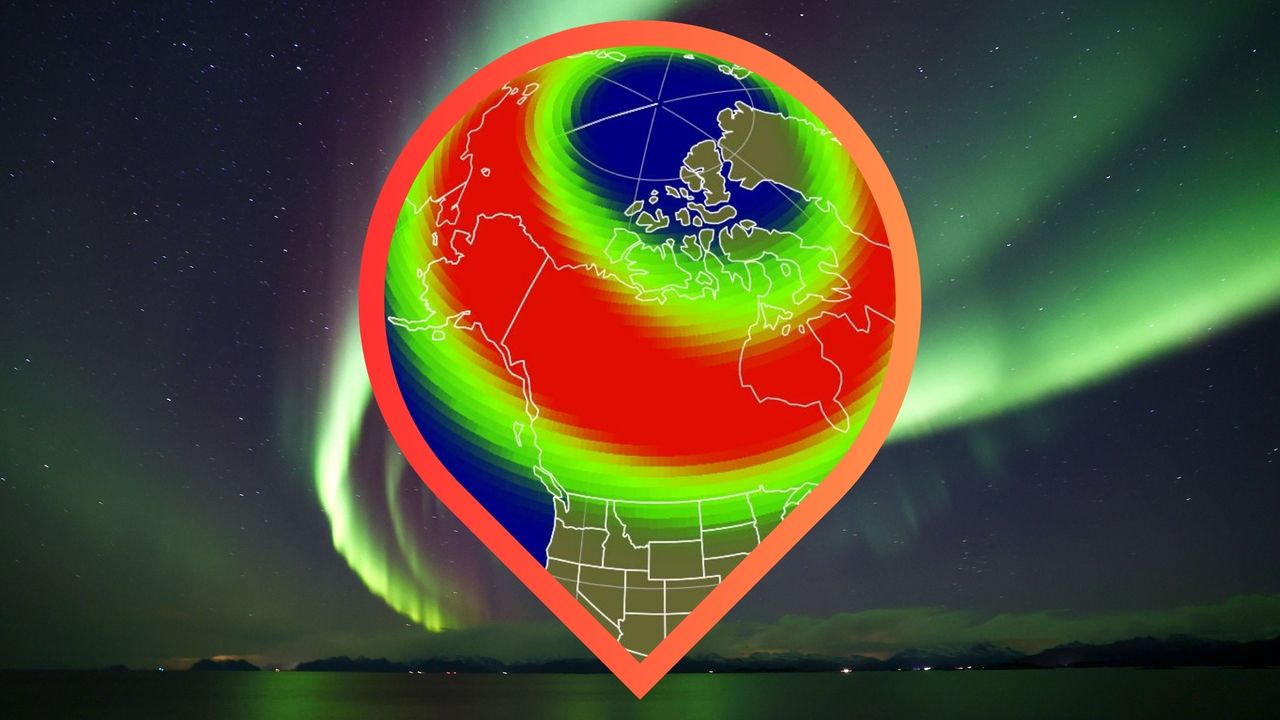
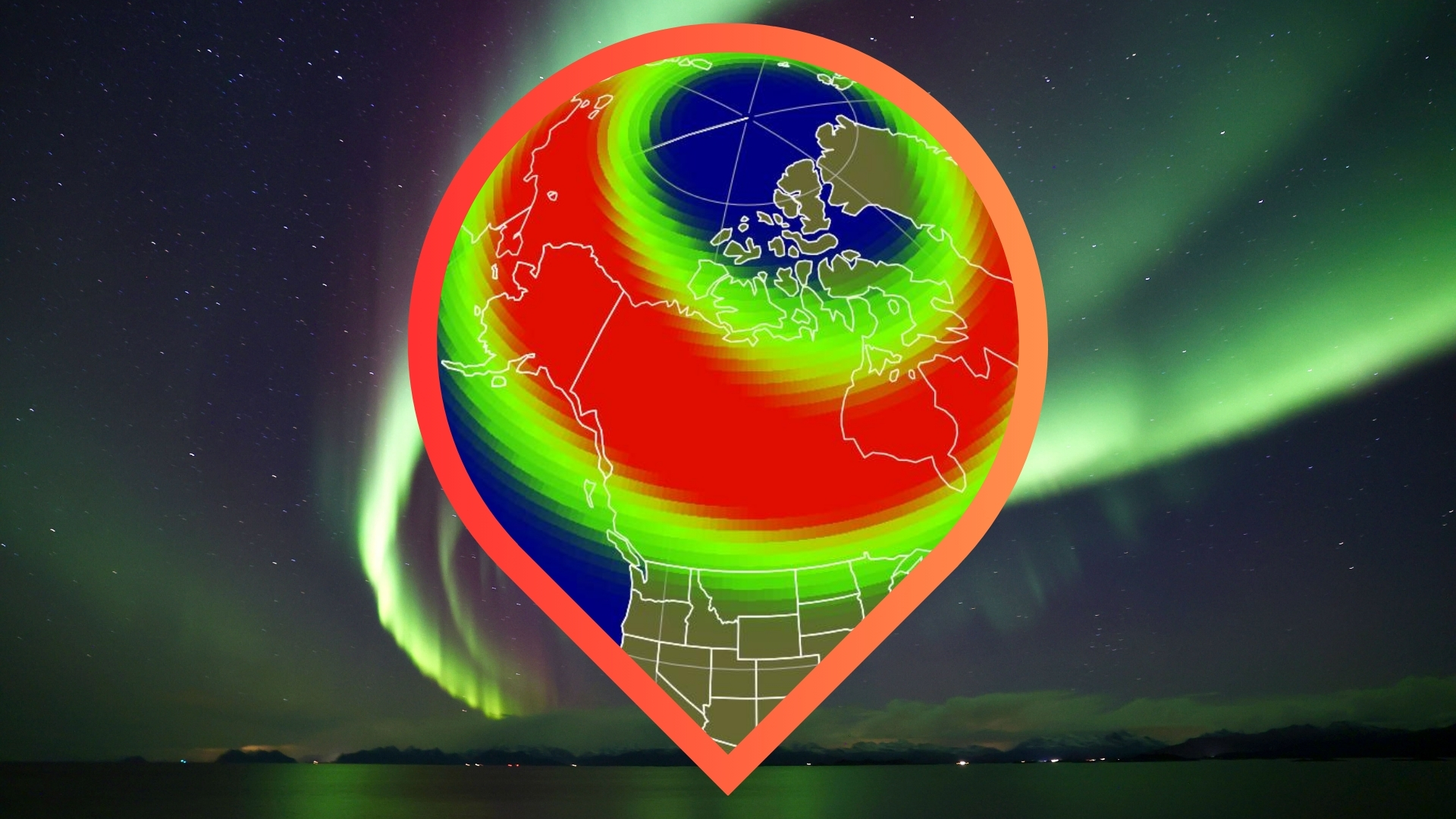
 A coronal mass ejection is currently racing toward Earth and could trigger G2 to G3 geomagnetic storm conditions on June 8, potentially boosting aurora displays across northern latitudes. (Image credit: Map: NOAA's Space Weather Prediction Center, Background: Daisy Dobrijevic, graphic created in Canva Pro.) Jump To: Share this article 0 Join the conversation Add us as a preferred source on Google Newsletter Subscribe to our newsletter
 An incoming coronal mass ejection (CME) is expected to slam into Earth's magnetic field today (June 8), potentially triggering geomagnetic storm conditions strong enough to supercharge auroras into mid-latitudes.
The CME erupted from the sun on June 6 and is forecast to arrive early to midday GMT on June 8. Space weather forecasters from NOAA's Space Weather Prediction Center and the U.K. Met Office suggest the impact could spark minor to moderate (G1 to G2) geomagnetic storm conditions initially, possibly ramping up to strong (G3) levels later in the day.
As such, NOAA has issued a G3 geomagnetic storm watch for June 8 and a G2 watch for June 9 as forecasters monitor the solar storm's approach. This is great news for aurora chasers.
When can I see the northern lights tonight?
The northern lights could become active at various times throughout June 8 as the incoming CME arrives.
The strongest storm conditions are currently expected between 11 a.m. and 2 p.m. EDT (1500-1800 GMT), when a strong (G3) geomagnetic storm is possible. While a daytime peak is far from ideal for North American aurora chasers, it doesn't necessarily rule out a nighttime display. NOAA's Space Weather Prediction Center forecasts geomagnetic activity to remain elevated through the evening, with G2 conditions possible between 5 p.m. and 8 p.m. EDT (2100-0000 GMT), before gradually easing overnight.
It's also worth remembering that CME arrival times can shift by several hours. If the solar storm arrives later in the forecast, the strongest geomagnetic activity could occur closer to — or even after — sunset for parts of North America, drastically improving viewing opportunities.
NOAA's geomagnetic storm watch issued for June 8. (Image credit: NOAA Space Weather Prediction Center)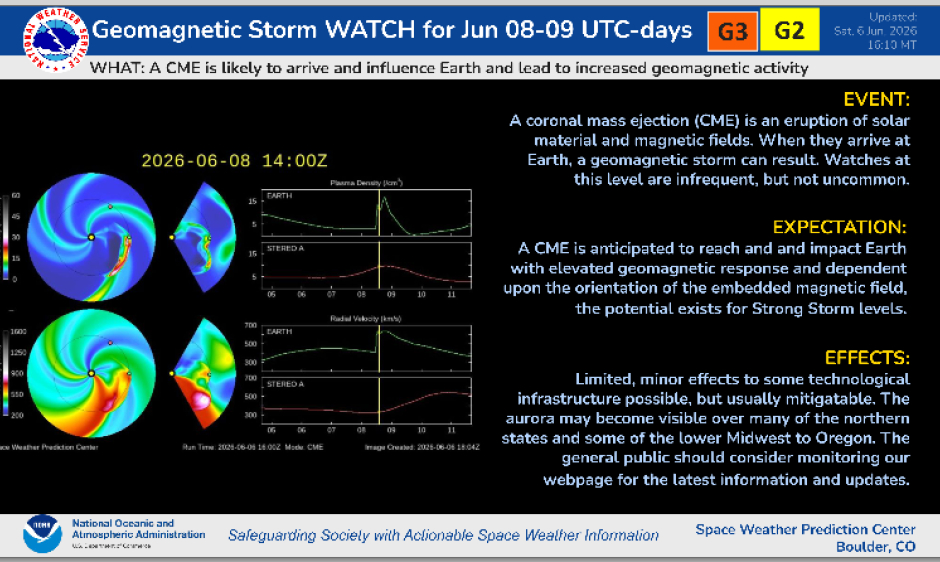
Will the northern lights be visible from where I live?
If the incoming CME triggers a strong (G3) geomagnetic storm, the northern lights could become visible much farther south than usual.
According to NOAA's geomagnetic storm scale, auroras may be visible as far south as:
- G1 (minor): Northern Michigan and Maine
- G2 (moderate): New York and Idaho
- G3 (strong): Illinois and Oregon
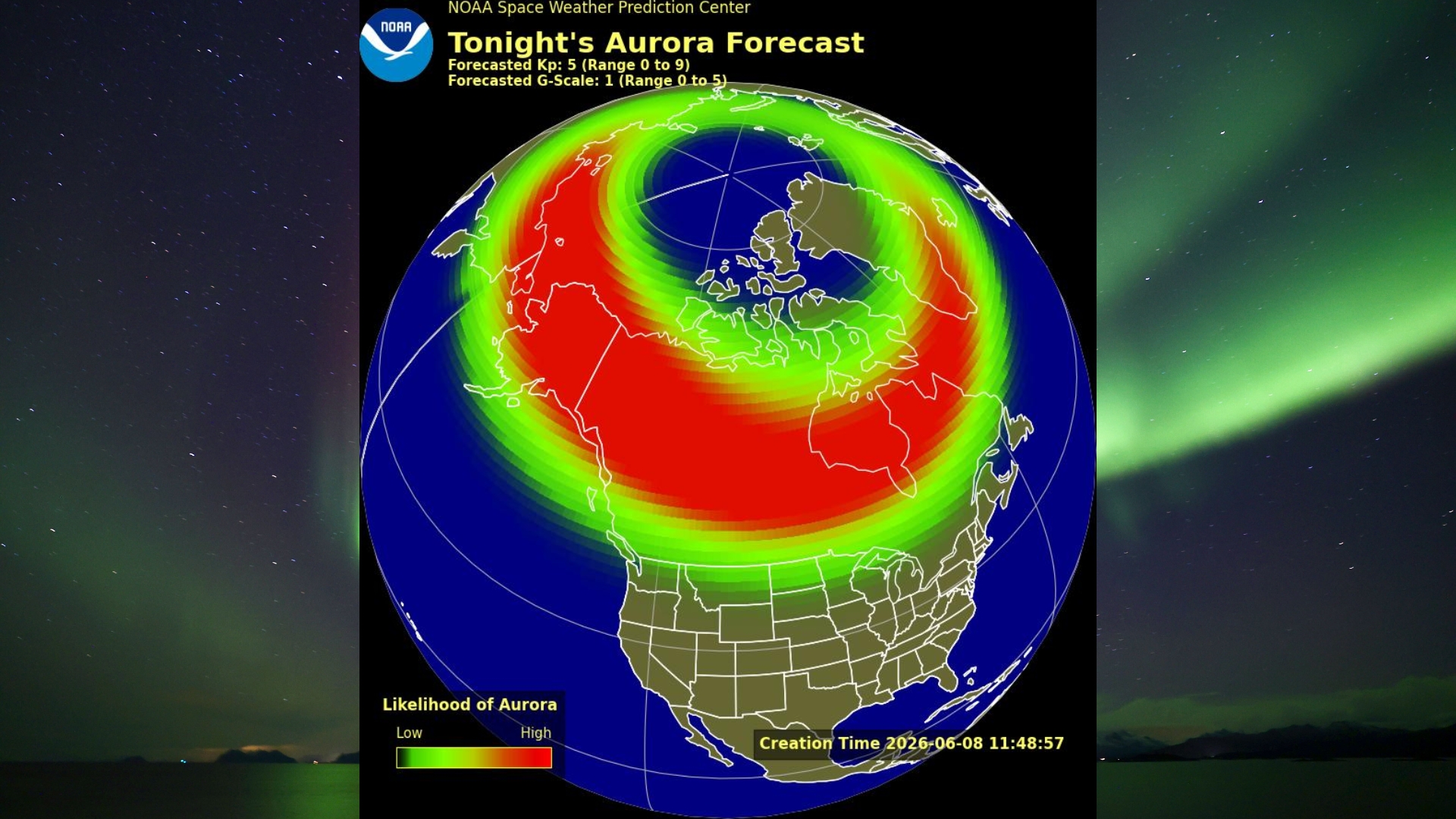
But remember, even during strong geomagnetic storms, aurora visibility is never guaranteed. Cloud cover, local light pollution and the orientation of the CME's magnetic field when it reaches Earth can all influence aurora visibility.
For the best chance of seeing the northern lights, head to a dark location with a clear view of the northern horizon and allow your eyes time to adjust to the darkness. If the aurora is faint, a smartphone camera can often reveal colors and structures that are difficult to see with the naked eye, during weaker displays.
For real-time forecasts based on your location, consider using a space weather app. A great option is "My Aurora Forecast & Alerts" (available for iOS and Android). For a deeper dive into space weather conditions, "Space Weather Live" is another excellent choice (available for iOS and Android)
View MoreYou must confirm your public display name before commenting
Please logout and then login again, you will then be prompted to enter your display name.
Logout Daisy DobrijevicSkywatching Editor
Daisy Dobrijevic joined Space.com in February 2022, having previously worked as a staff writer for All About Space magazine. She completed an editorial internship with BBC Sky at Night Magazine and worked at the National Space Centre, communicating space science to the public.
Daisy holds a PhD in plant physiology and a Master's in Environmental Science. Based in Nottingham, U.K., she covers all things space, with a special focus on solar activity and space weather. She also has a keen interest in astrotourism and is always on the lookout for the next northern lights adventure.
She will be a guest speaker aboard HX's Solar Eclipse Expedition in August 2026 and will join Hurtigruten as an onboard astronomer for a northern lights sailing in January 2027.