David Fear
Contact David Fear on X View all posts by David Fear November 27, 2026 Add us as a Google Preferred Source Add us as a Google Preferred Source
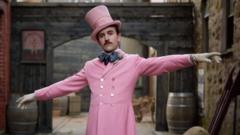
 Andrew Scott in 'Elsinore.' Anthony Dickenson/Focus Features
Elsinore is the type of movie that you’d assume was cooked up in a lab dedicated to concocting the perfect flavor of awards-season prestige-tainment. It’s based on a true story, involving extraordinary actor Ian Charleson, best know for his role in Chariots of Fire, given an even more extraordinary opportunity, i.e. portraying Hamlet at London’s National Theater in 1989. It’s a tragedy (Charleson was diagnosed with AIDS right before he began the play; he’d pass away several weeks after his final performance) that somehow manages to end triumphantly. It has moments designed to make viewers laugh, montages that rival any sports film’s training sequences, and entire sequences engineered to dehydrate audiences one crying jag at a time. It has the sort of symphonic score that leaves not a micro-ounce of doubt as to how you’re supposed to feel at any given moment. It’s a potent reminder that art is healing, our time here is short, and Olivia Colman in spiky, snarky mode should be categorized as a Class 1 narcotic.
But what separates this tribute to the need to thine own self be true from the usual glossy, touchy-feely melodramas that dominate the end of the year is the majestic presence, fretted with golden fire, at the center of it. The saga of one man literally dying to play one of the greatest stage roles ever written, not to mention the legacy of a thespian who left this mortal coil way too soon, rests on the extremely slim shoulders of Andrew Scott. The 50-year-old actor isn’t just up to the task. He is the supernova at the center of this film’s universe, the one behind the sound and the fury that signifies everything.
Scott has his own relationship with Shakespeare‘s magnum opus, having played the melancholy Dane onstage in 2017. This would initially suggest an advantage in terms of playing Charleson, for whom taking over the National’s production (after Daniel Day-Lewis infamously walked offstage mid-performance) was too good to pass up. Until you realize, of course, that anyone who’d already inhabited that role for months on end would have their own interpretation embedded in their muscle memory and their bones, and suddenly the degree of difficulty seems staggering. Scott was not playing his Hamlet, but someone else’s.
Editor’s picks
The 250 Greatest Albums of the 21st Century So Far
The 100 Best TV Episodes of All Time
The 500 Greatest Albums of All Time
100 Best Movies of the 21st Century
And not just “someone else’s,” but one of the most universally praised takes on the legendary role in the late 20th century. Charleson’s tenure as Hamlet was brief, yet was immediately considered both revelatory and canonworthy. Not to mention ephemeral — no footage exists of the late actor’s roughly two dozen performances. Only the raves remained. Yes, writer Simon Beresford’s well-researched screenplay offered a road map of sorts. Scott still had to recreate an actor playing a completely different version of the part, with nothing but third-party memories and decades-old reviews to go by. All while channeling someone whose body was betraying them.
In interviews, Scott has spoken about having to “unlearn” the play and start fresh, as well as juggling the responsibility of doing justice to Charleson’s talent. That he’d also have to deal with the posthumous shadow of Charleson’s burden over hiding his sexuality (a sticking point with his frenemy and fellow artist Derek Jarman, a contentious relationship that’s dramatized in Elsinore) and the nature of his illness was left unsaid, but it’s something that required attending to in a respectful yet authentic manner as well. There’s a lot of business to deal with here than just putting on a pair of tights, dying your hair blond and bellowing, “To be — or not to be!”
Andrew Scott as Moriarty in ‘Sherlock Homes.’ Colin Hutton For anyone who’s been following Scott’s career since his who-the-fuck-is-that-guy spin on Professor Moriarty, archnemesis and evil genius extraordinaire, opposite Benedict Cumberbatch in BBC’s Sherlock, it will not be surprising to find out that there are unexpected left turns in spots where other actors would chose to lean into the pathos. Easy-target dramatic events are dutifully trotted out, yet Scott knows when to rage and when to repress. Even a series of agonized yowls, after finding out a fellow patient in the Royal Free Hospital’s AIDS ward has died, aren’t milked for maximum effect.
Related Content
'All of a Sudden' Is the Rare Movie That May Change Your Life
Paul Mescal, Daisy Edgar-Jones, Kneecap Sign Open Letter Against Sally Rooney Book Ban
Taylor Swift to Perform at Academy Museum's Annual Gala
‘NAZA’ Wants You to Bear Witness
Neither are the arguments over whether it’s advisable for Charleson to do the play while receiving treatments, given that Hamlet is an exhausting role for those in peak physical condition, much less anyone battling a debilitating disease. Those exchanges reunite Scott with his Fleabag costar Olivia Colman, and just when you think everything will devolve into mere comic relief, the actors pull things back from the brink of the noble irresistible force vs. the cutesy-cranky immovable object. Scott has a way of grounding the conflicts and the depiction of the sickness in a way that doesn’t diffuse the impact. The Camille-style coughing is kept to a minimum. Instead, he gives you a portrait of someone who refuses to let mortality stop him from making a dream come true, one endurance test at a time.
There was a period where, post-Sherlock, Scott could have been stuck playing mustache twirlers in perpetuity. When his old theater friend Phoebe Waller-Bridge offered him a lifeline via a part in the second season of Fleabag, the pivot was so successful it threatened to pigeonhole him a second time: you can imagine an alt-career that’s nothing but his variations of Hot Priest sex-symbolizing. Nor is hard to picture a world in which Scott becomes one of those theater legends whose occasional screen work only hints at what they’re truly capable of — his generation’s version of Mark Rylance or Simon Russell Beale.
Instead, Scott has parlayed his matinee-idol good looks and penchant for flawed, tragic men (a reputation he pushes back on, well-earned or not) into a versatile catalog of screen characters that come close to matching the variety of his stage roles. He’s played class-jumping con men, debt-ridden medieval lords, a fantasy-world shaman, Broadway icons, and opportunistic authors-turned-online trolls. In the case of Vanya — his one-man show captured for posterity and currently available to view on the National Theatre at Home app — every character in Anton Chekhov’s Uncle Vanya, using everything from lilting falsettos to sunglasses and novelty noise machines to differentiate who’s screwing over who. It sounds like a gimmick. It plays like a magic trick. And should you think this is merely stunt-theater pyrotechnics, watch Scott’s alcoholic doctor down what he knows is a fatal half-bottle of Vodka in one go. You feel like you’re watching a self-destructive soul snuffing itself out.
You could say that he’s been building up to something like Elsinore for a while, which is the closest thing Scott has played to a traditional leading-man role in a traditional Oscar-courting Hollywood prestige drama. It’s to Scott’s credit that he keeps making you forget you’re watching something calculated for awards season and gives you the sensation of seeing something more artisanal, more heartfelt and heartwrenching than a last-act biopic. It’s less reminiscent of the sort of Miramax-style gold-digging movie of the late 1990s and closer to the delicate, more devastating work Scott had done in a far more idiosyncratic project a few years ago: All of Us Strangers.
Writer-director Andrew Haigh’s 2023 character study starts with Scott’s lonely, emotionally distant screenwriter blowing off the advances of a hot neighbor (Paul Mescal, hot and neighborly) and retreating to his apartment. It ends as a multi-layered ghost story, in which the reclusive man starts to unpack both old and new grief, and Frankie Goes to Hollywood’s sweeping cover of “The Power of Love” improbably feels like it deserves its place over the closing credits. The film itself mirrors its lead’s journey from closed-off to wide open as a wound, and it’s another example of Scott standing out in a potentially stock role while working almost preternaturally in sync with another actor.