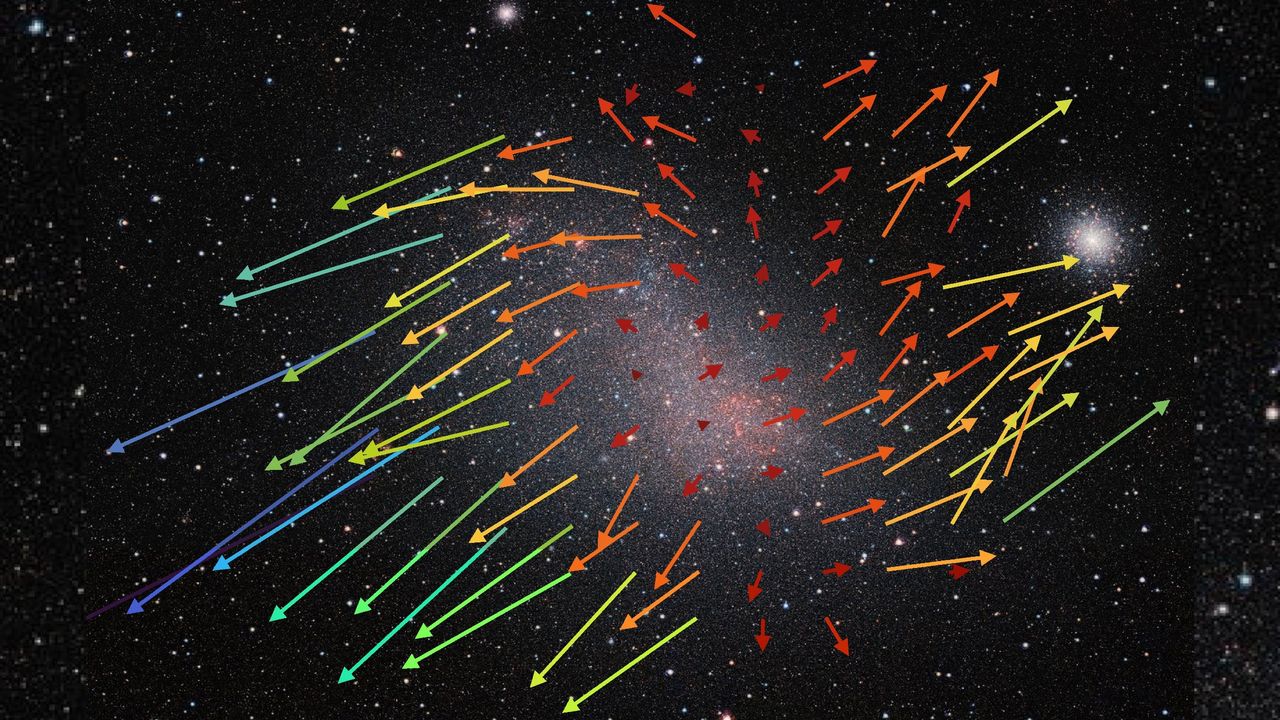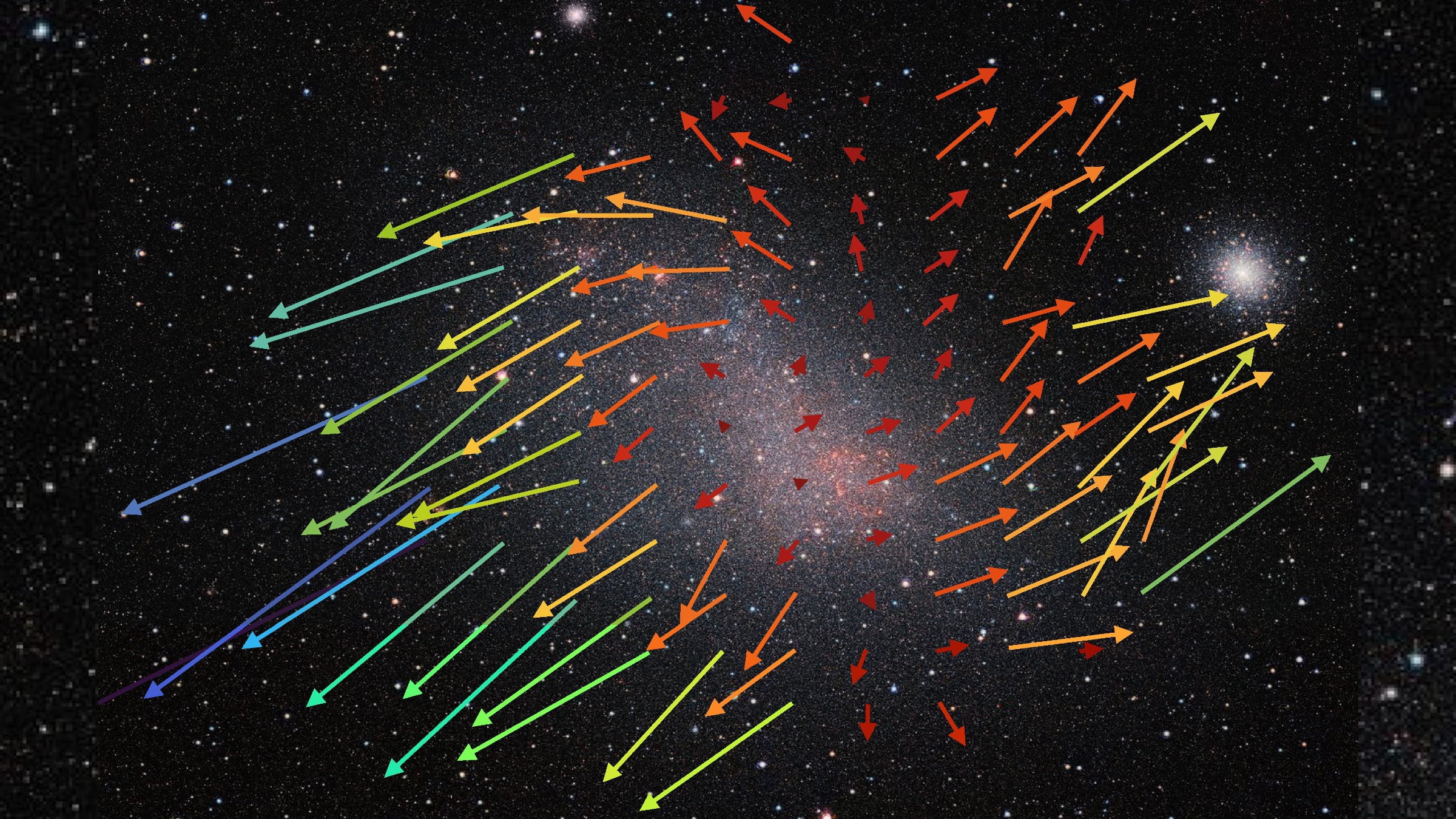
A new study shows that the stars within the Small Magellanic Cloud are being dragged apart by the gravitational pull of its big sibling, the Large Magellanic Cloud. (Image credit: ESO/VISTA VMC/ AIP/ S. Vijayasree)
Share this article Join the conversation
Follow us Add us as a preferred source on Google Newsletter Subscribe to our newsletter
A pair of sibling dwarf galaxies is having a gravitationally charged squabble in our cosmic backyard, and it will likely end with one ripping the other in half, a new study suggests. The surprising revelation reminds us that you never know your neighbors quite as well as you think, even in space.
The mini galaxies, known as the Small Magellanic Cloud (SMC) and the Large Magellanic Cloud (LMC), are satellites of the Milky Way that closely circle our galaxy like a moon orbits a planet. The LMC is the closest of the two, at around 160,000 light-years from Earth, while the SMC sits slightly farther away, behind the LMC, around 200,000 light-years from us. Both are clearly visible from the Southern Hemisphere.
The SMC and LMC are fairly hefty compared with other dwarf galaxies. The former has around 3 billion stars, while the latter boasts up to 10 times as many. (For context, the Milky Way has around 200 billion stars.) The pair of dwarves are also connected by a giant tail of gas and dust, known as the Magellanic Stream, left over from a three-way tug-of-war with the Milky Way.
In the new study, published May 21 in the journal Astronomy & Astrophysics, researchers looked more closely at some of the stars within these cosmic clouds and uncovered a "galaxy-wide tidal disruption" in the SMC that could only be explained by the gravitational pull of its larger sibling.
Using more than a decade's worth of observations from the VISTA Survey of the Magellanic Clouds (VMC), the team found that almost all of the stars within the SMC — even those nearest to its center — were moving outward at an average speed of around 38,000 mph (61,000 km/h). Their movements are oriented along the galaxy's southeast-northwest axis, meaning it must be the LMC, and not the Milky Way, causing this disruption.
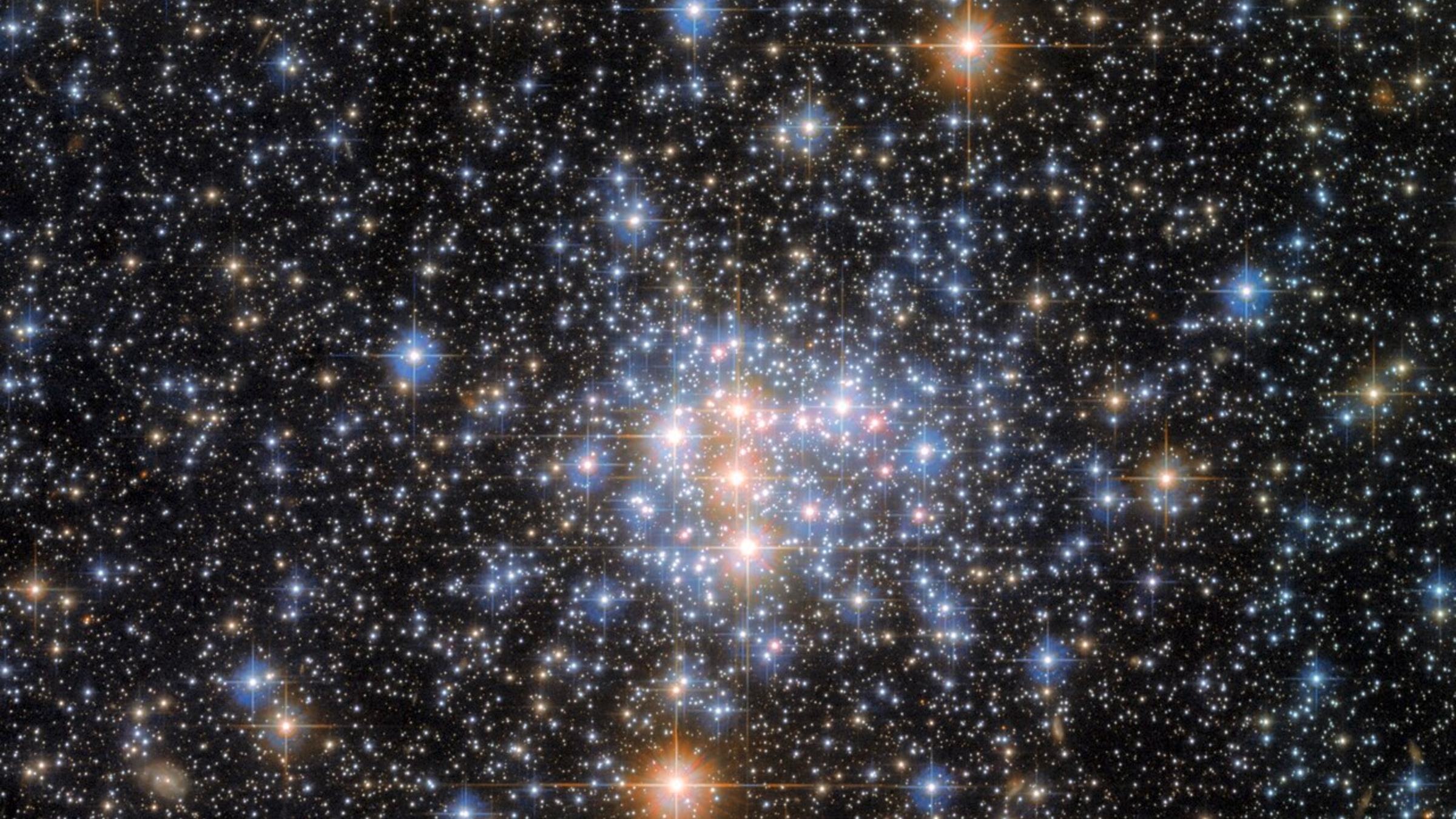
Researchers tracked the movements of thousands of stars within the SMC in order to make the surprising discovery.
(Image credit: ESA/Hubble)
At this speed, the stars will have moved by "several thousand light-years" over the next few hundred million years, which will be "enough to significantly distort the galaxy's structure," the researchers said in a statement. There is, therefore, a decent chance that the SMC will be completely cleaved in half by the time both the SMC and the LMC eventually collide with the Milky Way in around 2.4 billion years.
This is not the first research to suggest that the LMC is tearing the SMC apart. Last year, a similar study revealed that some of the smaller cloud's stars were moving in opposite directions from each other. However, the new paper is the first to prove this is happening across the entire dwarf galaxy.
Sign up for the Live Science daily newsletter now
Get the world’s most fascinating discoveries delivered straight to your inbox.
Contact me with news and offers from other Future brandsReceive email from us on behalf of our trusted partners or sponsors
A surprising shape
Due to the SMC's obscured position behind the LMC, scientists have struggled to map the small satellite galaxy in great detail. It is also thought to have an irregular shape, which adds to the confusion. But until now, researchers have been fairly confident that the smaller dwarf galaxy spins in place, much like a spiral galaxy such as the Milky Way.
However, the new findings "challenge [the] long-standing assumptions that the SMC behaves like a rotating disk," study first author Sreepriya Vijayasree, a doctoral candidate at the Leibniz Institute for Astrophysics Potsdam in Germany, said in the statement. "The internal motions of stars in the SMC are dominated not by orderly rotation, but by gravitational disturbances caused by repeated encounters with the LMC over billions of years."
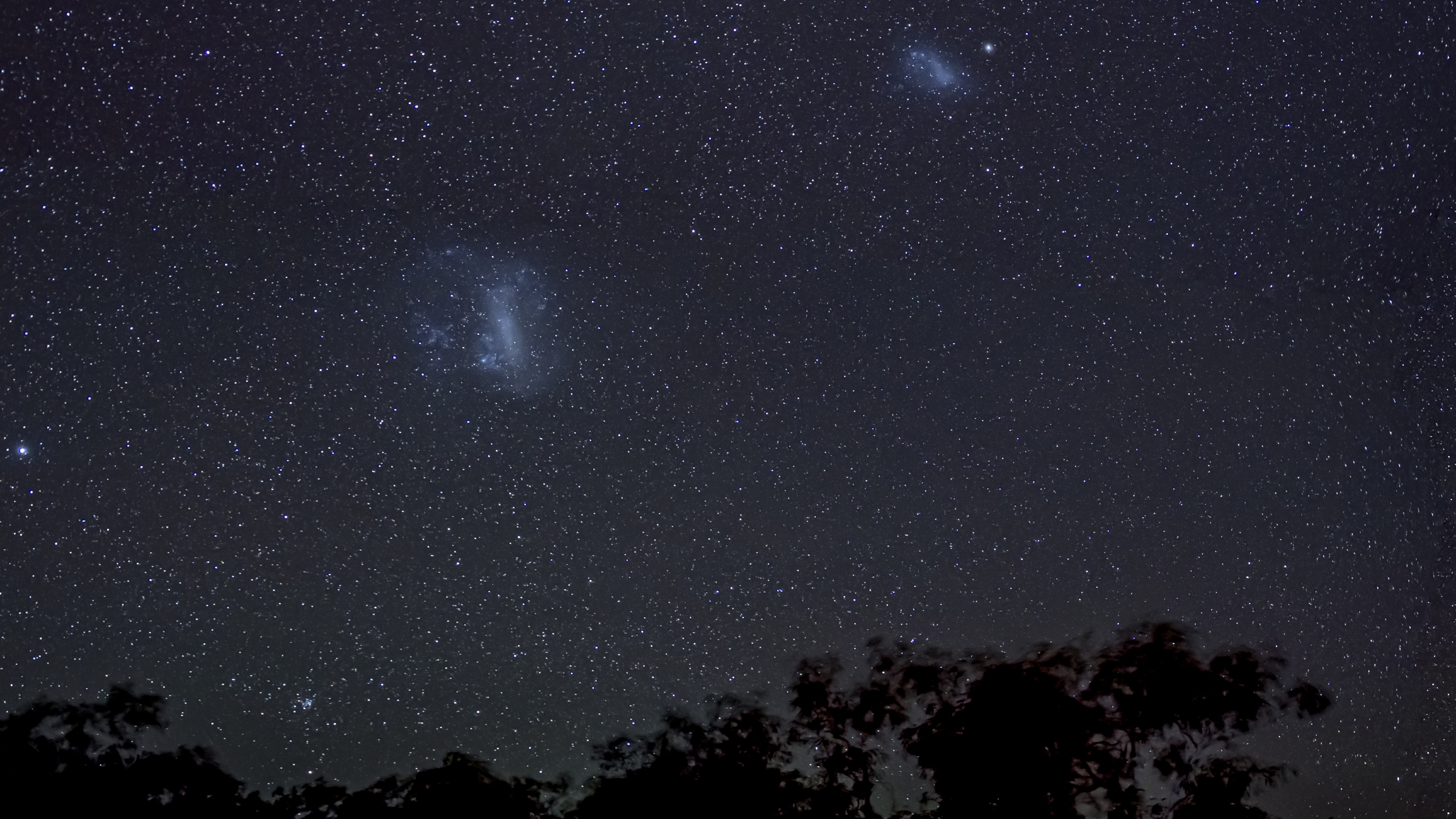
The LMC (left) and the SMC (right) are both clearly visible in the night sky from the Southern Hemisphere.
(Image credit: MWX Photo via Getty Images)
The extent to which scientists may have been wrong about the SMC's structure raises questions about other satellites of our galaxy, which have been studied in much less detail. There are at least 60 dwarf galaxies orbiting the Milky Way, ranging from the LMC all the way down to "ultrafaint" galaxies with just a few hundred thousand stars each — and more are being discovered all the time.
"Outstanding" observations
The new study was possible thanks to the VMC survey, which uses the Visible and Infrared Survey Telescope for Astronomy (VISTA) at the Paranal Observatory in Chile's Atacama Desert. The latest VMC dataset covers stellar movements over the past 11 years, showing researchers how the galaxy is evolving in real time.
RELATED STORIES
"When I saw the results for the first time, I was really amazed by the quality of the measured stellar motions," study co-author Maria-Rosa Cioni, an astronomer at the Leibniz Institute for Astrophysics Potsdam and principal investigator for the VMC survey, said in the statement. "We were able to map the internal kinematics [motions] of the SMC with a level of detail that is outstanding for observations from the ground."
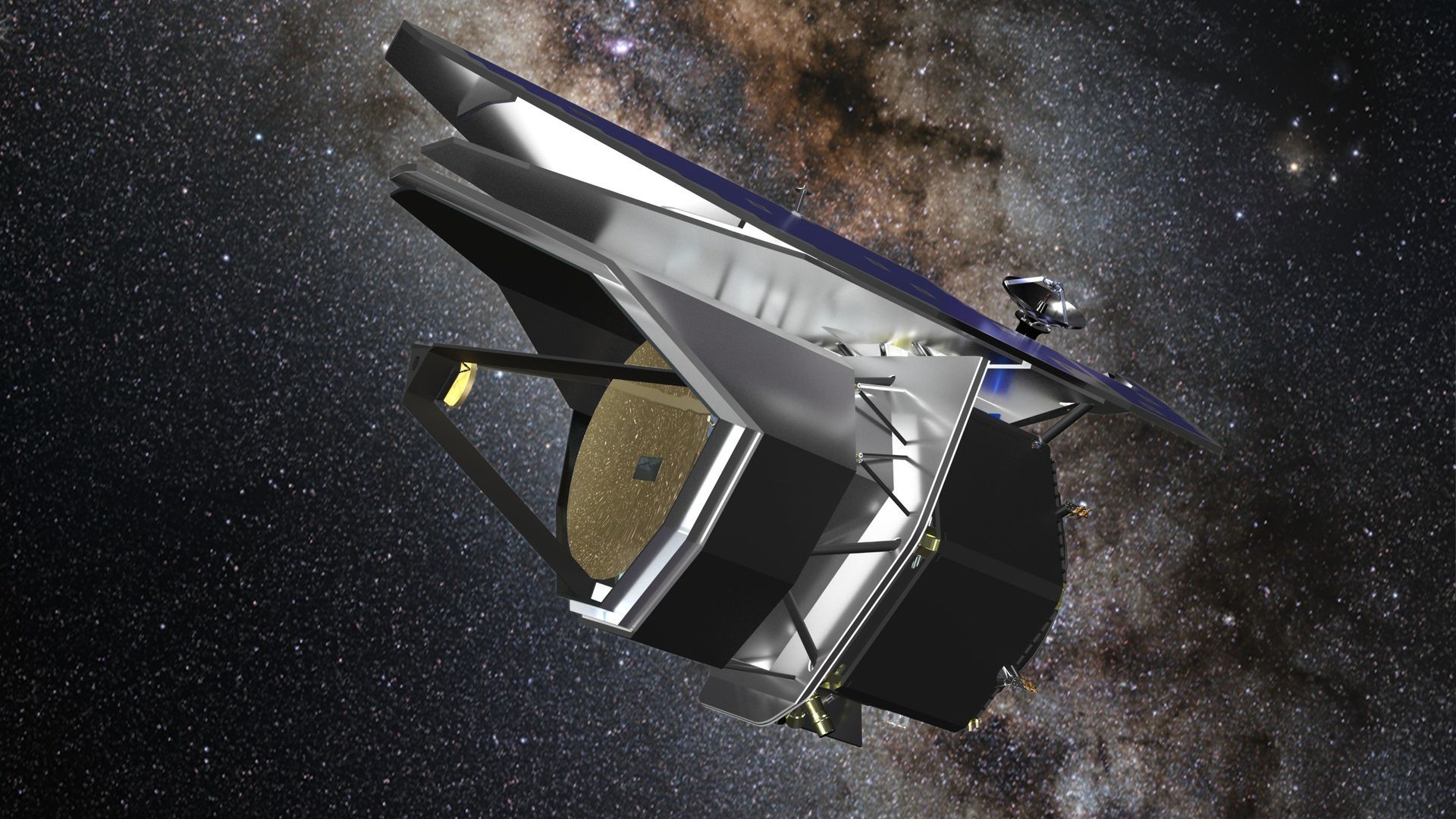
The researchers hope to bring the SMC's true nature into focus with the upcoming One Thousand and One Magellanic Fields survey, which will utilize a newly attached instrument on VISTA to map the movements of stars toward and away from Earth when it comes online later this year.
Article Sources
Vijayasree, S., Niederhofer, F., Cioni, M. L., Van Loon, J. T., Bekki, K., De Grijs, R., Subramanian, S., Kacharov, N., Omkumar, A. O., Cullinane, L. R., & Ivanov, V. D. (2026). The VMC survey. LV. The coherent expansion of the SMC. Astronomy and Astrophysics. https://doi.org/10.1051/0004-6361/202659431
 Harry Baker
Senior Staff Writer
Harry is a U.K.-based senior staff writer at Live Science. He studied marine biology at the University of Exeter before training to become a journalist. He covers a wide range of topics including space exploration, planetary science, space weather, climate change, animal behavior and paleontology. His recent work on the solar maximum won "best space submission" at the 2024 Aerospace Media Awards and was shortlisted in the "top scoop" category at the NCTJ Awards for Excellence in 2023. He also writes Live Science's weekly Earth from space series.
View More
You must confirm your public display name before commenting
Please logout and then login again, you will then be prompted to enter your display name.
Logout