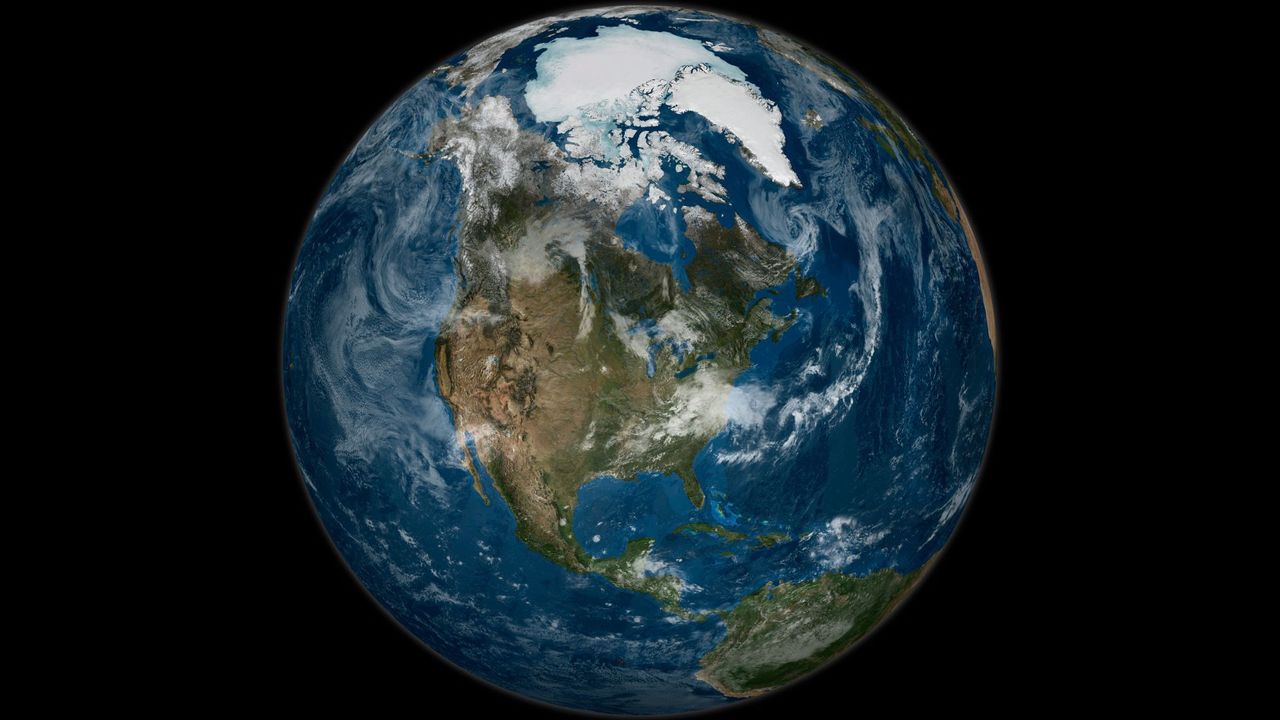
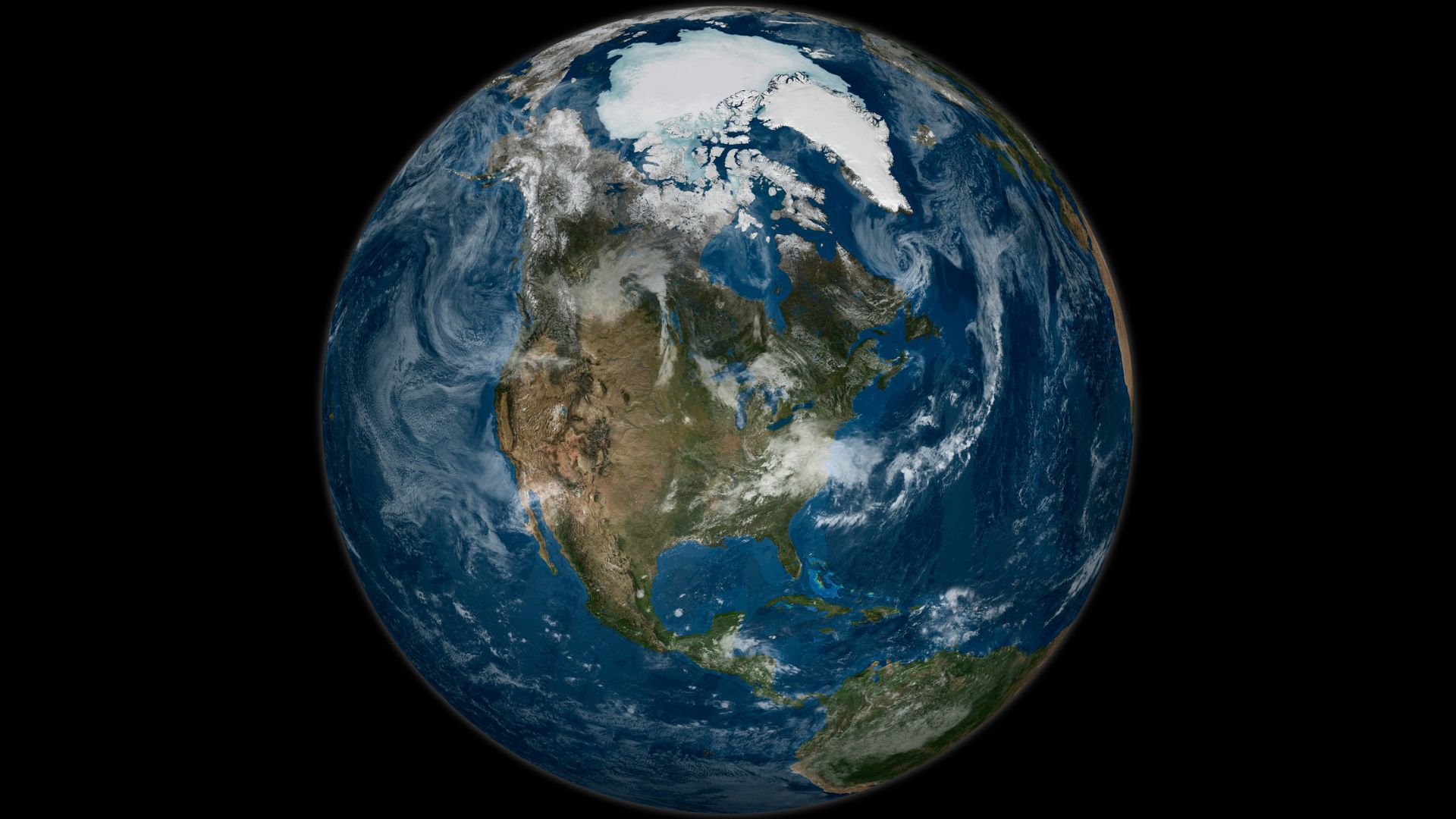
 Earth's rotation is slowing as a result of climate change-driven sea level rise, according to a new study. (Image credit: Stocktrek Images via Getty Images) Share this article 0 Join the conversation Follow us Add us as a preferred source on Google Newsletter Get the Live Science Newsletter
 Get the world’s most fascinating discoveries delivered straight to your inbox.
Become a Member in Seconds
Unlock instant access to exclusive member features.
Contact me with news and offers from other Future brands Receive email from us on behalf of our trusted partners or sponsors By submitting your information you agree to the Terms & Conditions and Privacy Policy and are aged 16 or over.You are now subscribed
Your newsletter sign-up was successful
Want to add more newsletters?
Join the club
Get full access to premium articles, exclusive features and a growing list of member rewards.
Explore An account already exists for this email address, please log in. Subscribe to our newsletterHuman-driven climate change is slowing Earth's rotation at a rate not seen in 3.6 million years, with sea level rise increasing the length of days by 1.33 milliseconds per century, according to a new study.
Earth spins faster when its mass is more concentrated, just as twirling figure skaters pull in their arms to speed up and spread out their arms to slow down. Rising sea levels have long been known to redistribute that mass and change the planet's spin, but the newly identified rate is unprecedented, scientists say.
Article continues belowHowever, this 2.4 millisecond rate is offset by an effect called glacial isostatic adjustment, which is the slow rise of the planet's crust that continues to occur after the retreat of the ice sheets. Glacial isostatic adjustment shortens the day length by about 0.8 millisecond per century, leading to a background lengthening over time of 1.71 milliseconds per century (with about 0.1 millisecond of uncertainty in the observations).
Other, shorter-term phenomena also affect day length, including strengthened winds during El Niño events, which slow the planet's rotation by about a millisecond per century, Mann said.
However, in recent years, the climate seems to be playing an increasing role in altering Earth's rotation, said study co-author Mostafa Kiani Shahvandi, a geoscientist at ETH Zurich. "I wanted to know if this was unusual or something like this happened in the past," Shahvandi told Live Science. "As it turned out, it is quite anomalous. The effect is therefore anthropogenic [caused by humans]."
Shahvandi and study co-author Benedikt Soja, a professor of space geodesy at ETH Zurich, turned to the fossils of shelled single-cell organisms called foraminifera to peer back millions of years into Earth's day length. Changes in the oxygen content of these fossils could reveal sea levels when the organisms were alive, from which the researchers could extrapolate day lengths.
Sign up for the Live Science daily newsletter nowContact me with news and offers from other Future brandsReceive email from us on behalf of our trusted partners or sponsorsThey found that today's 1.33-millisecond-per-century increase in day length was among the fastest changes seen in the past 3.6 billion years. "This is expected to get even larger and even bigger than the effect of the moon," Shahvandi said.
One episode around 2 million years ago saw a similar increase in day length of 2.1 milliseconds per century , the researchers found. That was in the Early Pleistocene, during a period when carbon dioxide in the atmosphere and temperatures rose. There is some uncertainty in the historical estimate, meaning that this period may have seen a similar increase in day length as today, or that today might be faster.
RELATED STORIES—Have days on Earth always been 24 hours?
—The rate of global warming has accelerated more in the past decade than ever before
—32 weird ways to fight climate change that just might work
Under a future warming scenario where greenhouse gases increase, the day could lengthen by 2.62 milliseconds per century by 2080, Shahvandi and Soja reported in their study, which was published March 10 in the journal JGR Solid Earth.
Although the impact would likely not be perceptible to humans, the findings have other real-world implications. For example, Mann said, instruments that require precise knowledge of Earth's rotation rate, such as those on spacecraft, may need to be recalibrated. Other precise timekeeping applications, such as in computing, could be affected, Shahvandi said.
The findings also underscore the rapidity of modern warming. "It tells us about the rapid climate change," Shahvandi said, "[the] melting of snow and ice in polar ice sheets and mountains glaciers, and increase in the sea levels."
Article SourcesKiani Shahvandi, M., & Soja, B. (2026). Climate‐Induced Length of Day Variations Since the Late Pliocene. Journal of Geophysical Research: Solid Earth, 131(3). https://doi.org/10.1029/2025jb032161
 Stephanie PappasLive Science Contributor
Stephanie Pappas is a contributing writer for Live Science, covering topics ranging from geoscience to archaeology to the human brain and behavior. She was previously a senior writer for Live Science but is now a freelancer based in Denver, Colorado, and regularly contributes to Scientific American and The Monitor, the monthly magazine of the American Psychological Association. Stephanie received a bachelor's degree in psychology from the University of South Carolina and a graduate certificate in science communication from the University of California, Santa Cruz.
View MoreYou must confirm your public display name before commenting
Please logout and then login again, you will then be prompted to enter your display name.
Logout LATEST ARTICLES 1Is the coming HIV pandemic inevitable?
- 2Live Science Today: Monte Verde controversy and heatwave lashes the West
- 3The first flying taxis could start operating in 2026 — will this new form of transport actually take off?
- 4Unusual burials of Celtic 'warriors' discovered in France point to violent deaths
- 5Should compulsive shopping and gaming be considered an addiction? Psychiatrists are considering expanding the definition.