

 Getty Images
Around 22,000 university students who were told they would have to urgently repay maintenance loans and childcare grants that were given to them in error have been given a reprieve.
The government has announced that the affected loans will be repaid through the usual student finance route, and repayments on grants are paused until "at least" September.
It follows a row in which weekend students were told their courses had never been eligible for student finance and should instead have been classed as distance learning.
The National Union of Students said the decision came as a "huge relief", and that not having to start repaying within months will have taken "pressure off their mental health".
It's just two weeks since students, including some on nursing or teaching courses, were suddenly told they had never been entitled to maintenance loans and childcare grants, and would have to repay them on an "accelerated timescale".
The Student Loans Company (SLC) had been instructed by ministers to make clear to universities that courses delivered at the weekend, some including online components, should have been classed as distance learning.
The regulations had been in place since 2011, according to the government, which blamed universities for not being clear through either "incompetence or abuse of the system".
In the House of Commons, MP Josh MacAlister said the government had asked the SLC to "collect any over-payments through normal student finance repayments, and to pause recoveries of overpaid grants until at least September".
The SLC said it would be contacting students "to explain what this means for them and what the next steps are, including their eligibility and entitlement, as well as confirming the repayment process".
"We are also continuing to work with providers who are in the process of correctly classifying courses," a spokesperson added.
Student finance repayments for loans taken out after 2023 in England are 9% of any earnings above a threshold of £25,000 a year. Loan terms vary depending on when and where in the UK they were taken out.
22,000 students told to pay back 'mis-sold' maintenance loans
How do student tuition and maintenance loans work?
Some students faced having to find tens of thousands of pounds to urgently repay, with the government saying it was up to the universities involved, and their franchise colleges, to make sure none suffered hardship.
Amira Campbell, president of the National Union of Students (NUS) said this still left students who were part-way through courses unclear about whether to continue.
"The government is still refusing to provide the future funding that all students are eligible for, meaning that many of these students have been considering dropping out mid-way through the degrees they have worked so hard for," she said.
Last week, the NUS handed in a petition signed by 13,000 students calling on the government to backtrack.
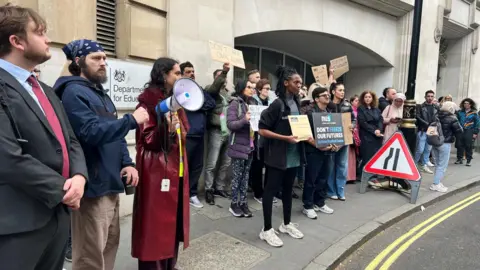 Branwen Jeffreys / BBCNUS president Amira Campbell (centre) handed in a petition with affected students at the Department for Education
Rachel Hewitt, chief executive of MillionPlus, which represents modern universities, said the change from government was "positive", but that the affected students' lives had been "turned upside down".
"Students and universities deserve further clarity, and the government should pause this action entirely, protect affected students and work with the sector on a fair and workable solution," she added.
The BBC understands ministers became concerned that support wasn't being provided as consistently or urgently as needed.
Nine of the universities involved took the first step towards legal action last week over what they called an "abrupt" decision, which risked penalising mature students on low incomes trying to get a better qualification.
Those nine universities said it was "disgraceful" that Monday's change was announced in Parliament before students were informed, adding that there were still more questions than answers.
In a statement, they added students were getting in touch with questions - "many of whom are among the most vulnerable, many are parents, many are from low-income backgrounds, many chose weekend study precisely because it was the only way they could access higher education around work and family commitments".
Some of the courses caught up in the row are delivered by private companies which have a deal with a university to teach their degrees, often in buildings hundreds of miles from the main campus.
The government has expressed concern this part of the system is open to abuse, and has said it will soon tighten regulations so that any of these franchise providers with more than 300 students have to register with the higher education regulator, the Office for Students.
UniversitiesStudentsStudent finance


