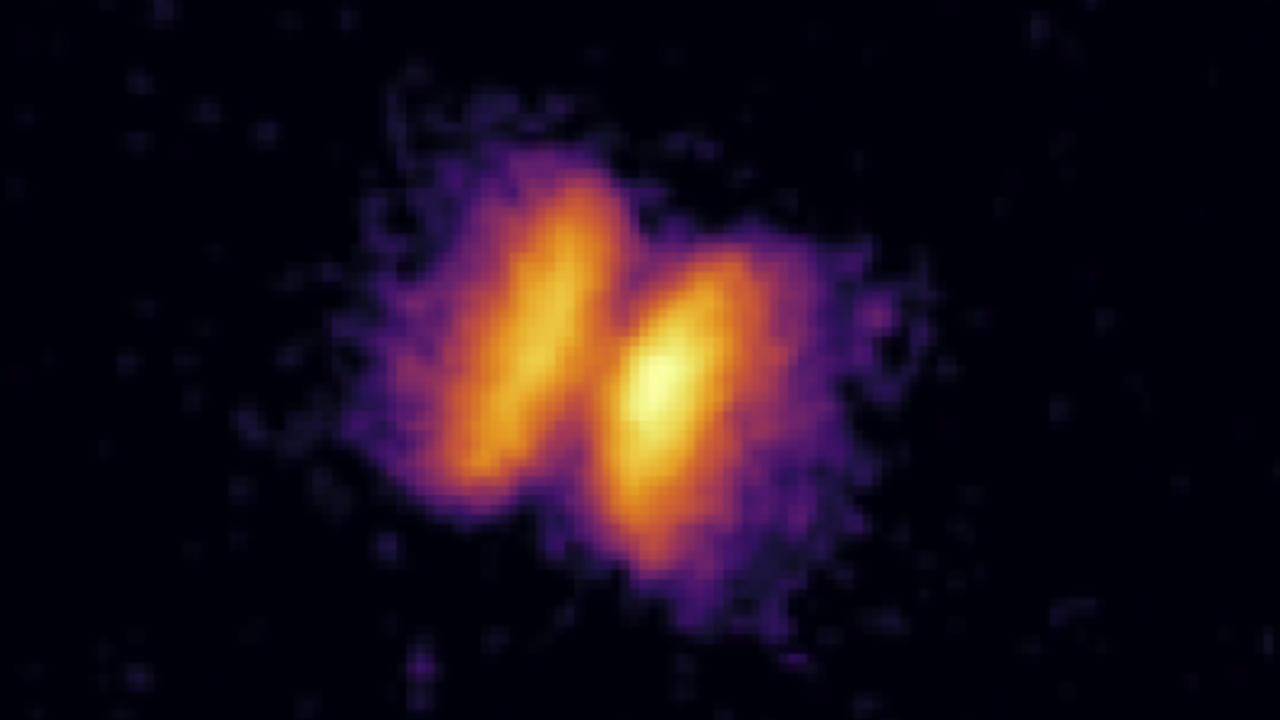
Using NASA's long-serving Hubble Space Telescope, astronomers have discovered that a stellar explosion in the Milky Way is blasting out cosmic bullets travelling at 20 million miles per hour. The cosmic explosion in question is V445 Puppis, which erupted in 2000 and is the only known "helium nova" in our galaxy. Though astronomers have been studying V445 Puppis for two decades, much of the phenomena associated with it were shrouded in mystery due to a vast cloud of dusty debris that surrounded this nova.
When this debris finally cleared, a team of researchers was able to peer into V445 Puppis using Hubble, NASA's exoplanet-hunting spacecraft TESS (Transiting Exoplanet Survey Satellite), and the Earth-based Very Large Telescope (VLT), along with an array of other instruments. This allowed them to discover not only the "bullets", clumps of potentially oxygen-rich gas it is firing, but also the true nature of this system. This revealed that V445 Puppis consists of a dead star hungrily feeding on a companion star that is, by itself, a rare find. Thus, this system offers scientists a rare chance to study one of the rarest types of binary systems and one of the rarest cosmic explosions.
"The origin of these 'bullets' is a mystery. We suspect that these originated post-outburst, but 'bullets' of this kind have not been observed in any other nova," team member John Mills, a researcher at the University of Warwick in the UK, said in a statement.
What is a helium nova?
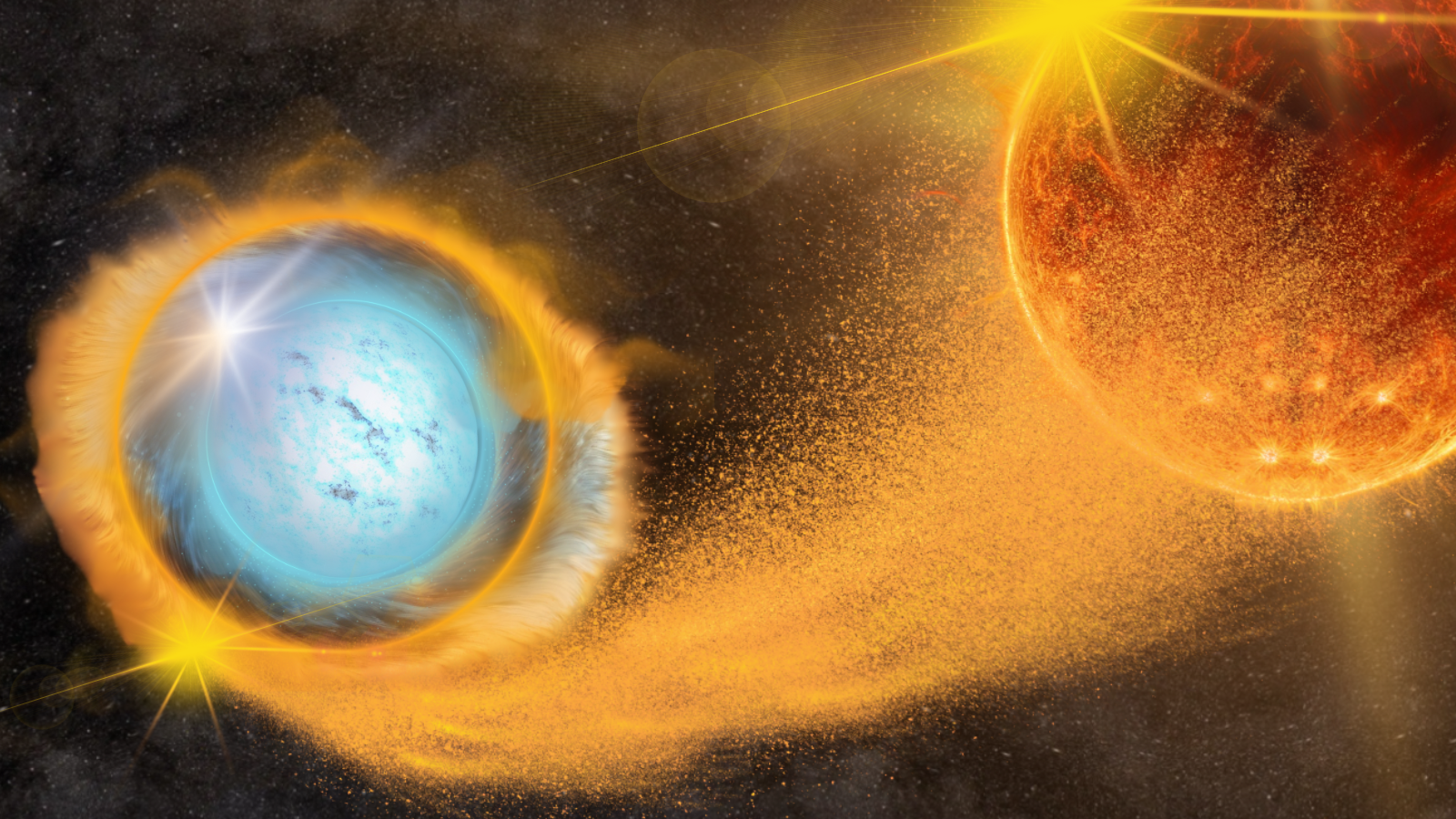
Helium novas like V445 Puppis occur when a white dwarf dead star cannibalistically strips helium-rich but hydrogen-poor matter from a star that has already lost its outer layer of hydrogen, exposing inner layers of helium; forming a rare "helium star." By contrast, "ordinary" novas are explosions triggered by the buildup of stolen stellar matter rich in hydrogen, not helium.
As the material accumulates on the surface of the white dwarf (a type of stellar remnant left behind when stars around the mass of the sun die) it creates runaway pressures and temperatures that eventually trigger a thermonuclear explosion.
When V445 Puppis went nova back in late 2000, it launched vast, twin plumes of debris that resemble butterfly wings. Stretching out for more than a trillion miles, astronomers initially spotted this bipolar outflow in infrared. The nova also spawned a thick disc of dust that completely obscured the binary star system. That cloud persisted for over two decades, preventing astronomers who were investigating the expanding debris from determining what kind of stars the blast originated from.
Once the debris cleared, this team determined that the system contained a helium star, one of only a few thousand of these stripped stellar bodies to be discovered among the billions of stars that populate the Milky Way.
"The culprits behind this galactic eruption have been an enduring mystery over the past 25 years, which is why it is very exciting to confirm that this helium nova was the result of a helium star accreting onto a white dwarf," Mills said.
The findings also revealed cosmic "bullets" that are even more remarkable, as they have never been seen around any other novas. Intriguingly, the team also found that V445 Puppis may be about to go nova again, and this could lead to an entirely different type of cosmic explosion.
Is V445 Puppis about to blow its top again?
Mills found that the white dwarf in V445 Puppis has overcome its stellar indigestion and is once again feeding on its companion helium star. This is the process that led to the initial helium nova, and could mean that another episode of this rare type of cosmic explosion is soon to occur.
That has implications for our understanding of another type of cosmic eruption, this time a type of supernova called a Type Ia supernova. These occur when white dwarfs overfeed on companions and are completely destroyed by the resultant explosion.
Scientists have long suspected that repeated helium nova eruptions could lead to final Type Ia supernovas.
A new Type Ia supernova would be exciting because these events are so regular in terms of their light emission that they can be used as so-called "standard candles" to measure cosmic distances and gauge the age of the universe.
This means that they can also be employed in the quest to understand how fast the universe's expansion is proceeding, and the influence of the mysterious force called dark energy on this process.
"I look forward to seeing how this result may help us uncover what powers other similar hydrogen-poor astronomical explosions, such as the famous Type Ia supernovas," Mills said.
The team's research was presented this week at the Royal Astronomical Society's National Astronomy Meeting in Birmingham, UK.