
 Getty Images
Sir Keir Starmer is fighting to stay on as as prime minister, after dozens of Labour MPs called for him to quit immediately or set a timetable for his departure.
The PM says that he intends to "get on with governing" as no formal leadership challenge has been launched.
But how could MPs who want to see Sir Keir replaced force a leadership contest and how would the winner be chosen?
Why is Starmer under pressure from his own MPs?
Labour performed badly in the biggest set of elections to be held since its landslide election victory in 2024. The polls were seen by many as a key test for Sir Keir's leadership.
Labour lost almost 1,500 councillors in local elections across England amid a surge for Nigel Farage's Reform UK, with the Greens also eating into the party's support.
It was also kicked out of power in Wales, where it had enjoyed political dominance for a century. Labour also won just 17 of the 129 seats in the Scottish Parliament, its worst ever result at a Holyrood election.
The BBC is aware of more than 80 Labour MPs who have called on Starmer to leave his post, or set out a timetable for his resignation.
Jess Phillips has resigned as safeguarding minister, telling Keir Starmer that "deeds, not words matter". Communities Minister Miatta Fahnbulleh and Victims Minister Alex Davies-Jones have also resigned.
Home Secretary Shabana Mahmood is also among those calling for him to set a date for leaving. And backbencher Catherine West has said she is collecting names of fellow MPs who want the PM to leave by September.
Follow live: Keir Starmer leadership latest
At a glance: Starmer grapples with leadership crisis
Henry Zeffman: Keir Starmer fights back for now
How would a leadership challenge work and who could stand?
MPs unhappy with Sir Keir remaining in post could try to force a leadership election.
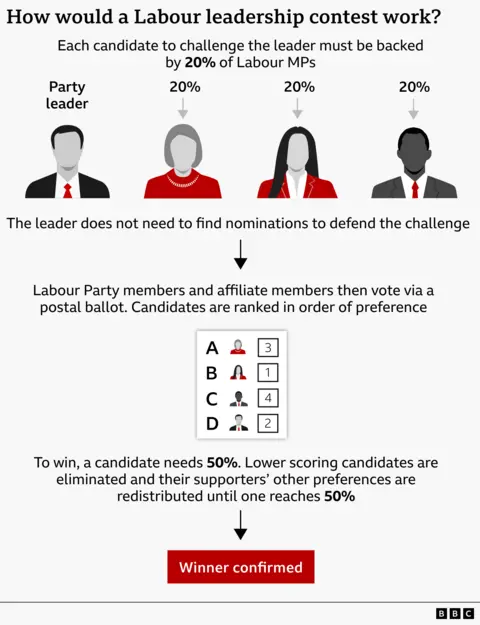
This would require 20% of the party's MPs to back a replacement candidate. There are 403 Labour MPs, so the support of 81 would be needed.
Once a Labour leadership election is triggered, other candidates could join the contest if they also have 81 backers.
Sir Keir would not be required to gather support as he would be automatically on the ballot paper if he chose to contest the leadership election.
He would continue as prime minister during any contest.
No Labour prime minister has ever faced a formal leadership challenge from their MPs.
How does the vote to choose a Labour leader work?
Party members and affiliated trade union supporters vote by ranking the candidates in order of preference – putting a one next to their favourite, two for their second choice and so on.
If one candidate receives more than 50% of first preferences then they will be declared the winner.
If not, then the candidate who finishes bottom will be eliminated and the voters who put them as their number one will see their vote moved to their second choice.
This process of elimination continues until one candidate receives more than half of the votes.
The timetable for the leadership ballot would be decided by Labour's decision-making body known as the National Executive Committee (NEC).
In 2020, candidates had time to secure their nominations before a ballot took place over a six-week period.
That leadership contest was triggered when Jeremy Corbyn announced he would stand down following the party's defeat in the 2019 general election.
Who could stand to replace Starmer as Labour leader and prime minister?
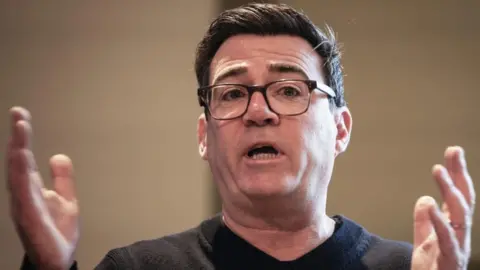 PA MediaBurnham was blocked from standing to become an MP by Labour's ruling body
Greater Manchester Mayor Andy Burnham, former deputy prime minister Angela Rayner and Health Secretary Wes Streeting are thought to be the main potential challengers to Sir Keir.
Andy Burnham
Although he has made little secret of his leadership ambitions, Burnham cannot enter a contest without first becoming an MP.
He was blocked from doing so earlier this year by the NEC.
Refusing to allow Burnham to stand in the Gorton and Denton by-election, it said the cost to the party of a mayoral election to replace him would be "disproportionate".
The mayor's supporters are hoping a leadership contest can be delayed until he is able to return to Parliament.
Angela Rayner
Rayner is favoured by some on the left of the party.
In her first public comments since the elections, Rayner called for Labour to offer regional mayors more economic powers and raise the minimum wage. "We are in danger of becoming a party of the well-off, not working people," she said.
Rayner resigned as Sir Keir's deputy prime minister last September after it emerged she had failed to pay the correct amount of stamp duty on a £800,000 flat in Hove.
It has been widely reported that she is still waiting for the result of an HMRC investigation into the purchase, which could complicate any immediate leadership campaign.
Wes Streeting
The health secretary backed the prime minister following its election losses, but did not explicitly rule out standing in any contest.
Some who would like to see him replace Sir Keir think this might be his very best chance, before Andy Burnham can get back to Westminster.
Streeting has been linked to Peter Mandelson, whose appointment as British ambassador to the US - despite his links to convicted sex offender Jeffrey Epstein - led to questions being raised about Sir Keir's judgement.
What would happen if Starmer resigns or sets a timetable to leave?
Prime ministers hold office unless and until they resign. Sir Keir has told the cabinet that he will prove his "doubters" wrong and will not "walk away".
However, if this changed, he could choose to stay in post during a transition period before handing over to a successor, who would be both Labour leader and prime minister.
If Sir Keir chose to resign with immediate effect, a member of the cabinet would replace him in a caretaker capacity, under Labour Party rules.
This would involve a decision by the cabinet, who would consult with the NEC.
Deputy Prime Minster David Lammy would not necessarily fill the caretaker role.
A leadership contest would follow.
Could the opposition force a general election?
Whoever won a Labour leadership election would automatically be the prime minister without the need for a general election.
However the PM must have the "confidence" of the House of Commons to govern, which means they must be supported by a majority of MPs.
If the leader of the opposition, currently the Conservative's Kemi Badenoch, introduces a motion of no confidence, the government is expected to provide parliamentary time for a debate and a vote.
To succeed, the motion needs just one more vote in favour than against.
If the government loses the vote, a general election is usually called.
Important caveats to note are that 403 of Westminster's 650 MPs are Labour.
Several Labour MPs would therefore have to support any motion for it to succeed, which is very unlikely.