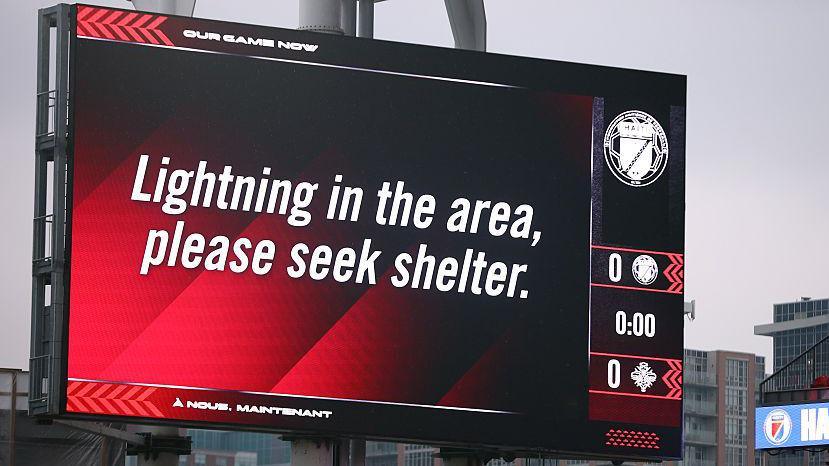
 Image source, Getty ImagesImage caption,
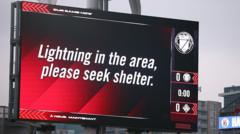
 Supporters and players must leave the bowl of the stadium if lightning is detected within eight miles
ByDale JohnsonFootball issues correspondent- Published27 minutes ago
"It's a joke - this is not football," Chelsea boss Enzo Maresca said after his side's Club World Cup last-16 tie against Benfica was delayed by extreme weather last summer.
The game in Charlotte, North Carolina had kicked off at 16:00 local time, but was suspended in the 86th minute when lightning was detected in the area.
Almost two hours passed before the storm had cleared. Players from both teams were spotted on exercise bikes or kicking balls around in the changing room, trying to keep active.
Eventually the game resumed, with the final whistle blown at 20:38 local time - four hours and 38 minutes after it had begun.
It was one of six games at the tournament halted by electrical storms.
With the 2026 World Cup - co-hosted by the United States, Canada and Mexico - taking place at the peak of thunderstorm season in several host cities, we are highly likely to see stoppages once again.
What happens when there is an electrical storm?
The delays at the Club World Cup made headlines, but football in the United States is very much used to stopping because of the weather.
A number of matches on pre-season tours - including Manchester City v Barcelona in Orlando two years ago - have faced lengthy delays.
Fifa has no power to make its own rules, it must adhere to the advice of local authorities.
In the United States, recommendations of the National Oceanic and Atmospheric Administration (NOAA) are used.
The NOAA says that if any lightning strike is detected within eight miles of a stadium the game has to be stopped.
How would that work out distance-wise in the UK?
If you are in Manchester at Old Trafford or the Etihad, you can just about get away with lightning in Rochdale.
A game could continue at Stamford Bridge if there was an electrical storm at Tottenham Hotspur Stadium - but it would be too close if lightning was at Emirates Stadium.
With an increased risk of lightning strikes, the safety of players and supporters is given paramount importance.
All players must leave the pitch, and fans must seek shelter away from their seats.
A mandatory 30-minute countdown begins. Each time there is a lightning strike inside the distance, the countdown clock resets to 30 minutes.
If a full 30 minutes has elapsed, the supporters can go back to their seats and players will have a short warm-up.
England to use palm-cooling devices at World Cup
- Published3 hours ago
Fifa risking player safety over heat at World Cup - scientists
- Published14 May
Heat experts warn Fifa of bottle ban health risk
- Published1 day ago
How long will delay be and could match be postponed?
If a game is suspended because of the weather Fifa will address the matter on a case by case basis.
But there is no cut-off point, no maximum time players must wait before a match is called off.
Essentially, the kick-off time is the guide, with ensuring a stadium full of supporters make it home safely key to any decision.
The earlier in the day a match starts, the more time there is to play with.
But time is not always the deciding factor. Take a Major League Soccer game from 2015.
FC Dallas v Toronto FC was halted for three hours 26 minutes because of lightning strikes and did not finish until 01:00 local time.
What if Fifa has no choice but to abandon a game if conditions are not improving?
World Cup regulations state that the game would be played on a future date, restarting in the same minute as it was paused, with the remaining minutes played.
Fifa would decide the date but it would almost certainly be the next day because of the tight nature of the schedule.
So if a game stopped on 76 minutes, the players would return to play 14 minutes.
Which games are under threat?
Host cities in the south east of the United States and the Gulf Coast regions are most likely to face interruptions. It is the height of thunderstorm season.
Atlanta, Boston, Dallas, Houston, Kansas City, Miami and New Jersey in particular regularly experience electrical storms. Mexico City and Monterrey in Mexico will also be susceptible.
But the stadiums in Atlanta, Dallas and Houston have fixed or retractable roofs which can reduce the impact.
England's first match against Croatia in Dallas is indoors, but the Three Lions then face Ghana in Boston and Panama in New Jersey.
All three of Scotland's matches could be impacted. Steve Clarke's men face Haiti and Morocco in Boston before taking on Brazil in Miami.
If lightning is detected nearby the match will be halted regardless of conditions at the stadium.
Why were no games delayed at 1994 World Cup?
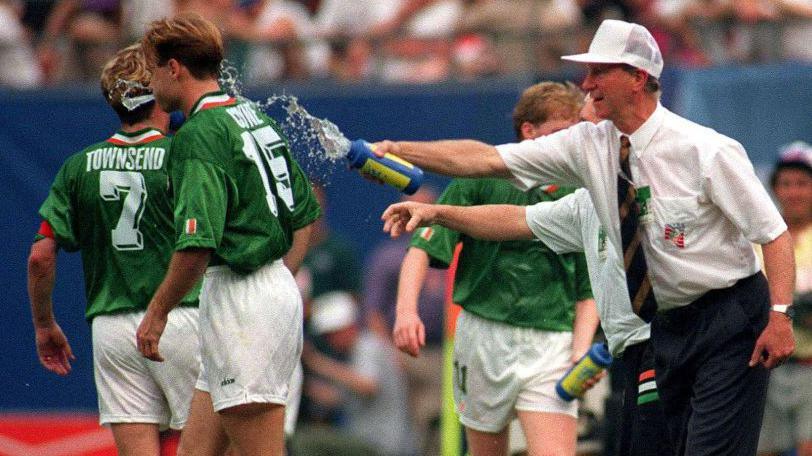 Image source, Getty ImagesImage caption,
 With Fifa not letting players drink on the pitch, Republic of Ireland boss Jack Charlton took to cooling his charges down by throwing water at them
Many of the matches at the 1994 World Cup were played in the blistering daytime heat.
The match between the Republic of Ireland and Mexico in Orlando, Florida saw air temperatures about 40.5C, while down at pitch level they reached as high as 49C (120F).
Astonishingly, at that tournament Fifa prevented players from drinking water on the field of play, much to the annoyance of Republic of Ireland boss Jack Charlton.
But despite the high temperatures, matches continued without interruption.
It will be different at the 2026 World Cup for a couple of reasons.
The US has always been used to intense thunderstorms and lightning strikes in the summer months.
But climate change has caused global temperatures to rise and the risk of dangerous heat has significantly increased., external
The climate crisis has resulted in warmer air, with more moisture, which brings a higher chance of thunderstorms - many of them more violent, increasing the number of lightning strikes.
And the evidence shows there are now many more extreme weather events in the United States compared to 30 years ago.
Until the early 2000s decisions around when to stop events were taken at local level.
Then regulations were drawn up by both professional and amateur sports to determine when it was safe to play or continue. The 30/30 Lightning Rule, external was initially brought in.
"When thunder roars, go indoors," is the advice.
Detection equipment has also become more sophisticated. No longer would you physically have to see lightning for warnings to be issued for a location.
Are major storms more likely in US than UK?
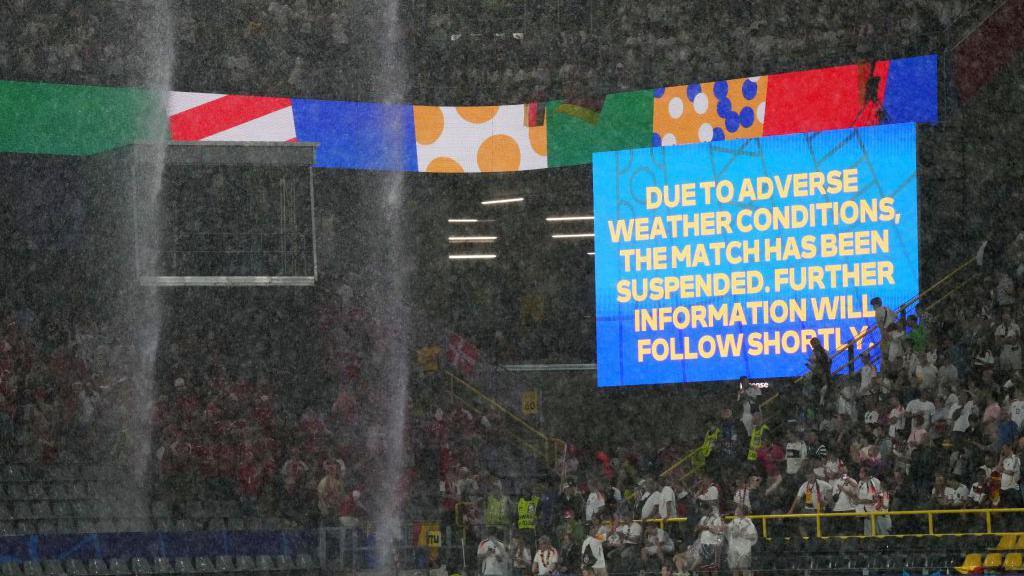 Image source, Getty ImagesImage caption,
 It is rare for a European match to be delayed by the weather, but Germany v Denmark at Euro 2024 had to be paused lightning struck
The Football Association offers guidance to the grassroots game, which places an emphasis on planning.
It says that it is "the responsibility of the match official to determine whether a fixture should be postponed, cancelled or abandoned".
Officials and competition organisers ensure conditions are safe for a game to begin, or continue.
When it comes to a game in the Premier League or the English Football League, the referee will make the call.
It is unusual for an electrical storm to cause a game to be paused or postponed in England - largely because it is a winter sport and few games take place when electrical storms are more prevalent.
In fact, thunderstorms are reported to be four times more common in North America than Europe.
In September 2016, the Champions League tie between Manchester City and Borussia Monchengladbach was abandoned on "safety and security grounds".
That, however, was more down to the rain than lightning - the goalmouth at one end was heavily waterlogged.
Manchester United did see a pre-season event abandoned because of an electrical storm in 2004.
Two games were due to be played at Old Trafford, with PSV Eindhoven v Urawa Red Diamonds cut short by referee Andy D'Urso with 10 minutes remaining. With more storms forecast, the match between Manchester United and Urawa Red Diamonds was also cancelled.
In Europe, a game at Borussia Dortmund's Westfalenstadion at Euro 2024 was affected.
Referee Michael Oliver halted the last-16 encounter between Germany and Denmark at 0-0 in the 36th minute, with the players leaving the pitch as lightning flashed in the sky.
Heavy rain drenched the pitch, with water pouring down one corner of the stadium roof close to the Denmark supporters.
The match was suspended for about 25 minutes before continuing.
If there are delays to several matches at this summer's World Cup it could make for a unique experience.
How long will a match last? Is it going to overlap another? And will it even finish on that day at all?
That is something the powerful North American weather will decide.
Related topics
World Cup fixtures and group standings
How to watch the World Cup on the BBC
- Published10 December 2025

Everything you need to know about the World Cup
- Published1 April