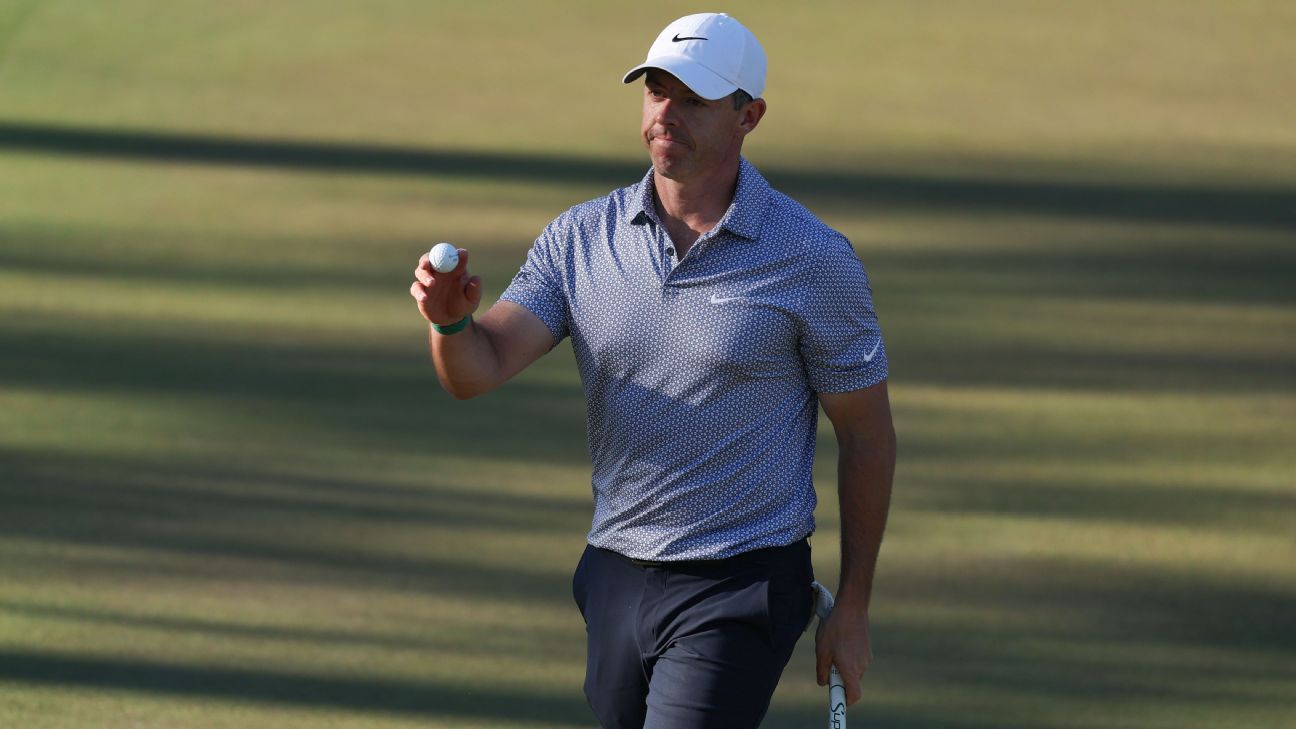
AUGUSTA, Ga. -- The slumped shoulders and the frustrated sighs, the hands running through his hair and listless glances up to the sky were back. Behind Augusta's iconic 12th green Saturday afternoon, a red-faced Rory McIlroy suddenly looked like he had just seen a ghost he thought he had already outrun.
In the span of a few hours, the six-shot lead he had accrued over 36 holes -- the largest at this tournament -- had evaporated into the hot Georgia air.
Not only was McIlroy's lead gone, the Masters had suddenly transformed from a potential blowout into a wide-open affair.
It was never going to be easy. Not at Augusta National, where every corner of the property can become a trap as soon as you start marveling at the view, and especially not for McIlroy, who knows all too well that 18 holes is an eternity and 36 holes might as well be forever and a day. A six-shot lead was historic, but it was never comfortable given the way that this course and McIlroy are prone to craft a cocktail of chaos. 2011. 2025. And now, 2026.
Last year, McIlroy appeared to conquer the place that had haunted him year after year, albeit in a dramatic playoff. Or so we thought. Skeptical and curious, the golf world showed up this year ready to celebrate McIlroy and watch him take a victory lap. McIlroy relished it but he also prepared; he wanted to win again.
In the lead-up to the tournament and throughout the first two days, he displayed a version of himself that was calm, cool, collected and confident. For two rounds, he galivanted through Augusta National with the swagger of a champion. Things were different now -- McIlroy said it himself -- and how could they not be? Even if he had realized the grand slam and a green jacket was not his "destination" it was sure nice to be able to find solace in their possession.
Then Saturday arrived and McIlroy was once again caught in the crosshairs of a collapse.
"This golf course has a way of, when you're not quite feeling it, you struggle," McIlroy said. "You have to dig deep."
It is clear that McIlroy finds a certain comfort in being aggressive. In a documentary detailing his 2025 win, he talks about how, when he got to the 15th hole that Sunday and he had lost what was at one point a five-stroke lead, he knew he needed to be aggressive, and it helped him deliver one of the most iconic shots of his career.
"I needed to pull something out of the bag at that point because I was going in the wrong direction," he said.
On Friday, he shared that his mantra all week was to just keep swinging. Through two rounds, he had missed fairways left and right and yet he kept swinging, relying on his short game and his putting to lead the way. It was working. Until it didn't. He overdrew his approach shot on 11, found the water and missed a short putt for bogey. On 12, his sawed-off swing looked uncommitted, and the ball missed the green. By the time he teed off on 13, there was no doubt where the ball was going because it had gone there all week: right and into the trees. The previous two days, McIlroy had still made birdie. Saturday, he had to scramble for par.
"I kept committing to trying to make good swings," McIlroy said. "But yeah, there was probably a little -- when I made the double at 11, I probably got a little bit uneasy on 12 and 13."
When he was in his mid-20s, conquering the golf world fearlessly, leads did not seem to faze McIlroy. At other events, that has mostly continued to be the case. And yet here, the quandary persists.
Just take a look at Saturday. Once he had lost the lead, McIlroy birdied 14 and went for 15 in two shots, giving himself another birdie. The lead was his again. He made par on 16 and then put it in the trees on 17, leaving his par putt just short. He was the only player inside the top 12 on the leaderboard who shot over par on a day where the scoring average was 70.63 -- the second lowest of any round in Masters history.
The way that McIlroy's game can create such highs and such lows, often in contrast to what the rest of the field is doing, is singular and he knows it all too well. When asked Friday if he would prefer to win in dramatic fashion or in a runaway finish, McIlroy shot back.
Of course, McIlroy would prefer to win by six or more, but here he just can't seem to do it. With one round left in this tournament, McIlroy has the lead and does not. At 11 under, all tied with Cameron Young, the final round provides something he didn't have when the madness occurred last year: a clean slate.
This time, aside from Young, six players at 7-under par or better are happily playing the role of chasers, including two-time Masters winner Scottie Scheffler, last year's runner-up Justin Rose and Shane Lowry. All of them have recent, palpable evidence from last year that McIlroy can be prone to give it away. On Saturday, he reminded them.
"I was aware that he wasn't kind of stretching it out," Rose said of McIlroy's lead. "So it kind of made it feel like, yeah, all to play for."
"I thought if Rory could shoot a 68 today he might run away with the tournament," Lowry said. "It's not easy to go out and go after it when you're at the top of the leaderboard. It obviously wasn't going to be an easy day for Rory to shoot a score."
"I don't feel like I'm out of the tournament," Scheffler said after posting a 65 Saturday before McIlroy regressed. He certainly isn't now.
Even if McIlroy might be more comfortable chasing the leader as opposed to protecting the lead, Sunday's backdrop will inevitably be that. Should he come up short, he will have blown the biggest 36-hole lead of any Masters. In reality, he has already blown it -- whether the weight of such a collapse is too much to overcome or just enough to prompt the kind of aggression he needs to repeat remains to be seen.
"I'd like to think that I'll play a little bit freer and I'll play, you know, like I've already got a green jacket, which I do. Sometimes I just have to remind myself of that," McIlroy said. "I wish I was a few shots better off, but I'm comfortable. ... I just know I need to be better tomorrow to have a chance."
After speaking to the media, McIlroy trotted off to the tournament practice facility, where the floodlights had just come on and began hitting shots into the night hoping to find a fix to his stumble. On Sunday, he and Augusta will converge for another spin around the block. Whatever transpires over the course of 18 holes, one thing is certain: It will not be boring.
"We all know it's all about tomorrow," Lowry said. "Obviously, it matters today, but when we get to tomorrow, that's when we'll see what everyone is made of."