

Jan-Niklas Hustedt remembers going to techno parties in the abandoned canteen of a pump factory that had drastically downsized after reunification, in his hometown of Oschersleben.
He was born in East Germany in 1989, just a few weeks before the fall of the Berlin Wall. He describes himself as a "wendekind"; a child of the turning point.
Now, at 36, he recalls how that time would change his community.
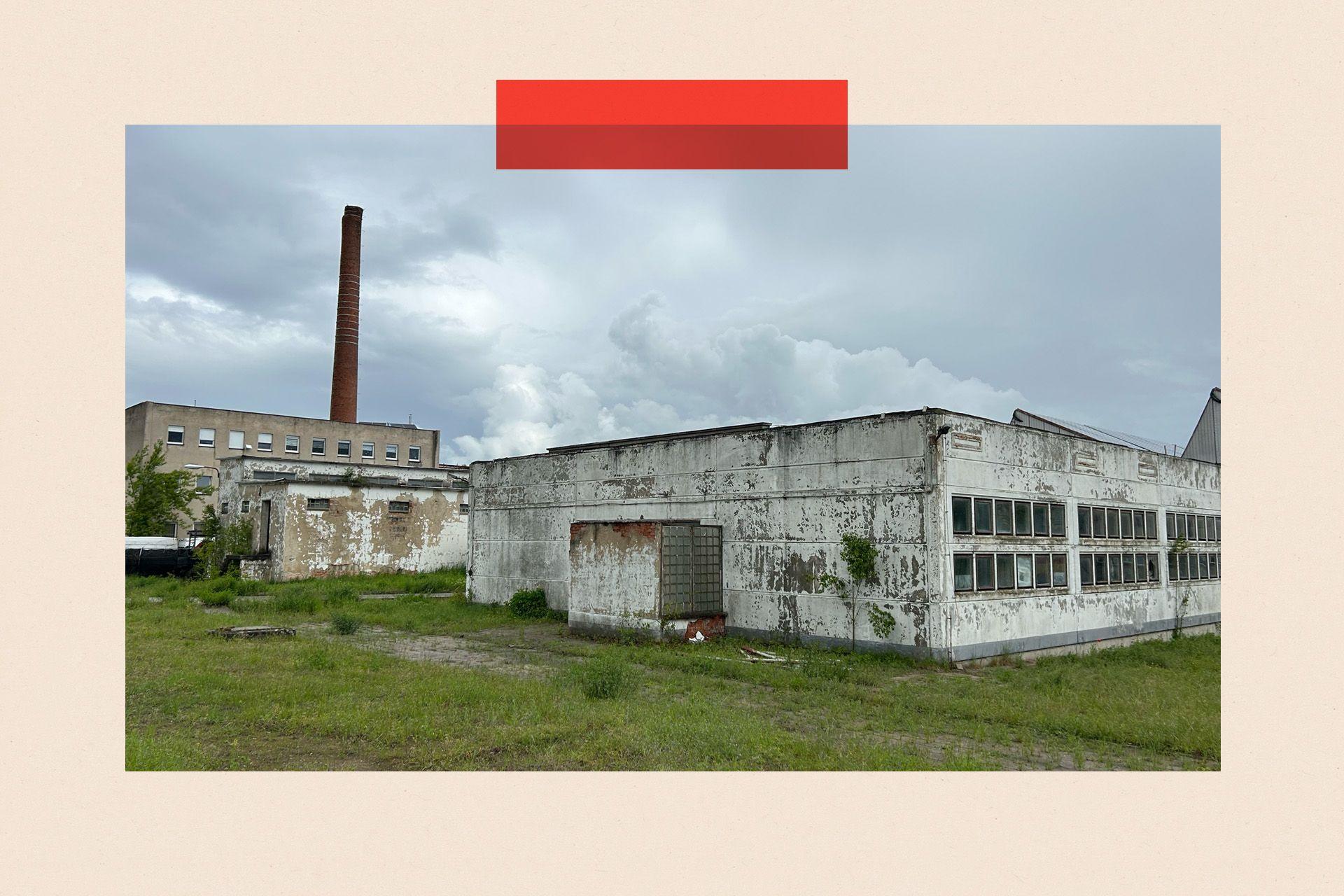 Image caption,
 Parts of the old East quickly emptied out
Many businesses in the communist east struggled or simply collapsed as they were thrust into a profit-driven, highly competitive, global economy.
"You hear all the stories," says Jan-Niklas. "Lots of people left because the opportunities were in the west."
In the 35 years after reunification, the country's overall population grew by 3.8 million, a 5% increase - driven by immigration.
But in the five states that were part of the eastern German Democratic Republic (GDR), the population has fallen by 16% (this figure excludes East Berlin).
The state of Saxony-Anhalt, where Oschersleben lies, recorded the most dramatic decline at 26% - according to official statistics published last year.
Now, across large swathes of the more rural east, further population falls are expected as the east's post-reunification "brain drain" combines with a national trend: low birth rates.
Look at the map by government demographers; the deep blue areas – where the starkest drops are expected – are highly concentrated in the less urbanised parts of the east.
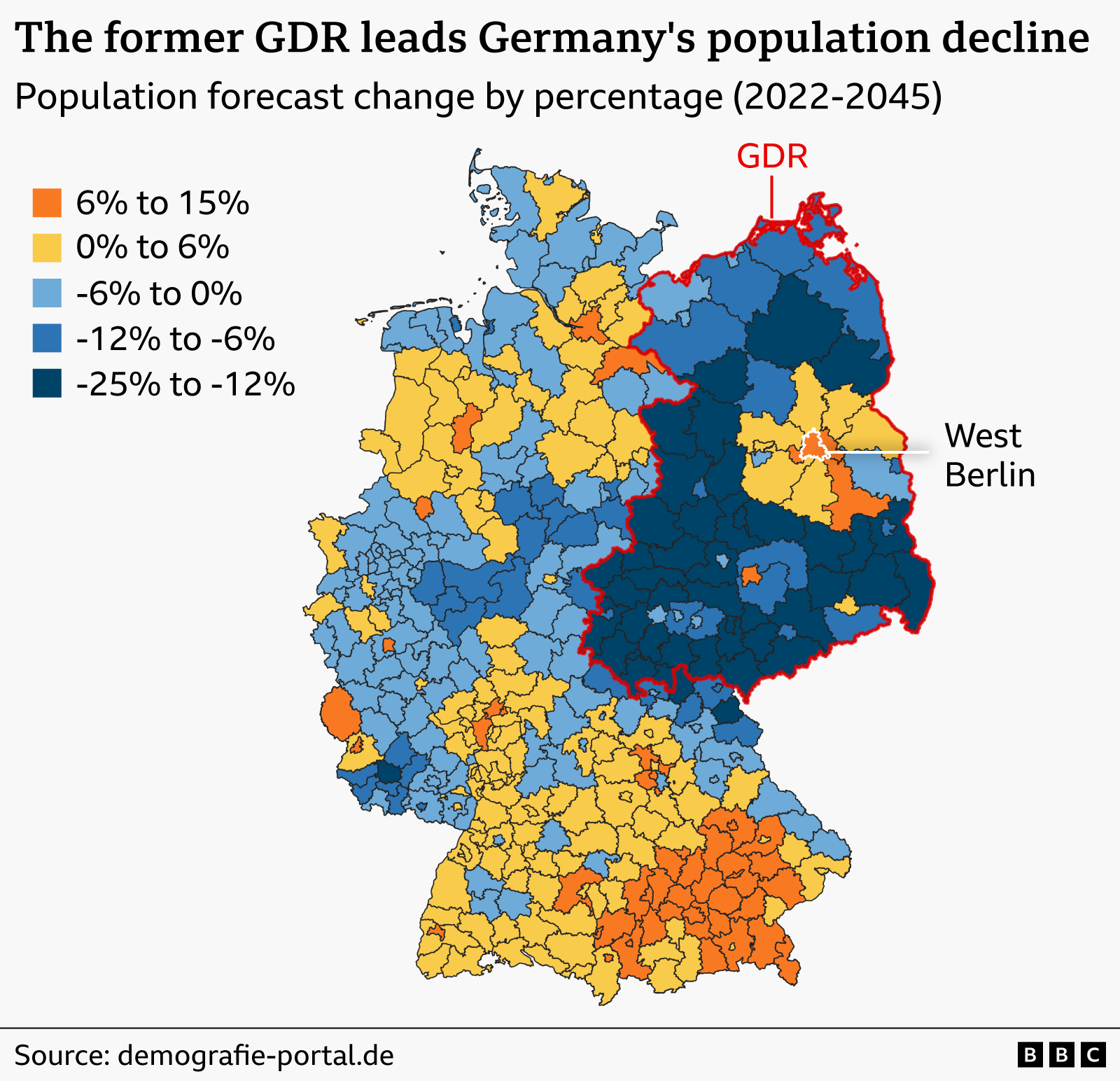
Only the state of Brandenburg, which encircles Berlin and sees spillover from the capital city, bucks the trend.
Longer term, as Germany's population ages, the country's federal statistics office says there will "in all likelihood" be fewer people by 2070. For eastern states outside of Berlin, that's projected to be the case "under all scenarios".
Such projections are based on certain assumptions and are not set in stone. But this demographic change may be helping drive up support for Alternative for Germany (AfD), a party that's classified, within Saxony-Anhalt, as right-wing extremist by domestic intelligence.
Yet it's in this state that the AfD could win power in elections later this year. It's a potentially seismic moment for Germany.
'Tear down this wall'
News footage from 1989 shows the euphoric scenes as people poured across what had, for decades, been a heavily guarded no man's land; the Berlin Wall.
Those on foot swarmed across in crowds while the sudden influx of fume-belching East German Trabant cars sparked complaints about pollution in the west.
But it would also become a time of an enormous sense of loss for people in the east who found their socialist society absorbed, almost overnight, into the capitalist west.
A satellite state of the Soviet Union, the German Democratic Republic (GDR) - as East Germany was known - was a centrally-planned, state-owned economy.
The regime relied on strict media censorship and the Stasi, a large and feared secret police force to keep citizens in line.
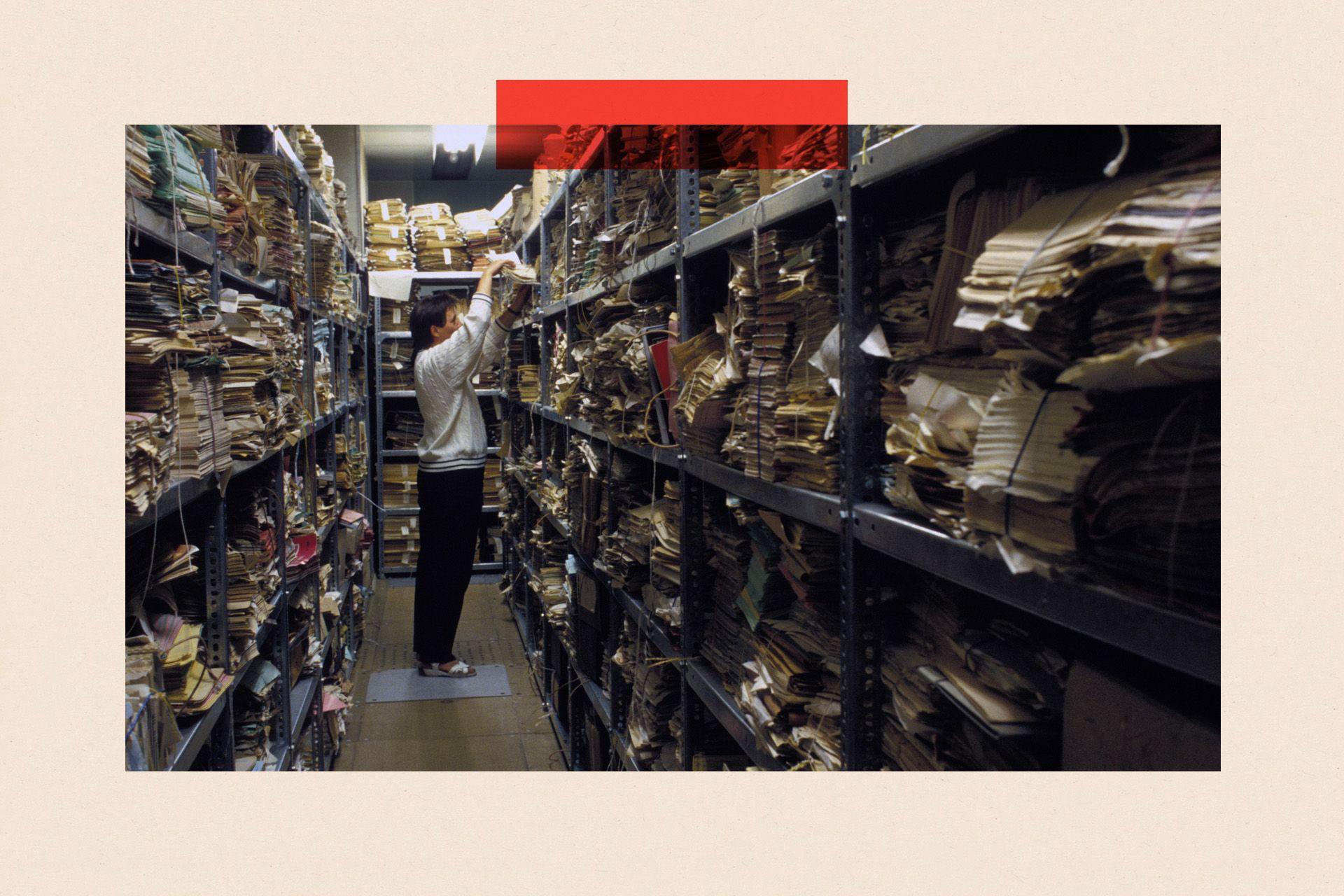 Image source, Gamma-Rapho via Getty ImagesImage caption,
 The Stasi kept extensive files on its citizens
There were also heavy restrictions on people's ability to leave as the authorities tried to prevent people from fleeing west - as so many had over the decades.
East Germans did, however, get subsidised housing, generous childcare support and guaranteed employment.
But it was built on an increasingly inefficient and debt-ridden economy, which meant that the rapid process of privatisation, when it came, was brutal and led to mass unemployment.
Graphs show how fertility rates in the east plummeted while there was a huge exodus west, which came in two main waves. The first began right after the wall fell, while the second peaked in the early part of this century.
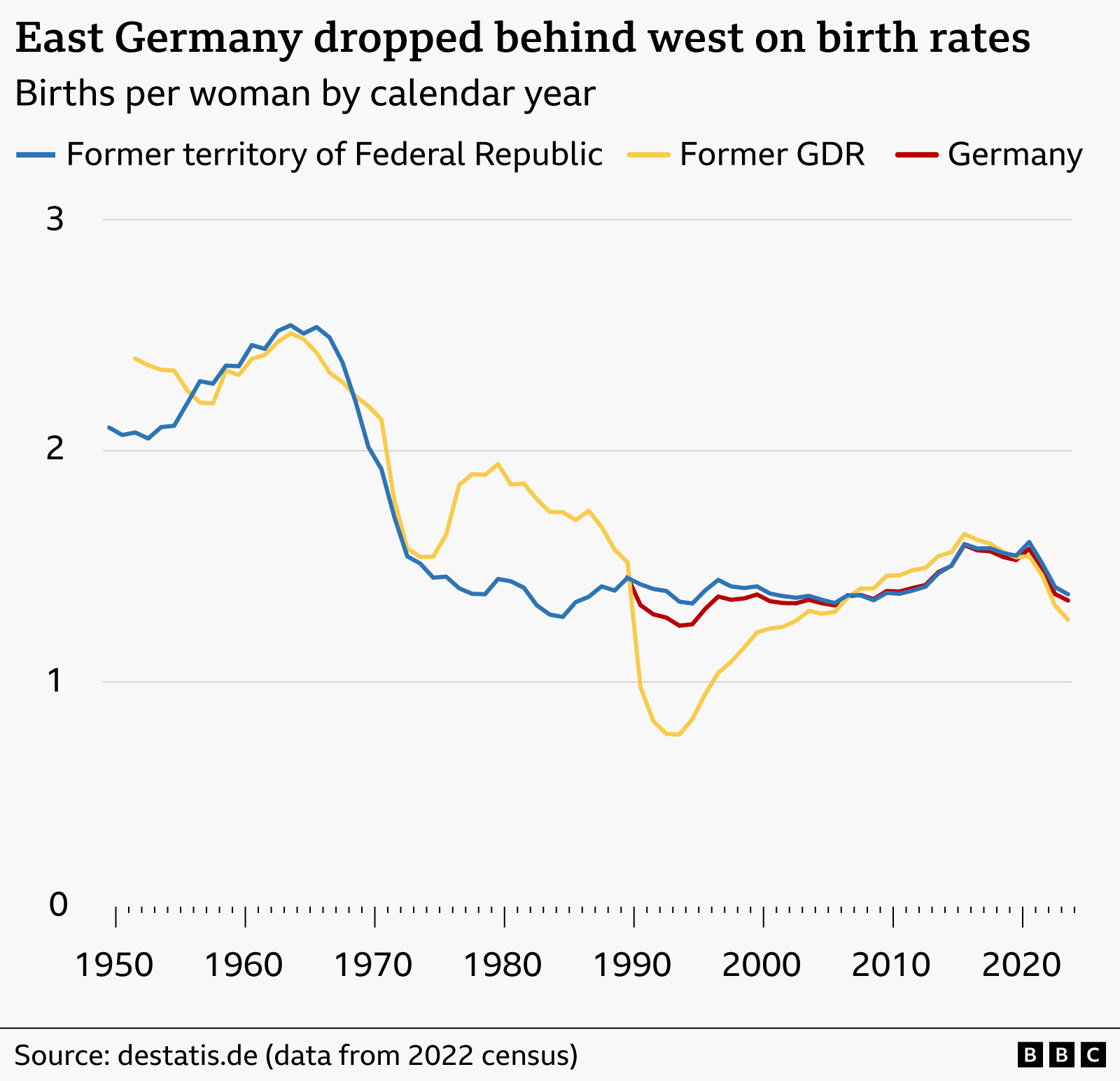
That second wave was "smaller in scale but no less consequential because it was highly selective," says Dr Katja Salomo, a sociologist at the University of Kassel who grew up in a rural part of east Germany.
"Young people, highly educated people and especially women, were more likely to leave."
One reason for women leaving was that the east's female workforce was treated as an "afterthought" during the reunification process - argues Katja Salomo.
"And so they went to West Germany and got them [jobs] there."
Fewer women naturally meant fewer children. And while the big exodus ended years ago, the east still has a more pronounced shortage of young people and skilled workers than the west. As well as emptying kindergartens.
The baby bust
This is an emerging phenomenon in east Germany: "Kitasterben". It literally translates to "daycare dying".
It's driven by low birth rates within an already depleted population in regions that, during the communist era, had built up an extensive network of childcare settings.
"There are now [newspaper] articles where kindergartens [say they] need children, which is crazy," says Jan-Niklas.
He says the kindergarten his daughter goes to asked if he and his wife knew of other families needing a place.
I met Jan-Niklas in the centre of his hometown, Oschersleben. Including surrounding villages, it has a population of roughly 19,000 people.
It's a Wednesday lunchtime. The centre isn't quite deserted, but it's not busy either.
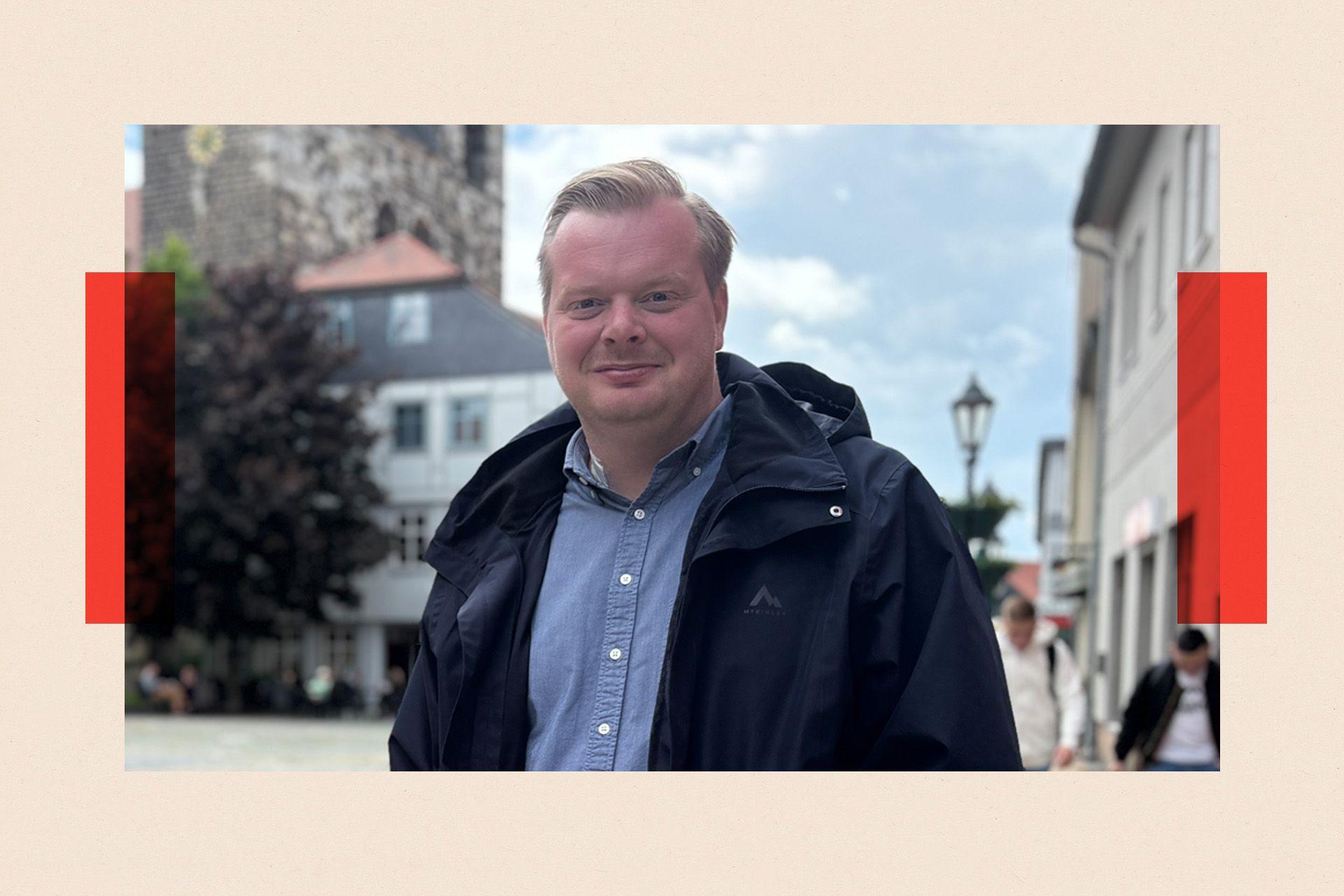 Image caption,
 Jan-Niklas has become an advocate for his hometown
It doesn't take long to spot an empty shop front, or several of the area's growing number of elderly people.
Now Jan-Niklas, who sees reunification as a "success story" overall, is on a mission to bring younger people and families back.
It's "home", he says. "I like the people. I think they deserve [to do] well."
He left when he was in his late teens, to later return having built a career as a recruiter for a major German bank. His move home made the local news.
"Back in Oschersleben after 13 years," read the Volksstimme (People's Voice) headline. "Returnee calls for ways to combat the skilled-worker shortage."
That's just one problem with population decline; filling vacant jobs, including crucial social and healthcare roles to support the increasingly elderly population.
Fewer people can also lead to fewer services, such as shops, maternity wards, and schools.
While a large number of migrants or refugees have come to Germany from countries including Ukraine, Syria and Turkey – as well as from other EU nations – those immigrants have mainly headed to big cities, such as Berlin, and the more urbanised west.
And even when accounting for these people, Germany has an ageing population as the baby-boomer generation increasingly retires, and the nationwide birth rate stays stubbornly low.
It means a shrinking workforce is having to shoulder the cost of a growing number of retirees.
Birth rates began falling in the late sixties, after the introduction of the contraceptive pill and at a time when women became more likely to enter the workforce. But last year the number of births reached their lowest level since 1946, according to preliminary figures.
Professor Martin Bujard, from the Federal Institute for Population Research, a government agency, says data suggests that the impact of global crises like covid and the war in Ukraine have exacerbated the trend.
"After Russia launched its full-scale invasion, nine or ten months later, birth rates in Germany fell," says Professor Bujard.
The latest figures show that women without German nationality have more children than German citizens, with rates of 1.84 and 1.23 respectively (known as the fertility rate).
But both are below the "replacement rate" of 2.1; the level at which a population stays steady from one generation to the next.
Germany's not alone in this. The UN has warned of an "unprecedented decline" in global fertility rates, driven by factors such as affordability and a lack of suitable housing.
What's unique about the east of Germany today is that these birth rates are happening within a population that was so recently – and so rapidly – hollowed out.
Heading east
There have been many initiatives over many years to increase the population in the east of Germany.
Katy Löwe runs one of them from Halberstadt, a town that lies at the northern foothills of Saxony-Anhalt's Harz Mountains, 120 miles west of Berlin.
We met in Cathedral Square, near the Gothic-style St. Martini church which was destroyed at the end of World War Two and then rebuilt.
It's one of the attractions for passing tourists, but Katy's mission is to get people to actually live in the region.
Funded by local firms who need workers, Heimvorteil Harz (which translates as Home Advantage Harz), tries to match people with vacancies and promote the area's perks.
Driving through the region, you'll find well maintained roads and picturesque towns.
Standards of living in the east have significantly improved since reunification, even if wages still lag behind the west, particularly when compared to wealthy states like Bavaria.
For Katy, who's from a nearby village, bringing people back is personal: "I think the main thing is the fear that towns will be half empty. Villages will be half empty."
"That's what we have to reverse in order to maintain a good quality of life in rural areas."
Heimvorteil Harz doesn't have precise records of how many people they've lured back and campaigns like hers, Katy says, can only go so far. "The problem is too big."
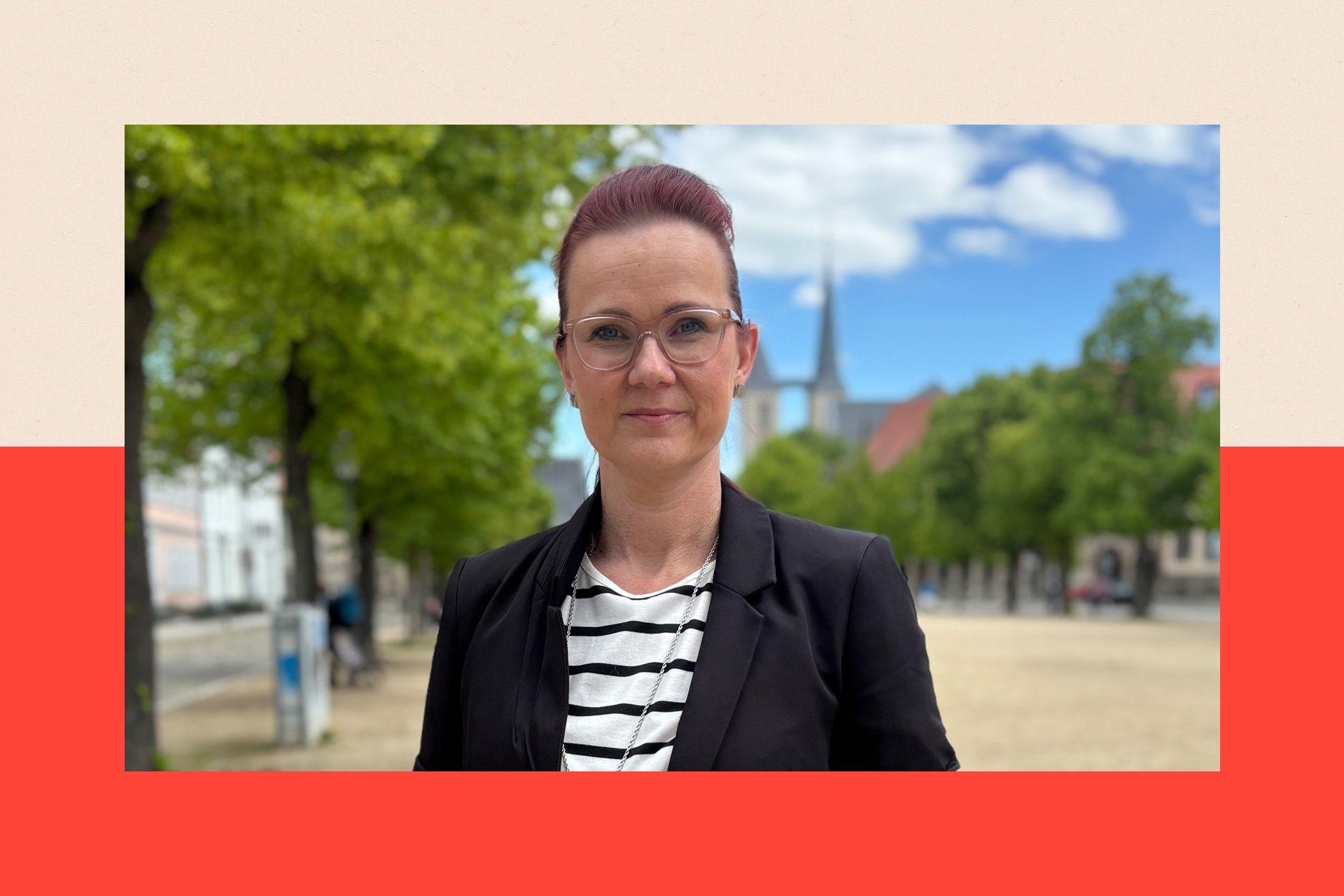 Image caption,
 Katy wants people to live in the region
It's about trying to get your area noticed, she says, as regions are "competing" against each other for people.
Academics have spent decades trying to understand the lingering divide between east and west Germany; "Ossies" and "Wessies", and these are divides that cut across numerous spheres.
For example, all firms listed on the Dax, Germany's stock market index, are headquartered in the west or in Berlin while east Germans also have far less inherited wealth.
After the upheaval of reunification, Katy believes it's also a matter of mentality.
The east German mindset, she says, is marked by a "collective experience of huge loss."
"They are very fearful that they may experience it again. That's the main driver of people either leaving or voting the way they do."
And the way people vote in Saxony-Anhalt could be about to change the political landscape in Germany.
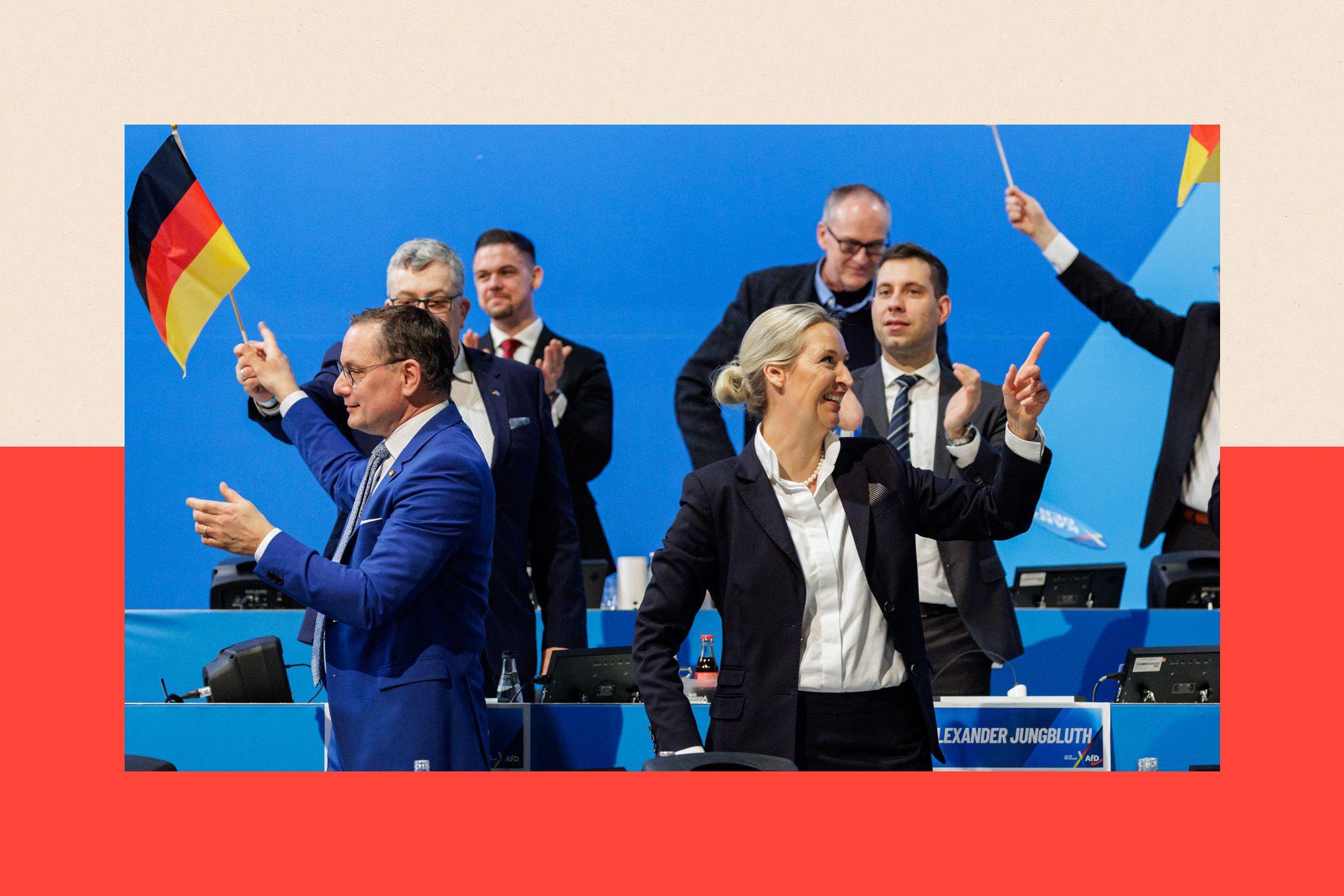 Image source, AFP via Getty ImagesImage caption,
 The AfD's popularity is on the rise in the east of the country
It may be where the Alternative for Germany (AfD) party forms its first state-level government.
This would be an explosive moment in a country where the far-right hasn't held that kind of power since World War Two, although AfD leaders strongly reject comparisons to Nazism and insist they are a conservative, libertarian movement.
The social-media savvy Ulrich Siegmund is the AfD's lead candidate in Saxony-Anhalt, where the party is polling at more than 40% ahead of elections in September. This could be enough for an overall majority.
Population decline may be among the reasons behind the AfD's popularity.
According to sociologist Katja Salomo, "Research shows that electoral support for far-right parties, including the AfD, tends to be higher in the regions most affected by population decline."
While it's difficult to prove precise links, she says - for example- a sense of stagnation and dwindling infrastructure can make communities feel that the political system, "is not working for people like them."
Such areas can also have a more "sceptical view of immigration" even though more immigration would, in principle, "help to stabilise East Germany's demographic situation."
In 2023, domestic intelligence found that the AfD's Saxony-Anhalt branch was permeated by a "racist ideology" in violation of the German constitution which guarantees "human dignity" for all.
As a result, it's one of the states in which the party's been classed as right-wing extremist. It generally rejects such designations as politicised persecution.
In its manifesto, the AfD in Saxony-Anhalt argues that immigration is an, "Unsuitable remedy for the extinction of the local population."
Instead, it wants to incentivise larger families by, for example, handing out baby bonus payments to parents.
Critics say the AfD's wider anti-immigration and deportation plans would be both a disaster for Germany's already ailing economy and potentially illegal. But many Germans see it differently.
According to surveys, the AfD is now the country's most popular party with polling numbers in the high twenties, although its support remains heavily skewed to the east.
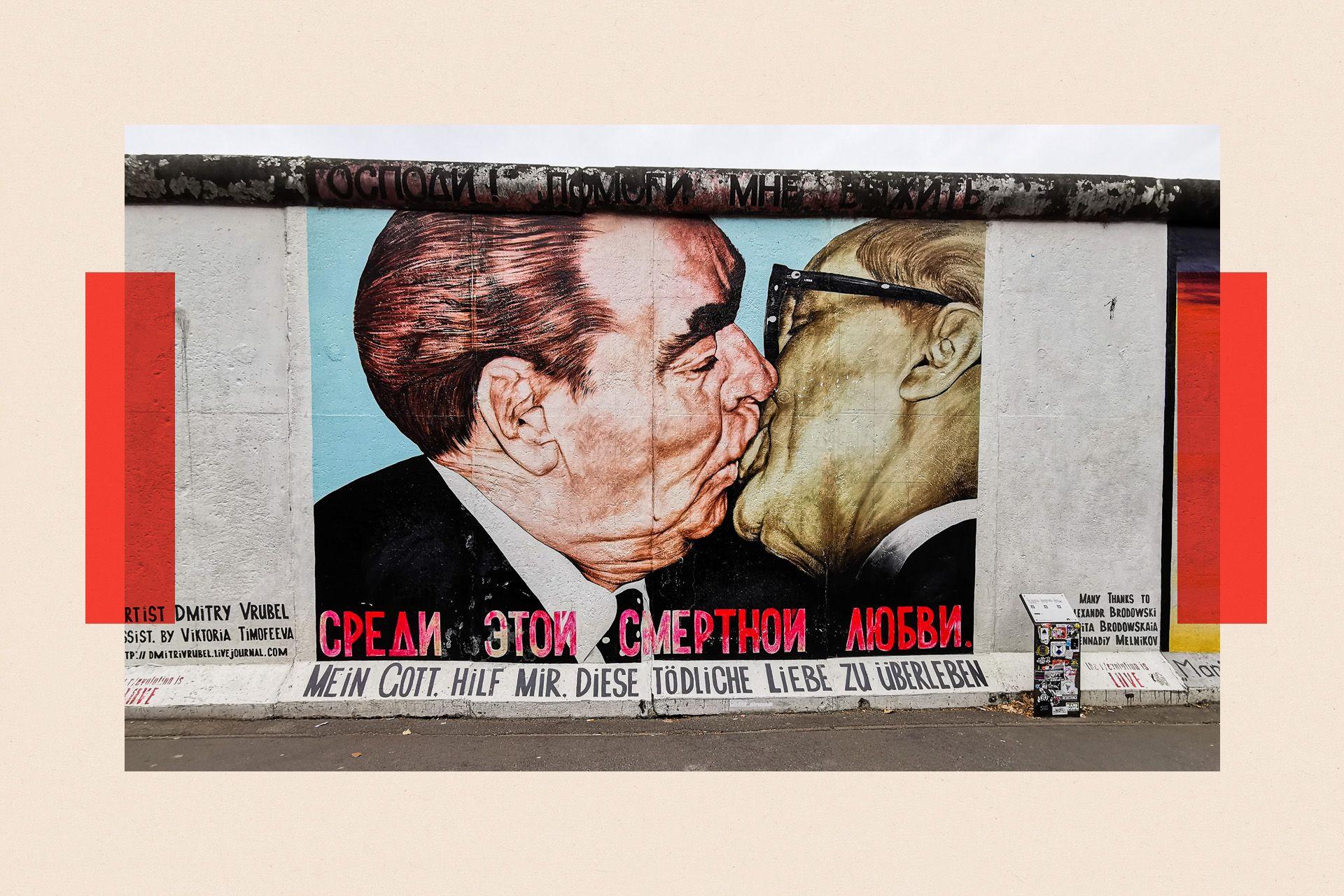 Image source, Getty ImagesImage caption,
 Decades after the Wall fell, divisions remain
Some may point to possible benefits of depopulation, such as less traffic and cheaper accommodation.
"It can make housing more accessible," says Professor Martin Bujard, who notes our ecological footprint "reduces a little bit with population decline."
But Bujard says low birth rates are a bad thing overall, due to the imbalance it creates between young and old - while population decline can cause frustration in local communities.
Bujard says more must be done to support people in the "rush hour of life", such as those trying to hold down jobs and raise young families.
"Policy should help potential parents realise their hopes," he says, through improved childcare, financial support and living space.
More from InDepth
Ten years on, Brexit's economic impact is becoming clearer
- Published5 days ago
What one country's experiment says about attempts to boost birth rates
- Published16 June
A decade on from Brexit, the new PM has big calls to make on Europe
- Published6 days ago
German reunification is often celebrated as a moment of great hope and change that brought families and friends back together - as well as an entire country.
But its legacy has proven complicated and enduring; the old border may be gone but it's cast a long shadow.
Additional reporting: Michael Steininger
Lead image: Getty

BBC InDepth is the home on the website and app for the best analysis, with fresh perspectives that challenge assumptions and deep reporting on the biggest issues of the day. Emma Barnett and John Simpson bring their pick of the most thought-provoking deep reads and analysis, every Saturday. Sign up for the newsletter here
Get in touch
Are you personally affected by the issues raised in this story?
Contact formContact form