 Ryan McGeeApr 5, 2026, 07:59 PM ETClose
- Senior writer for ESPN The Magazine and ESPN.com
- 2-time Sports Emmy winner
- 2010, 2014 NMPA Writer of the Year

The ball is tipped And there you are You're running for your life You're a shooting star
David Barrett was sitting in a bar when the idea came to him. The 31-year-old musician had spent his entire young adult life grinding as a performer in the watering holes of Michigan. College bars. Dive bars. Even the occasional honky tonk. On this particular spring night in 1986, it was an East Lansing establishment known as the Varsity Inn and his set -- a performance heard by perhaps two dozen patrons -- was done.
And all the years No one knows Just how hard you worked But now it shows
Barrett was unwinding over a drink. With one eye he watched the TV over the bar, watching Larry Bird's Boston Celtics running over another unfortunate NBA opponent. His other eye was affixed on the woman who had served him that drink.
"The waitress was so beautiful, I thought, well, I'm a songwriter, so perhaps my only chance to catch her attention was through poetry," Barrett says today. "If I could express to her the poetry of Larry Bird's abilities at the height of his career, this special moment in his life creating so many special moments on the court, perhaps she would be impressed."
No offense to Barrett, but we should all be thankful that she had more critical tasks than posting up at the bar to admire the singer's basketball spoken word. Because it was within that space of lonely time that, inspired by his own lesson about moments, he scribbled three words onto a cocktail napkin. The following morning, he expanded those words into a chorus, this time onto a stack of napkins at a brunch spot, The Knight Cap Too.
In one shining moment, it's all on the line One shining moment, there frozen in time
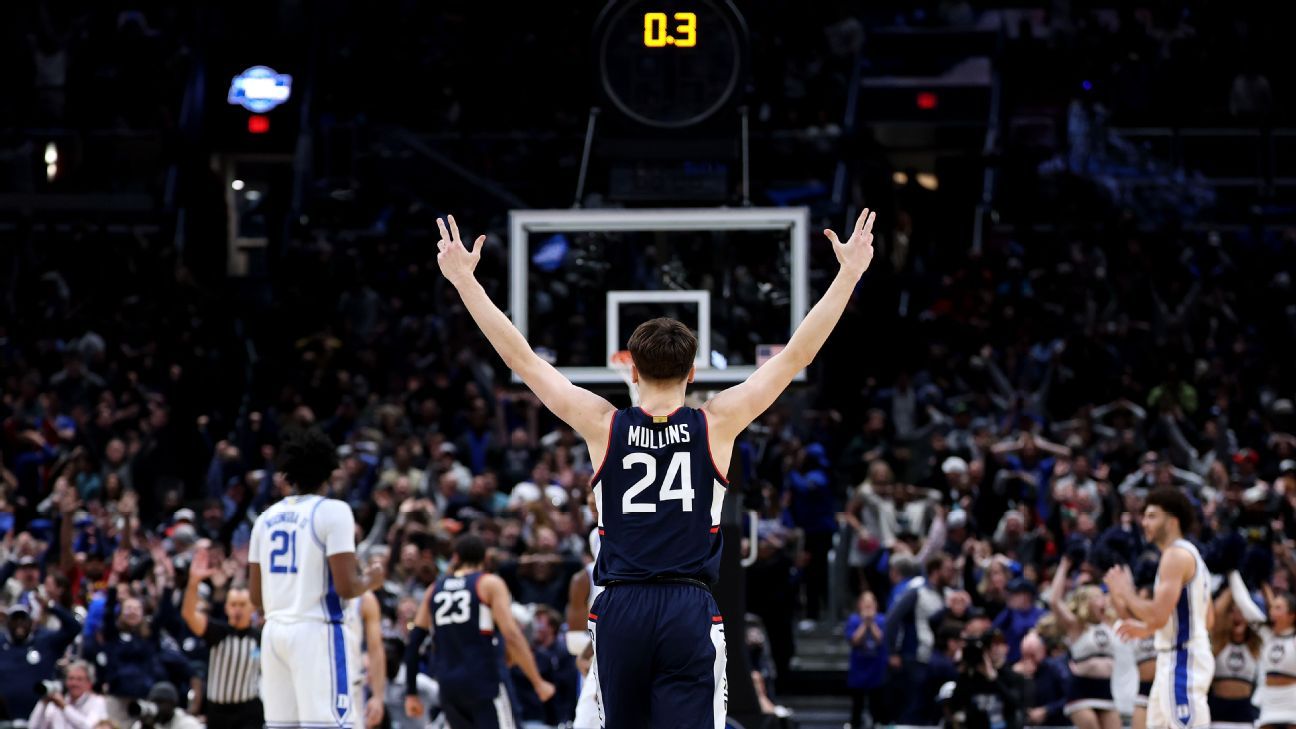
For nearly 40 years, those lyrics and the tune Barrett wrote to accompany them have been the soundtrack of our college basketball lives. On Monday night, shortly after the men's college basketball national champion is crowned, the winning team will lock arms on the floor of Lucas Oil Stadium, gaze up at the jumbotron and soak up a three-minute montage of clips from this year's tournament, set to Barrett's song, building to the inevitable 30-second climax of images of them winning the very title that they are very much still celebrating.
"There are so many moments that make up a championship celebration," explains Mike Krzyzewski, who won five national titles as Duke's head coach. "There's the moment the game ends. There's hugging your family. There's cutting down the nets. The moment of being handed the trophy. But the moment it feels real is when they play 'One Shining Moment.'"
"It's this literal life-flashing-before-your-eyes thing, watching that video set to that song," adds John Calipari, who won it all with Kentucky in 2012. "It's like watching a movie of your life, that you wrote, with the people who wrote it with you."
"You also don't just watch it if you win it," says Tom Izzo, who celebrated with Michigan State in 2000. "If you are there at the game, you wait to see it. If you are home on the sofa, you wait to see it. The season isn't done until you hear that song."
And to think, the NFL almost intercepted it right out from under college basketball's nose.
For that moment, let's go back to '86. That's when Barrett met sports reporter Armen Keteyian. Keteyian, like Barrett, was a native of the Detroit area and had moved to New York to write for Sports Illustrated. Whenever Barrett went East, he'd stay at Keteyian's apartment. During one of those visits, the two were watching the NBA Finals on TV -- Larry Bird again, doing work against the Houston Rockets -- and Barrett mentioned his basketball song from the napkins.
Keteyian told Barrett that if he got the song recorded, he'd love to hear it.
A few weeks later, a cassette was waiting in Keteyian's mailbox, tracks laid down in a make-do studio used for local advertising jingles. The reporter loved it, so he walked the tape over to a colleague in TV production.
"One day my phone rang and the gentleman on the other end said he was Doug Towey and he was the creative director at CBS Sports," Barrett recalls now, his throat catching to hold back tears. "Of course, I didn't believe him at first. He sounded like a buddy of mine pulling a prank. But over the next 15 minutes, I made a friend for life over a phone call that changed my life."
Towey, a sports television legend -- the theme music for The Masters, the iconic CBS Sports college sports themes, you name it and Towey was probably behind it -- had fallen in love with the song and told Barrett that he really, really wanted to use it for ... Super Bowl XXI?
"Yes, it was a basketball song, but you know what you do not do in that situation?" Barrett says. "You do not say no to CBS. Why yes, Doug Towey, please use my song for the Super Bowl!"
CBS even flew Barrett out to Pasadena to watch the matchup between John Elway's Denver Broncos and Lawrence Taylor's New York Giants. During his postgame report, sportscaster Brent Musburger even quoted the song. "The New York Giants, their first Super Bowl triumph, a shining moment they will never forget..." The time had arrived. Barrett's big break was happening!
But it never ran. The Super Bowl-winning Giants were a little too chatty in their postgame locker room interviews, so the broadcast ran long, and time ran out. Barrett was crushed -- until a second call from Towey.
"He said they wanted to use it for March Madness," Barrett's voice nearly explodes as he tells the story. "So, my little song about basketball, you know what? It figured out a way to make sure it was still a basketball song."
On March 30, 1987, "One Shining Moment" made its debut in the most perfectly shiny momentous manner.
Indiana's Keith Smart had stroked a drifting corner jump shot with four seconds remaining to defeat Syracuse for the championship. CBS Sports editors scrambled to add nine shots from that game to the end of the montage they had already pieced together throughout the month. The seventh of those images was Smart's dagger.
From a clunky makeshift video edit room next to the CBS production truck in the bowels of the Superdome, the instant those shots were added, the videotape was popped and sprinted by hand via a panicked young producer to the end of that truck, where tape machines had just spent hours turning around instant replays and interview clips for the telecast. It got crammed into one of those machines, cued, and ready to play.
Once again, it was Musburger who did the lead-in honors. And this time it aired.
"The idea of the song, that one moment can change everything. Well, that's what happened to me in that moment," says Barrett, who has since composed themes for CBS, ABC and PBS, melodic backdrops for the Olympics, U.S. Open tennis, the PGA Championship, and a documentary about C.S. Lewis. He's won two Emmys.
His go-to joke now is to say: "After all those years, suddenly I had talent!"
Since that night, CBS Sports and now TNT have aired 38 editions of "One Shining Moment" performed by four different singers. Barrett himself did the honors over the first seven editions before Towey recruited Philadelphia soul legend Teddy Pendergrass for a new version. Bennett's vocals returned in 2000, along with a bluesier overhaul of the tune. Two years after that, Barrett received another call from Towey, asking how he'd feel if Luther Vandross were to give the song a spin. Barrett said of course and asked when it would happen. Towey, clearly having already made up his mind before the call, told Barrett that Vandross was slated to be in the studio that very night.
Vandross laid down his vocals in the winter of 2002, captured by CBS cameras to be intercut with the hoops highlights in true music video fashion. The following spring Vandross suffered a massive stroke that forever altered his voice, meaning that "One Shining Moment" was the final song recorded by the legendary artist.
It has been Luther's song ever since, with the exception of 2010, when Oscar winner Jennifer Hudson's rendition was beloved for its sound but criticized because the internet claimed it was imbalanced, with too much of her and not enough college basketball. (At 3:12, it's only a few seconds longer than average, and Hudson is featured for a total of about eight seconds.)
Screening all 38 editions of "One Shining Moment" (thanks, Internet!) is a history lesson not just on college basketball, but television production. Grainy standard definition video transitions into 4K HD as majestically as the images of 1980s feathered hairstyles morph into low burst fades. The production process has evolved not unlike the game being played on the floor of the arena. Digitized and fast-paced, with the ability to be nimble on the fly like UConn and Michigan on the break. But the spirit of how it is pieced together hasn't changed at all.
"We have a dedicated team that travels to the Final Four. They are on site," explains Drew Watkins, SVP and Creative Director of TNT Sports, from the sprawling TV production compound that sits outside the south gate of Lucas Oil Stadium.
Watkins has been with TNT since 2000; before that he was an entry-level producer at ESPN. On Monday night, he will be keeping an eye on his on-site producer and editor, George Adams and Chris Vining.
"They're in one of our edit trucks and are linked in with the studio and the game production truck," Watkins says of how it will all go down as the clock ticks down on the title game. "So, when we're editing those plays, and we're filling in those last few moments and winners are being decided and 'One Shining Moment' is minutes away from airing, there is a team on site in the TV compound that is putting those shots together, talking to the broadcast trucks to make sure everything is on track."
There will actually be two edit suites running simultaneously, just in case. Because all it takes is one power outage, one video glitch or one computer deciding that it's a great time for a restart, to turn the dream of Barrett's song into one nightmare moment. Redundancy is a producer's best friend. No one wants to be the person who ended a four-decade streak of making air.
"The good news is that we have backups in place," Watkins said. "The better news is that nobody's having to pop a tape and run it across a parking lot anymore."
Once that final shot is added and the final click of the mouse sends the finished product to the truck, Adams, Vining, Watkins and their colleagues make sure to pause and watch their work go out into the world, collapsed back into the chairs of their respective production trucks, just like the 20-plus million viewers at home.
Meanwhile, the viewing of "One Shining Moment" as it airs on the arena's big screen always feels downright intimate, even on a tiny basketball floor situated in the center of a 70,000-seat NFL stadium-turned-basketball gym.
That's the part that chokes up Krzyzewski, Calipari and Izzo when they talk about it. The part that former players always remember as the pinnacle of their first minutes as champions.
On Monday night, the man who brought us the song will be right there with them. Because it's his favorite part, too: David Barrett's literal "One Shining Moment."
"People ask me all the time which 'One Shining Moment' is my favorite one to watch, but I can't answer that. That's impossible," he said on Saturday morning as he prepared to attend the semifinal games with his wife, Tracy. (No, she's not the waitress from East Lansing, though that server, Jan Shoemaker, and Barrett were eventually reunited through a mutual friend.)
Tracy is a Michigan alum, and she and David still live in the Detroit area, where they raised two girls. As soon as they arrived in Indianapolis, they purchased some Block M Final Four gear before they witnessed the Wolverines' devastation of the Arizona Wildcats to officially become the favorites to win the national title.
"No, I do not have a favorite 'One Shining Moment,'" Barrett repeated. Then he laughed. "But Monday night, if we get to watch the home team watch themselves celebrate a championship, set to my little basketball song, well..."