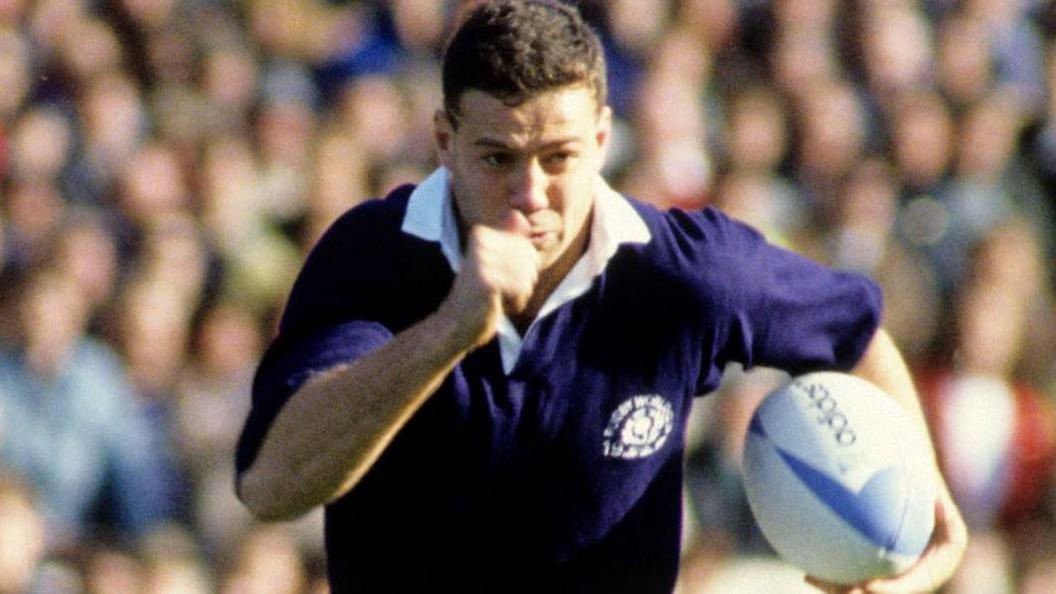
 Image source, SNSImage caption,
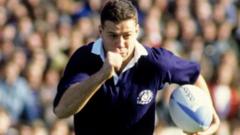
 Scotland rugby great Scott Hastings died on Sunday
ByTom EnglishBBC Scotland's chief sports writer- Published30 minutes ago
The rain was belting down in Invercargill, the southernmost spot in New Zealand, a place founded by a Scottish settler in the 1850s and nicknamed the city of water and light. Whatever about the light, they got the water bit right.
It was September 2011 and the Rugby World Cup was on. When Mick Jagger toured here with the Rolling Stones in 1965 he infamously called it the "arsehole of the world" but Scott Hastings begged to differ.
In two days' time, Scotland were playing Georgia and Hastings was in town as a television summariser, one of the things he turned to, including business, when his playing days ended.
The city was quiet, but scampering down Esk Street in the torrential rain of early evening a racket could be heard in the distance.
Looking in the window of a pub it seemed like half the population was in there. One person was on a chair holding court, leading the sing-song, conducting the crowd, loving life. Scott Hastings was doing The Proclaimers. It was only polite to go in and take a look.
"What a place this is!" he gushed, of Invercargill, excitement bursting out of him like he was in some rooftop bar in downtown Tokyo or a speakeasy in the East Village in New York.
As a moment captured in time, that was him, adapting to circumstances, no matter what they were. He was a force of energy and positivity, in his rugby career and after his rugby career, in happy family times and in days that were profoundly sad, in his work and his charity work.
Scotland rugby great Scott Hastings dies at 61
- Published4 hours ago
'I go back to the bay where my wife died every week'
- Published15 September 2025
Ex-rugby player completes record canal swim for teammate's late wife
- Published25 September 2025
Strong man on the field & even stronger off it
Hastings always had a smile on his face. He was a charity campaigner, a great friend and champion of Doddie Weir in life and in death. He was heavily involved in raising awareness and funds for research into motor neurone disease, the condition that took the big man in 2022.
Hastings had his own challenges at that time. He had been fighting non-Hodgkin's lymphoma, a cancer that affects that white blood cells that help you fight infection. He spoke about it with humour and with a fierce determination to beat it.
The extraordinary thing was there were other awful things he had to contend with, the suffering of his beloved wife, Jenny, in particular. Jenny had been living with depression for two decades before taking her own life in the autumn of 2024.
He spoke with immense power of his life with her, their fantastic ups of having children and travelling the world through rugby and then the pain of her illness.
Depression would take hold of her for months at a time. Meeting him at rugby games you wouldn't have known such darkness existed in his world because that's not how he saw it. He was upbeat, he was meeting his wife's circumstances head-on.
After going for a swim in Wardie Bay in Edinburgh, Jenny, who was 60, disappeared in the water. Hastings spoke numerous times about how he would return to swim in the bay where she lost her life, how it brought him comfort, how it was a place of healing. Strong man on the field and an even stronger man off it.
When the news came through on Sunday that he was longer with us, gone at 61, it was hard to take in. He did media during the most recent Six Nations.
He was utterly in thrall to rugby and massively supportive of Gregor Townsend and his players. To those on the periphery of his world the announcement of his passing was an almighty shock. Cancer had claimed him.
To play this video you need to enable JavaScript in your browser.
This video can not be played
Figure caption,'A man of huge integrity' - Moore's tribute to Hastings
Everyone knew his importance in golden era
Hastings had been a wonderful rugby player, a powerhouse, a centre with strength and ferocious will.
He made his debut for Scotland in 1986 alongside his older brother, Gavin. He won 65 caps in 11 years. For a period he was the most capped Scottish player of all time, something he may have reminded his sibling of on occasion.
Gavin was the celebrated goalkicker and captain, the leader of the British and Irish Lions in 1993 and a player of world stature. Scott may not have resonated with foreign audiences in the same way but everybody knew his vast importance to Scotland in a golden era.
In 1989 he became not just a Lion in Australia but a Test Lion, a key cog in Ian McGeechan's side as they came from 1-0 down in the series to win 2-1.
The Wallabies were an incredible unit back then. The Lions had to fight the infamous Battle of Ballymore on their way to glory. Hastings used to revel in retelling the story of the melees that broke out that day. He had a perfect ringside seat, he said. Far removed from the violence, which wasn't for pretty boys like him.
He had a wonderful self-deprecating humour but when game-day came he was like a man possessed. The greatest moment of his illustrious career was on 17 March 1990, when he was part of McGeechan's and Jim Telfer's Grand Slam-winning team against England at Murrayfield. It remains the last Scottish Grand Slam.
Hastings, and others involved in that momentous afternoon, have recalled what he was like and the picture was, at times, hilarious.
"I was in a trance," he said of the hours leading up to the great decider and, still, the biggest day in Scottish rugby, 36 years on.
"I relied on passion. I cried all the way to the ground. I cried in the dressing room beforehand, I cried on the way out to the pitch."
That was the famous Slow Walk, led by captain David Sole, a piece of theatre in which the Scots didn't sprint like demons into the fray but walked single-file like soldiers going to war.
They'd worked it all out. Sole would be first as leader and then the rest would fall in behind in numerical order. Kenny Milne, wearing number two, would be behind Sole. Paul Burnell, wearing number three, would be behind Milne and so on down the line to the last man, Gavin Hastings, with the 15 on his back.
"Scott jumped the queue and went in third," said Chris Gray, the big Scottish lock. "I was saying, 'Scott, get back'. He ignored me. 'Scott, you're 13th in line'. No response.
"I looked at him - and he was gone. He was in another world. We were lining up in the corridor, ready to walk, but there was a delay. I was thinking, 'If Scott doesn't get on the move soon he's going to blow a gasket'. He was like a horse down at the starting stalls. He had to be let loose.'"
Hastings laughed heartily when those words were read to him years back. He loved the depiction and agreed with it completely. Some of the English team spoke of Hastings' mad focus and he loved that, too.
A tackle for the ages in Grand Slam win
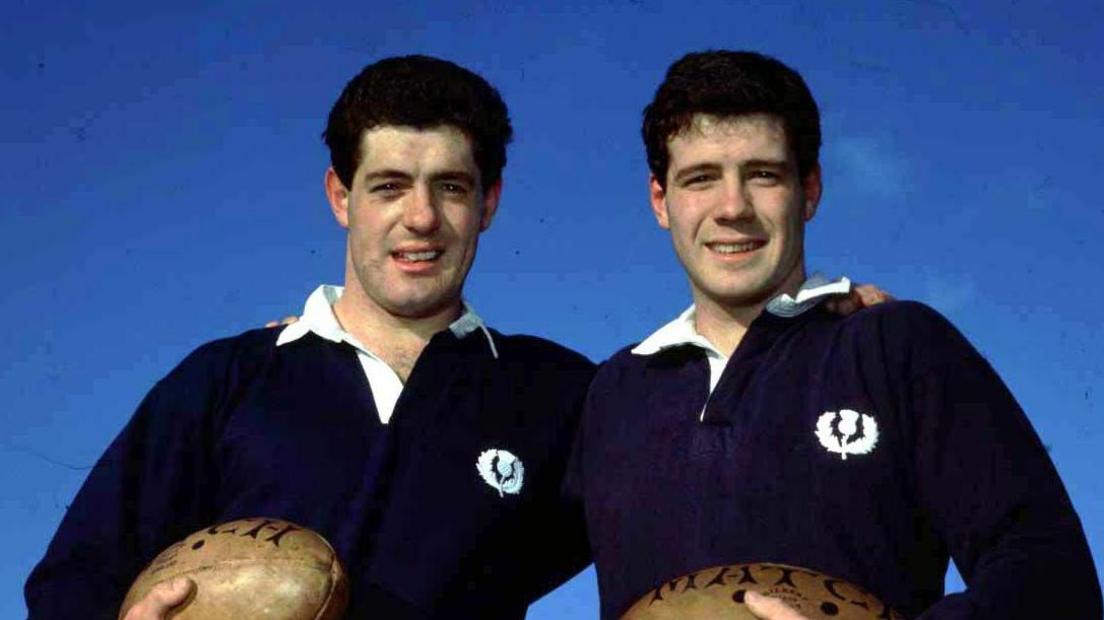 Image source, SNSImage caption,
 Scott Hastings, right, and brother Gavin both served Scotland with distinction
Jeremy Guscott had been his midfield partner on the Lions tour the previous summer. Guscott was the laidback boy wonder of that brilliant England team, captained by Will Carling.
"Scott was like a zombie," Guscott laughed when recounting the day. "He wasn't there. He was away at the races, gone from the emotion and the history of it all.
"After they came out I was looking for the players I'd toured with eight months earlier with the Lions - and there was no recognition from any of them."
That day ensured Hastings' place in the folklore of Scottish rugby. He blamed himself for the try England scored - Guscott cutting through - but then he bounced back with a tackle for the ages.
Rory Underwood was one of the most ruthless wingers on the planet and at a critical stage of the game - it was right in the melting pot - Underwood saw a gap between Hastings and his winger, Iwan Tukalo, and went for it.
"A lovely big space and through I go," said Underwood. "But then I'm down. How the hell am I down? I should be running over the try line now. But I'm down."
Hastings nailed him: "I got him at the knees, slid down to his boots and managed to hang on." For decades later, Scott and Gavin used to joke occasionally about that pivotal incident, Gavin saying it wasn't the tackle that won the Slam because Underwood still had him to get through, which, of course, he was never going to do.
Scott said the try would have been a formality because his big brother was useless tackling on his inside.
They were Scotland men together, Lions together, the first brothers to be on the same Test Lions team since the early 1900s.
Scott left an indelible mark on the game, not just through what he did on the pitch but in his friendships and enormous support of team-mates. He will be remembered, mourned and loved by so many.