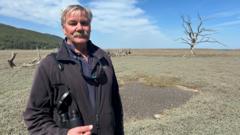

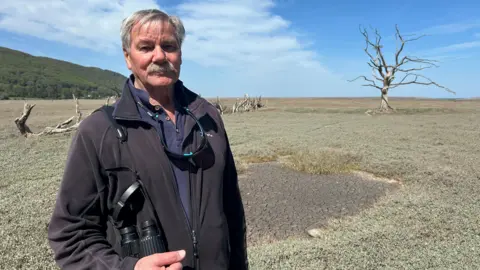
 BBCThis year marks 30 years since Porlock's salt marsh was created
This year marks 30 years since a hurricane created a salt marsh near a small coastal village.
In 1996, Hurricane Lili caused a storm to move from the Atlantic to Porlock Bay, where it battered the shore, changing the appearance and nature of the coast itself.
Old stone walls near the shoreline were flattened, while the Exmoor bay's shingle ridge was breached and moved inland by around 90 metres, creating a salt marsh which was left to its natural course.
Nigel Hester, who was the National Trust countryside manager at the time, said: "The advice was we must start thinking about climate change and how our coastline might change in the future. We wanted to work with natural processes."
More from SomersetRenters reforms 'depend on proper council funding'
Fundraiser for Paralympian almost at £100k target
'I had to pay £14k after my cat was run over'
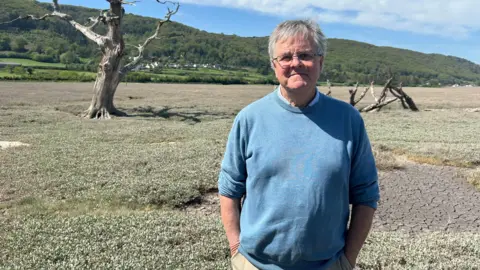 Jeff Cox said there had been pressure to restore the area before it became established as a salt marsh
"There was a great pressure to restore the area. I think people worried it would stay a muddy mess but soon vegetation started to appear and it became established as a salt marsh," Hester added.
A new exhibition has now opened in Porlock museum outlining the 30-year process to create the marshes.
"It became a national symbol of how we might manage coastlines in the future," Hester said.
How a hurricane created a 'precious saltmarsh'Porlock historian Jeff Cox, who is putting on the exhibition, said Porlock Weir is the longest natural barrier of its kind in the whole of the west coast of Britain.
"The fact this really was a test case for environmental policies, can we defend against rising sea levels and increased storms?" Cox added.
"The idea of the exhibition is to try to make people more aware of what a precious and significant environment this is."
The exhibition is at Dovory Manor Museum in Porlock until October.
Follow BBC Somerset on Facebook and X. Send your story ideas to us on email or via WhatsApp on 0800 313 4630.
More on this story