
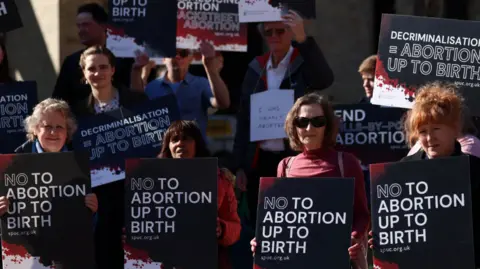
 EPAProtesters demonstrate against the decriminalisation of abortion outside the House of Lords
Peers in the House of Lords have backed plans to decriminalise abortions, which MPs voted in favour of last summer.
Labour MP Tonia Antoniazzi launched her bid to end police investigations into abortion under a 164-year-old Victorian law last year, with an amendment to the Crime and Policing Bill.
The move followed a BBC investigation into the unprecedented number of women enduring criminal investigations, with more than 100 prosecutions under the 1861 Offences Against the Person Act in recent years.
The new Archbishop of Canterbury, Sarah Mullally, was among those speaking out against the MPs' decision, but a majority voted to support decriminalisation.
How US groups are driving a new generation of anti-abortion activism in the UK
MPs vote to decriminalise abortion for women in England and Wales
Woman accused of illegal abortion found not guilty
Conservative peer Baroness Monckton of Dallington Forest tabled an amendment in the Lords which aimed to overturn support for the Antoniazzi amendment in the Commons, which she said had been "added to the Bill after less than an hour of debate by MPs, and without the necessary scrutiny required for an issue of such seriousness".
She urged peers to remove Antoniazzi's "radical proposal" from the draft law, because decriminalisation was "an extreme social change for which there is no public pressure or demand, and could have tragic consequences for women".
Baroness Monckton was backed by the Archbishop, who said she believed the change risked "eroding safeguards".
Referring to the Commons decision, the Archbishop said: "Though its intention may not be to change the 24 week abortion limit, it undoubtedly risks eroding the safeguards and enforcement of those legal limits and inadvertently undermining the value of human life".
Stressing that all life was precious, she agreed a question of such "legal, moral and practical complexity" should not be addressed through a "hastily added" amendment to another bill.
Conservative Baroness Lawlor criticised the amendment as "a bad clause" and one that would lead to "tiny lives being ended in the most cruel and painful way" by mothers who would then be "haunted forever".
However, Labour peers including Baroness Neate backed the changes to make abortion more accessible for the most vulnerable, saying "it's common for domestic abuse to begin with pregnancy".
"Creating clinically unnecessary barriers to abortion helps abusers, not survivors," she said.
Baroness Monckton's amendment was rejected by 185 votes to 148.
Peers also rejected a bid to make it mandatory for a pregnant woman to have an in-person consultation before lawfully being prescribed medicine for the termination of a pregnancy at home.
Tory peer Baroness Stroud said her amendment to require an in-person appointment "would ensure medical professionals can accurately assess a woman's gestational age, any health risks and the risk of coercion before abortion pills are prescribed".
Under the current law it is legal to take prescribed medication at home if a woman is less than 10 weeks pregnant.
The Government changed the regulations during the first Covid-19 lockdown in March 2020, to allow women to have medical abortions at home following a phone or video consultation.
This change was made permanent in 2022, so women can take pills at home for gestation of up to nine weeks and six days.
House of Lords rejected the bid to move back to compulsory in-person consultations by 191 votes to 119.
Pro choice and pro life campaigners brought banners and placards to the House of Lords as peers arrived for the debate.
Speaking to the BBC, pro life campaigner Sarah said: "We need to protect the unborn child in the womb and we also need to protect women from abortion because abortion harms women as well as their children.
"I believe that every child, from the moment of conception, is valuable in the eyes of God and I don't believe that there are any situations that really allow abortion, because we're not the ones that give life and we're not the ones that should take it away either.
"I've struggled to conceive - I've been married 15 years - so it's very difficult to see so many lives lost by abortion when I would have gladly taken any one of them into my family."
Pro choice campaigner Louise McCudden told the BBC she believed it was "unacceptable" for women in England and Wales to still be subject to a Victorian law created before women had the right to vote.
McCudden, who works for abortion provider MSI Reproductive Choices UK, said: "We know from providing reproductive healthcare across six continents that criminalisation harms women and makes abortion less safe.
"The House of Lords now has a historic opportunity to end the threat of prosecution once and for all, pardon women who have been previously convicted, and drop ongoing investigations.
"At a time when we are seeing rollbacks in reproductive rights around the world, most notably in the US, it's encouraging that our parliament is standing up for women."

Sign up for our Politics Essential newsletter to read top political analysis, gain insight from across the UK and stay up to speed with the big moments. It'll be delivered straight to your inbox every weekday.
Domestic abuseAbortionWomenWomen's rightsPregnancy


