
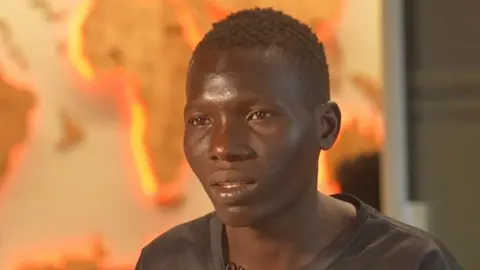
 BBCRasheed Wasiu describes his life in prison as "hell"
 Not listening to his mother cost 23-year-old Nigerian Rasheed Wasiu dearly – more than five years of his freedom for something he did not do.
Now released from prison, where he was stuck waiting for his trial as the judicial process crawled on, Rasheed has no idea where she is. His mother has gone missing.
In October 2020, she had told him not to go out as widespread anti-police brutality demonstrations, known as the End Sars protests, swept into his area of Lagos, Nigeria's bustling commercial heart.
People's anger was directed towards the now-disbanded Special Anti-Robbery Squad (Sars) accused of robbing, attacking and even killing innocent people.
The reaction of the security forces to the 2020 demonstrations was to reach a crescendo on the evening of 20 October, when officers opened fire on a group of protesters in the city.
But the protests had been building over the previous fortnight, with some turning violent, and the police along with a local vigilante group began responding by rounding up anyone they thought might be involved.
On the morning of 20 October, Rasheed, 17 at the time, was trying to get to a painting job with a friend in an area called Amukoko, but on their way they learnt that violence had broken out there and so turned around.
When he arrived home, his mother told him to "stay indoors" and not to "go outside because of the protests" that had by that point reached his neighbourhood.
But as a disobedient teenager he ignored her and stepped out on the street again.
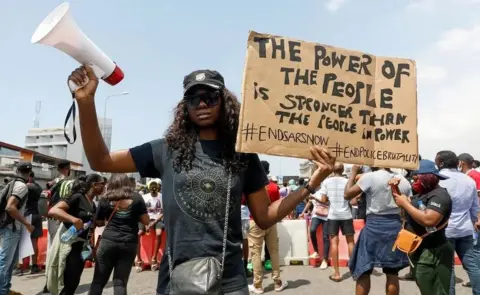 ReutersThe protests were fed by anger at the way some police officers carried out their jobs
Although he says he did not join the demonstration, members of the vigilante Odua Peoples Congress (OPC) caught him in their dragnet and bundled him into a van alongside weapon‑wielding protesters.
His mother and neighbours remonstrated with the OPC, insisting Rasheed was not part of the group, but their pleas were ignored.
He was first taken to an army barracks and then moved to a prison – Lagos's Kirikiri Correctional Centre – where he waited for his trial to start.
Rasheed says he was initially arrested on allegations that he had been involved in looting "but when I appeared in court, the offence on my charge sheet was 'unlawful possession of firearms'".
His experience and the charges chimed with many who were detained during the protests.
Speaking to the BBC, dressed in worn-out clothes and bathroom slippers, he sounds stressed and bitter as he recalls his incarceration.
"Jail is hell if you do not have money to ease your way through and cater for your needs," he says.
"The food is miserable; we get weak after eating. The space is really congested. They locked up to 70 people in a tiny room at a time. There is no good healthcare, but if you have money, you can have access to good food, a bed and proper medications.
"There was a time a young man died in my cell, his leg was just getting swollen." No-one had gone to help diagnose what was wrong.
More on the End Sars protests:Nigerian army 'shot #EndSars protesters': report
What next after the protests that shook Nigeria
Lekki toll gate shootings: What really happened?
Rasheed took on menial jobs to survive like washing clothes for inmates in exchange for a bit of cash or food. He also sold food items on behalf of prison staff, like cow skin, popularly known as "ponmo", and baked snacks. They would give him some of what he was selling or some money.
Months passed without his case being called. On the rare occasions when he was taken to court, his case was not mentioned. One of the lawyers who was representing Rasheed even died while he was in prison.
This state of purgatory continued for nearly six years.
However, at a hearing early last month, a judge at Lagos's high court struck out his case over a lack of evidence and Rasheed was set free.
The judge's ruling came after the intervention of an advocacy group known as the Take It Back Movement (TIB), which provides lawyers for free and fights for the release of people arrested during the End Sars protests as well as other demonstrations.
According to Nigeria's prison authorities, some 50,000 people are currently in detention in the country even though they are still awaiting trial - some 64% of the total prison population.
Human rights groups say that cases like Rasheed's - of people spending years in prison without being convicted of any offence - are not uncommon.
TIB's Lagos coordinator, Adekunle Taofeek, called the ruling on Rasheed's case "a significant milestone".
"This development reinforces our belief that persistence, solidarity and commitment to justice will always yield results."
TIB says it has managed to free 100 people who were detained during the End Sars protests.
Asked whether he planned to pursue legal action for the years he has lost, Rasheed responded: "No, I am leaving everything to God."
But Rasheed's joy at finally being released turned into another nightmare as, on returning home, he was unable to find his mother.
"People in my neighbourhood said they thought I was dead since they couldn't find me. I checked around for my mum but couldn't find her… neighbours told me she left the area because she was being threatened that she would be arrested as well."
 Getty ImagesThe protests were led by young Nigerians
He had only seen her once since his arrest, in the immediate aftermath of his detention when she followed him to the barracks where he was initially held.
On the following two days she returned with some food but was denied access.
He did not see her again.
Rasheed's neighbours could offer very little information about her whereabouts.
"When I asked… they said they did not know where she had moved to, but sometimes they see her when she passes by the market. They would greet her but she won't reply.
"They said my arrest caused her so much pain and tears."
Rasheed now lives with his mother's brother in another area of Lagos. They are both actively searching for his mother.
"I pray to God every day that I will see her, let me just come face to face with her," he says.
Rasheed's top priority is finding his mother but he is determined to rebuild his life after losing out on almost six precious years.
He says that before his arrest he was training to become a tailor and would have finished by now and set up his own business.
"Ever since I got out of prison, my neighbours have been the one[s] supporting me with food. But I don't want to be dependent on them, I wish to get a job and be a giver as well. I have two hands and legs, I can work."
More BBC stories from Nigeria:'We want a voice in our land' - the people evicted to build Nigeria's capital
The kidnap gangs, jihadists and separatists wreaking havoc in Nigeria
Carnival fever hits Lagos as locals celebrate Afro-Brazilian heritage
 Getty Images/BBC
Go to BBCAfrica.com for more news from the African continent.
Follow us on Twitter @BBCAfrica, on Facebook at BBC Africa or on Instagram at bbcafrica
BBC Africa podcasts