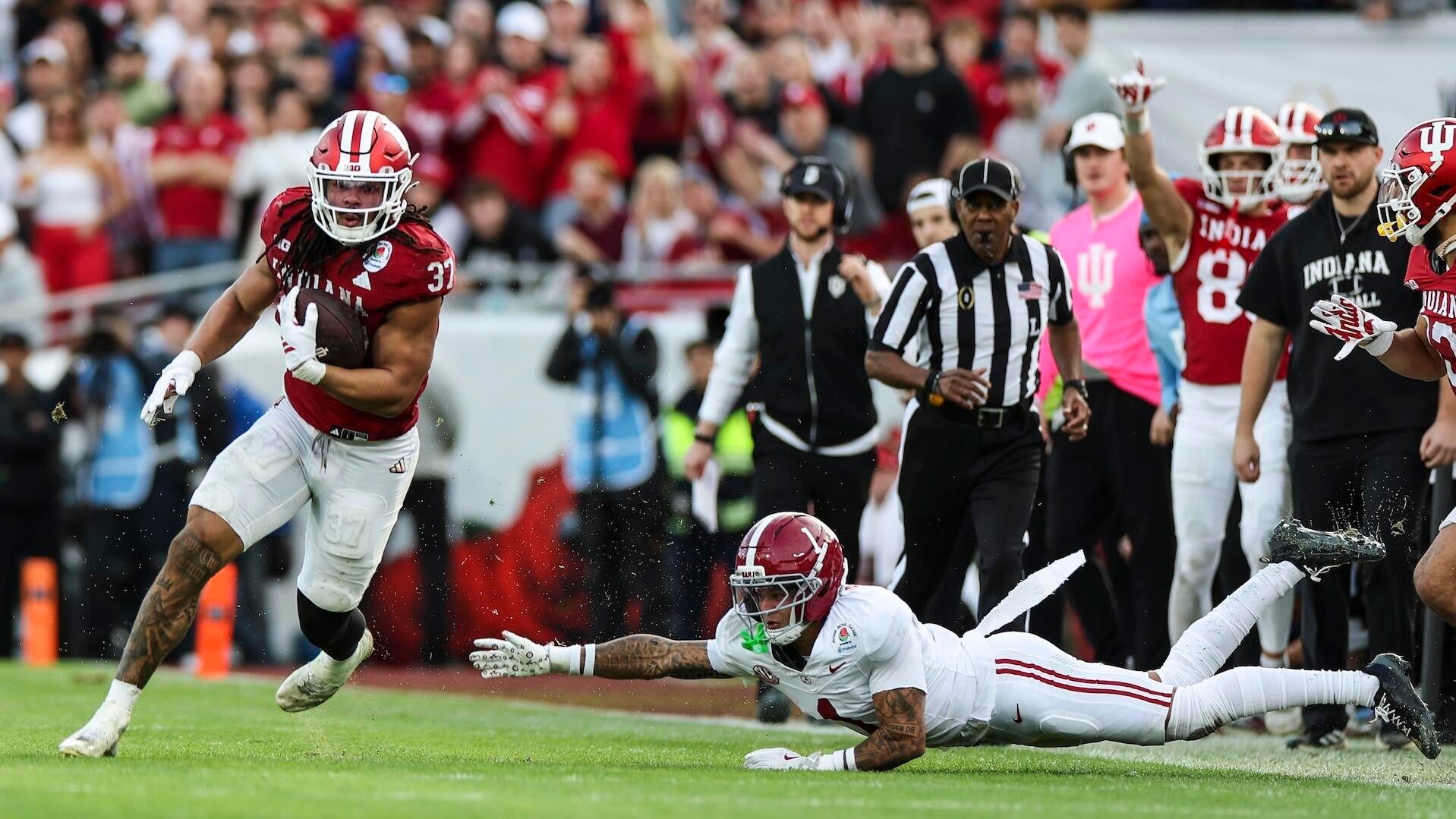
The Big Ten has a strong case for superiority with three straight national titles, but what do the players think?
 By Chris Hummer & John Talty Apr 7, 2026 at 9:43 am ET • 6 min read
  Getty Images
 It's a good time to be the Big Ten.
The conference has won the last three College Football Playoff national championships with three different schools (Michigan, Ohio State and Indiana). And with Michigan's win over UConn on Monday night, the Big Ten finally put an end to its men's basketball title drought that dated back to 2000.
But has that success fully shifted perception, especially in football? After all, the SEC long reigned as king for its incredible run, which started with Nick Saban at LSU in the early 2000s.
Way-too-early college football bowl projections: Picks for every postseason game, including CFP field Brad Crawford
With that in mind, CBS Sports talked to several outgoing Big Ten and SEC players about which conference is the best.
The argument for the Big Ten
It had been six years since a Big Ten team won it all when Michigan finally broke through over Washington in 2023. The Wolverines' title seemed to spur Ohio State to run it back one more time, too, resulting in back-to-back titles for the league. No one could have predicted three years ago that Indiana would win a championship, but it speaks to where the conference is right now.
"I feel like they've taken it the last few years," Michigan linebacker Jaishawn Barham said of the Big Ten. "It's running the ball. The transfer portal played a little bit of a role in it, just getting more guys into the Big Ten."
Barsham's teammate, tight end Marlin Klein, had a similar take.
"I think toughness, physicality," Klein said of what has powered the Big Ten's title run. "Every single game you play, you play superstars, especially D-linemen, O-linemen. The team down south (Ohio State) got their whole team here (at the combine). Tough and physical football."
2026 Big Ten win totals, odds, picks: Predictions for every team as Indiana, Oregon face high expectations Cody Nagel
The rise of the Big Ten has coincided with the introduction of name, image and likeness (NIL) and revenue sharing. It certainly hasn't gone unnoticed around college football that there is some serious financial firepower within the Big Ten, from Phil Knight's generous donations at Oregon to former Dallas Mavericks owner Mark Cuban donating to Indiana football for the first time. The Michigan and Ohio State titles occurred in part due to expensive retention with numerous key pieces passing on the NFL Draft and returning to school for a final season.
Barsham, though, doesn't think that's the driving force behind the conference's success.
"I feel like there's money everywhere," he said. "It's not just the money. The SEC is good, just as good as the Big Ten. There's just more competition everywhere."
One area that could be helping the conference, according to its players? The Big Ten's nine-game conference schedule. The SEC has historically played eight conference games but will move to a nine-game model for the first time in 2026.
"We play a competitive schedule," said Northwestern defensive end Aidan Hubbard. "We play nine conference games and three out-of-conference games. Playing good games week in and week out makes everyone better."
Ohio State defensive end Caden Curry co-signed. "It definitely builds your team up and gets you ready for that moment," Curry said. "I mean, if you're playing really good nine teams, it's going to prepare you."
The argument for the SEC
"Uhh…no," Auburn cornerback Kerryon Crawford said with a laugh about the Big Ten overtaking the SEC.
Even if the SEC hasn't been able to win it all the last three seasons, plenty of its players still believe it is the best conference in football.
"The SEC is still No. 1," said South Carolina defensive tackle Nick Barnett. "It's week in and week out."
Said Oklahoma tight end Jaren Kanak: "Playing in the SEC isn't easy. It's pretty much a one-score league. If you look at all the games we played this season, almost all of them came down to one score or less. It's a very tough and physical league."
From 2006 to 2022, the SEC won a stunning 13 national championships. It was Urban Meyer, Tim Tebow and Florida, Nick Saban's Alabama dynasty, the Coach O and Joe Burrow show in Baton Rouge, and, of course, Kirby Smart's incredible run in Athens. The SEC was bigger, faster and more talented than its conference peers, and it showed up on the field.
The rise of NIL and rev share has impacted the ability to stockpile talent the way those great SEC teams used to. With more parity, especially within the SEC, it has seemed to create more very good teams and fewer truly elite ones.
Still, SEC players cite the physicality and challenge of the SEC's weekly schedule as the most common reasons why it still reigns supreme.
"Everybody's entitled to their opinions. I just know playing in the SEC for five years, it gets down and dirty out there," Arkansas defensive tackle Cam Ball said. "I really don't know what the Big Ten is like, but I can just speak on behalf of the SEC and how physical it is and how it prepares you for the NFL."
2026 SEC win totals, odds, picks: Predictions for every team as Georgia, Texas aim for CFP berths John Talty
And then there was Alabama tight end Josh Cuevas' perspective.
Cuevas, who started his career at Cal Poly, said the Big Ten vs. SEC debate was popular at the annual pre-draft Senior Bowl down in Mobile, Alabama. "A lot of guys talking their talk in the locker room," Cuevas said. "Big Ten is better than the SEC; the SEC is better than the Big Ten. At the end of the day, football is football. The SEC has great points. The Big Ten has great points."
The argument for the Big Ten is pretty obvious given its recent on-field success. So we asked Cuevas what the SEC's counterargument was to why it was still better than the Big Ten. His answer surprised us, but perhaps sets him up for a career in television after football.
"It's the culture behind the SEC," he explained. "There's more looks of getting to the NFL within the SEC. The dynasties that we have amongst the SEC, like LSU, Alabama, you got a whole bunch of different schools. A bunch of rivalries. A lot more people tend to tune into SEC games -- Tennessee-Alabama, LSU-Alabama, Iron Bowl, games like that -- compared to some of the Big Ten schools."
The debate rages on
Three years is likely too small a sample size to make any sweeping assumptions about the Big Ten taking over the SEC.
But the debate will continue to simmer. An early shot at the "It Just Means More" conference came earlier this month via new Ohio State Buckeye defensive lineman James Smith, an Alabama native who spent the last three seasons with the Tide.
"The intensity is almost like … everything is so much faster," Smith said at a media availability when asked about the difference between Ohio State and Alabama. "I feel like the SEC we big, so much slower. Here it's more fast, more speed. We're just really trying to weigh an opponent down."
Is that a fair critique? Probably not if you look at the annual NFL Draft results.
But it's yet another interesting data point as the sport's talent leaks out of the Southeast and into the Big Ten footprint.
Can the SEC stop the Big Ten's streak in 2026? We'll see.
If you look at CBS Sports' too-early Top 25, the Big Ten claims four of the top 10 teams while the SEC also has four.
One thing is certain in the jockeying between the Big Ten and SEC in 2026 -- the debate will rage on.
Join the Conversation comments