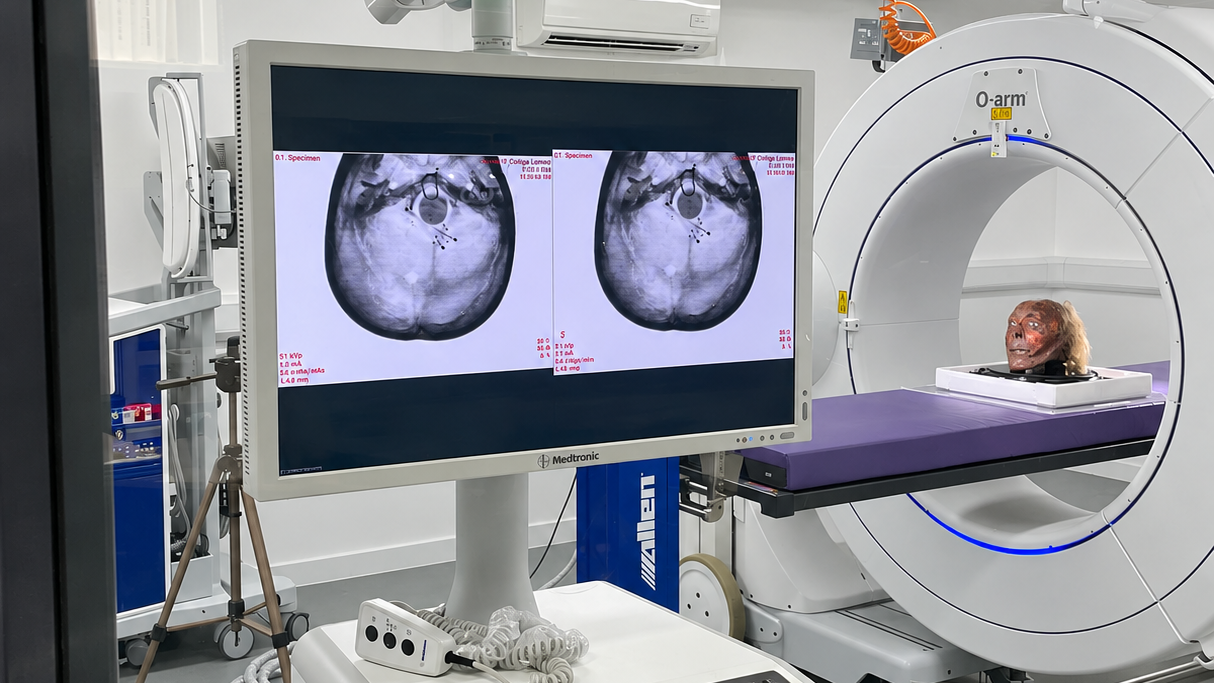
The great and "godless" English philosopher Jeremy Bentham, whose remains have been on display at a U.K. university for over 150 years, suffered from severe dental problems, according to X-ray scans of his skull.
The scans were conducted with CT (computed tomography) scanning equipment to create a digital 3D model of his head and highlight Bentham's lengthy "presence" at University College London (UCL) as it celebrates its 200th anniversary.
The scans revealed that Bentham was missing many teeth and had advanced arthritis in his lower jaw when he died of natural causes at the age of 84. During the scanning process, project leader Tannis Davidson, curator of UCL's Grant Museum of Zoology, saw how thin the jawbone had become. "He must have been in excruciating pain," she told Live Science.
Bentham's utilitarian philosophy inspired UCL's founders; it was only the third university in England, after Oxford and Cambridge, which was founded as London University in 1826 and opened to students in 1828.
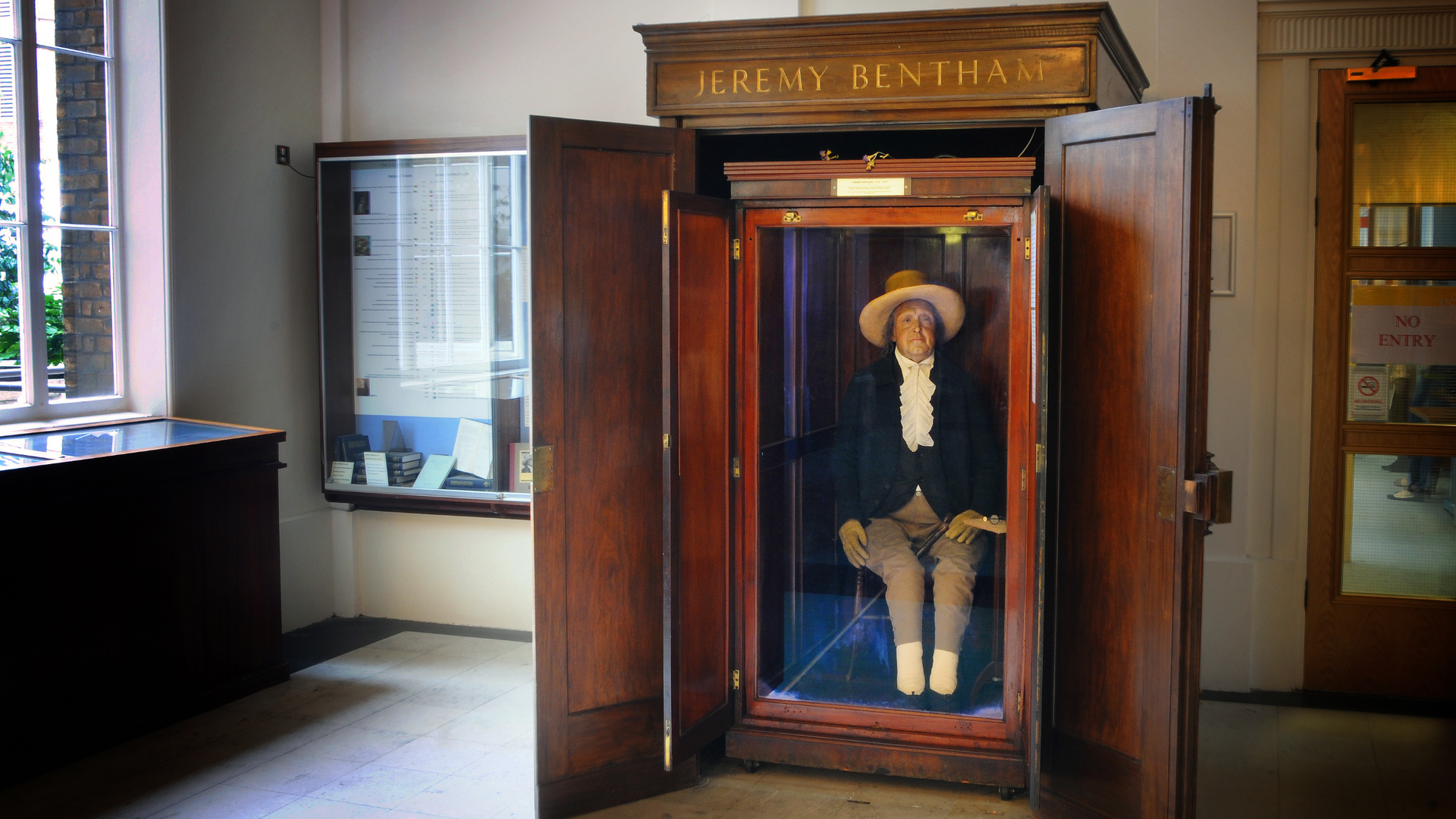
As a young man, Bentham had declared that he would donate his body to science after his death. This was a radical idea at the time; in the U.K., dissection after death was looked down upon, even if it was for scientific purposes, and it was reserved for the worst criminals. After Bentham died in 1832, his remains were fashioned into an auto-icon — a supposed replica of himself — to memorialize him in the way a tombstone might, Davidson said.
Except for brief visits across Europe and to the Met Breuer in New York City, this auto-icon has been in a display case at UCL since the 1850s, where it can be seen by students as they pass by.
Brainless auto-icon
To make the auto-icon (which is not a mummy), Bentham's body was dissected and studied. Then, his skeleton was dressed in his clothes, which were padded with straw. His severed head was badly disfigured during an attempt to preserve it with sulfuric acid, so a wax reconstruction based on paintings and death masks was attached to the body.
Bentham's real head was displayed at the feet of the clothed skeleton that had a lifelike wax head; the real head's eyes were replaced with highly detailed glass eyes, which can be seen in the scans. According to UCL lore, the real head was stolen in 1975 and held ransom for a few days by rivals from King's College London, after which it was locked away.
Davidson explained that Bentham had coined the term "auto-icon" to mean "self-representation" and was setting an example for others. "He imagined a future where people were making auto-icons to keep their dead relatives around," she said.
The CT scans of the real head show that Bentham had dental damage and jaw arthritis, and that his brain had been removed before it was preserved—although some of his dura mater, a layer of connective tissue that covers the brain and spinal cord, was preserved. Davidson said the brain extraction was done to keep with Bentham's instructions that his head be mummified in the same way as Māori heads, which had their brains removed. The scanning process is shown in a short film called "Bentham Revealed."
"Godless" philosopher
Bentham wrote about his dental problems several times, Davidson said, but it is not clear if he understood that he also had severe arthritis in his lower jaw, which must have made the problems with his teeth much more painful. In addition, modern ideas about cleaning teeth had not been established by Bentham's time. "Dentistry 200 years ago was a very different kettle of fish than it is today," Davidson said.
Bentham was a polymath who hoped to improve the lives of ordinary people through social reform. He wrote extensively about subjects as varied as law, economics, education and animal rights, and he believed that society could be engineered to produce better outcomes through legislation and the objective measurement of "utility."
RELATED STORIES- Atheists and believers have different moral compasses
- What led to the emergence of monotheism?
- Why does Christianity have so many denominations?
His most famous idea was the panopticon in 1791, a ring-shaped prison with one warden to watch all of the prisoners, which he proposed as a humane alternative to Australia's penal colonies. Today, however, it is a symbol of state control and surveillance. Bentham also invented a "felicific calculus" to numerically assess the benefits and drawbacks of any given action, based on variables like its intensity, duration, certainty, purity and extent.
Bentham's philosophy put him at odds with the established Church of England; he called himself an "unbeliever," while critics called him "godless."
This rift with the church may have played a part in Bentham's wishes for his remains. Davidson suggested that the auto-icon may have been a means for Bentham to avoid being buried with traditional Anglican rites. "Maybe this was a way he could 'stick it to them' a little bit," she said.