

 ReutersUlrich Siegmund, AfD's top candidate in Saxony-Anhalt, said the "whole of Germany" was watching the state's election
The far-right Alternative für Deutschland (AfD) party is riding high in the opinion polls in the eastern German state of Saxony-Anhalt and could win an outright majority in regional elections there in September.
It would be the first time a far-right party has held power in a German state since the Second World War.
This weekend the AfD officially adopted what has been described as a "radical" and pro-ethnic German government programme for Saxony-Anhalt, at a party conference in Magdeburg.
The AfD's leading candidate in the state, Ulrich Siegmund, a TikTok star who was given a standing ovation by the delegates, said it was a historic moment, not just for Saxony-Anhalt.
AfD hails court injunction on 'extremist' label as victory
"The whole of Germany is watching this historic election. Parts of Europe are watching this historic election. Parts of the world are watching this historic election, because from here, finally, the political turnaround can also happen here in Germany," he told the conference.
He said his party had the courage to speak out about what was going wrong in Germany, "that we don't feel safe anymore, that we scarcely feel at home anymore, that we don't recognise our homeland anymore."
"Let's take back our country," he said.
The programme, which is over 150 pages long, contains wide-ranging plans to overhaul Saxony-Anhalt, clamping down on immigrants and supporting large families of German origin. It also wants to improve relations with Russia, directly contradicting the policies of the federal coalition government, which is a key supporter of Ukraine.
"We say yes to consistent deportations, we say yes to free childcare facilities, we say yes to remigration," Ulrich Siegmund said.
Some of the proposals appear to be unworkable at a state level, requiring action by the federal government, but many others are feasible.
Eva von Angern, leader of the left-wing Linke Party parliamentary group in Saxony-Anhalt, earlier described the AfD's plans as a "nightmare scenario for Saxony-Anhalt and for our democracy". She said the AfD was promoting an authoritarian state that would severely curtail fundamental rights.
Accusing the party of harbouring "inhuman fantasies of omnipotence", she said the public must be made aware of the AfD's "ugly truths" and the "very negative consequences for them personally if the AfD were to govern in Saxony-Anhalt."
Saxony-Anhalt, like much of the former Communist East Germany, is an AFD stronghold, but the party is doing well all over the country.
It came second in federal elections in Germany last year, winning a record 152 seats in the 630-seat parliament with 20.8% of the vote.
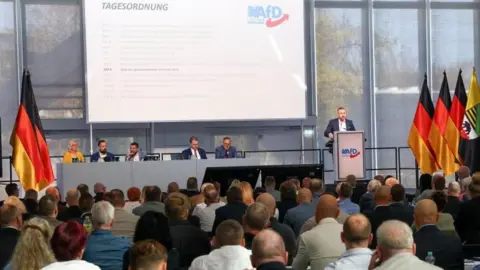 ReutersThe state branch of the AfD has been classified in Saxony-Anhalt as a "far-right extremist organisation"
In 2023, the Office for the Protection of the Constitution in Saxony-Anhalt classified the branch of the AfD in the state as a "far-right extremist organisation".
Observers say the government programme in Saxony-Anhalt is an indication of what the party intends to do if it gains more power across the country.
The draft manifesto, seen by the BBC, says "a complete U-turn" on migration policy is necessary. It calls for measures to put an end to what it calls "illegal, culturally alien and anti-native mass migration."
These include plans to deport refugees and asylum seekers or to house them in central accommodation.
The draft contains a number of references to the controversial term "remigration", the mass removal of people with "non-German" backgrounds from the country.
Two years ago, Germans were shocked by revelations that senior AfD figures attended a meeting in Potsdam where remigration or mass deportations were allegedly discussed. But now the term is a central theme of the government programme.
The manifesto specifically calls for the "remigration" or return of Ukrainians to their own country.
"Stop recognising Ukrainians as war refugees!" it says.
The manifesto comes across as distinctly pro-Russian.
"The current anti-Russian policies of the established parties… are not in Germany's interests," it says. It calls for energy sanctions on Russia to be lifted and for schools to teach more Russian.
Central to the AfD's plans are measures to support large families of people who are ethnically German.
Saxony-Anhalt has the oldest population in Germany, and the proportion of older people is increasing.
The AfD says it wants to fight against "the extinction of the German people" by giving tax breaks to large families and providing free childcare.
It espouses a very conservative view of the family, which it says should consist of "a father, a mother and as many children as possible."
The party blames the low birth rate in part on what it calls "sexual deviations and non-reproductive lifestyles." It plans to ban gay pride flags in schools.
The manifesto also says it plans to withdraw funding for public broadcasting in Saxony-Anhalt.
Several hundred people gathered to protest outside the party conference.
Last year the national party was also classified as "right-wing extremist" by the country's domestic intelligence service, a decision criticised by the White House. But the party challenged the move and a German court has now issued a temporary injunction stopping the use of the term until it has issued a ruling over it.