

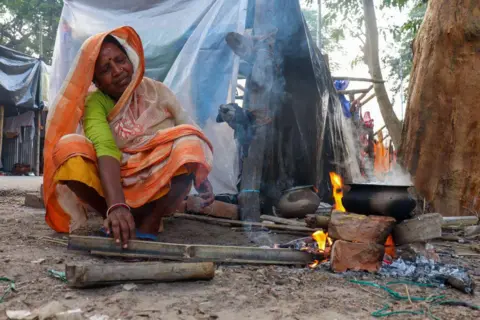
 Getty ImagesReports suggest a spike in firewood sales in parts of India
Shipping disruptions from the US-Israel war with Iran have squeezed gas supplies to India, risking a temporary shift back to polluting fuels like coal, kerosene and biomass, experts say.
There are reports that suggest some regions in India are witnessing a spike in timber sales, while others see increased sales of cow dung cakes - both biomass fuels.
India has been dealing with a squeeze in cooking gas supplies over the past few days, leading to panic-buying by domestic users.
The war that started on 28 February has halted ship movements through the Strait of Hormuz. About one-fifth of the world's oil and gas passes through the narrow waterway.
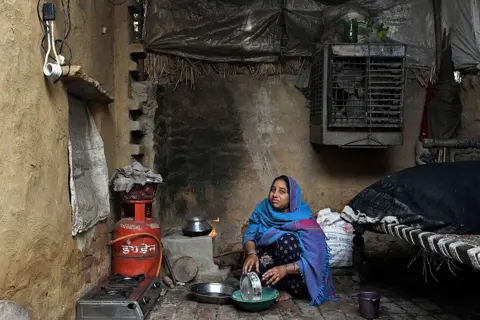 Bloomberg via Getty ImagesA woman prepares food to be cooked on an LPG stove in an Indian village
The Gulf chokepoint handles about half of India's LNG imports and most of its LPG shipments.
Foreign Minister S Jaishankar has said talks with Iran may ease disruptions in the Strait of Hormuz. Since Monday, three Indian-flagged vessels - two carrying LPG and one crude - have reached the western state of Gujarat, but about 21 ships remain stalled, keeping supply tight.
As an immediate step, the federal government has approved an extra 48,000 kilolitres of kerosene for states, beyond the regular quota, to support low-income households through the public distribution system (PDS).
"Kerosene is being made available through retail outlets and PDS channels," Petroleum Minister Hardeep Singh Puri said last week.
India's environment ministry has told state pollution boards to let restaurants and hotels temporarily switch to biomass (wood, dried crops, animal manure), fuel pellets, kerosene and coal for a month, prioritising cooking gas for households and essential sectors.
Government programmes have rapidly expanded LPG use for cooking in India, replacing kerosene and traditional biomass like firewood and dung. But with 60% of its LPG imported, India is now the world's second-largest importer after China.
The shift is stark: kerosene output has fallen from 7.5 million tonnes in 2014–15 to under one million tonnes in 2023–24, government data shows.
"We see it [people buying kerosene, coal and firewood] as a very temporary situation and when supply of LPG becomes better, consumers will immediately move back," said Nandikesh Sivalingam, director of Center for Research on Energy and Clean Air.
He warned that a return to kerosene, coal and biomass - linked to serious heart and lung disease - would quickly worsen indoor air pollution. Burning them releases carbon monoxide, nitrogen oxides and fine particles that penetrate the lungs and bloodstream.
"Urban households may be more exposed to fuel shortages than rural areas, as they have fewer immediate fallback options," said Vibha Dhawan, director general at the Energy and Resources Institute in Delhi.
In urban India, Sivalingam believes, a more likely scenario would be to move to electric cooking as a back-up rather than switching to biomass or other fuel. But it would increase demand for electricity - much of which in India is generated using coal.
India already relies heavily on coal. It provided nearly 79% of India's domestic energy in 2023-24, according to government data.
Such dependence means any short-term shift away from gas is likely to reinforce an energy system that is already built around coal, experts say.
Madhura Joshi of climate think tank E3G said rural households may turn to biomass like firewood and subsidised kerosene, while some could shift to electricity, biogas or improved cookstoves where available and affordable.
Dhawan further said technologies such as solar cooking systems - including solar cookers as well as solar photovoltaic systems connected to electric cooking devices - can reduce dependence on fossil fuels for household energy needs.
She added that wider adoption of such technology could improve household energy resilience while supporting India's clean energy transition.
However, such solutions take time to expand at scale.
And, in the short term, experts say, coal remains the most readily available fallback.
Follow BBC News India on Instagram, YouTube, X and Facebook.
AsiaIranOilIndiaFuelIran war