 From Africa to the NFL: Why 27-year-old Jeffrey M'ba is the Commanders' most intriguing rookie
 The undrafted defensive lineman begins his NFL journey in Washington, armed with rare perspective and untapped upside
 By Ryan Wilson May 8, 2026 at 10:38 am ET • 10 min read
  Getty Images
 When you get past the "can't-miss prospects" and "Day 2 steals," you arrive at the sleepers – those who may have been overlooked for one reason or another but occasionally end up having productive NFL careers. Dig further still and you'll find the deep sleepers -- names who look the part physically, or test through the roof, but lack either experience or youth or some other factor that might keep them from getting drafted.
Enter Jeffrey M'ba.
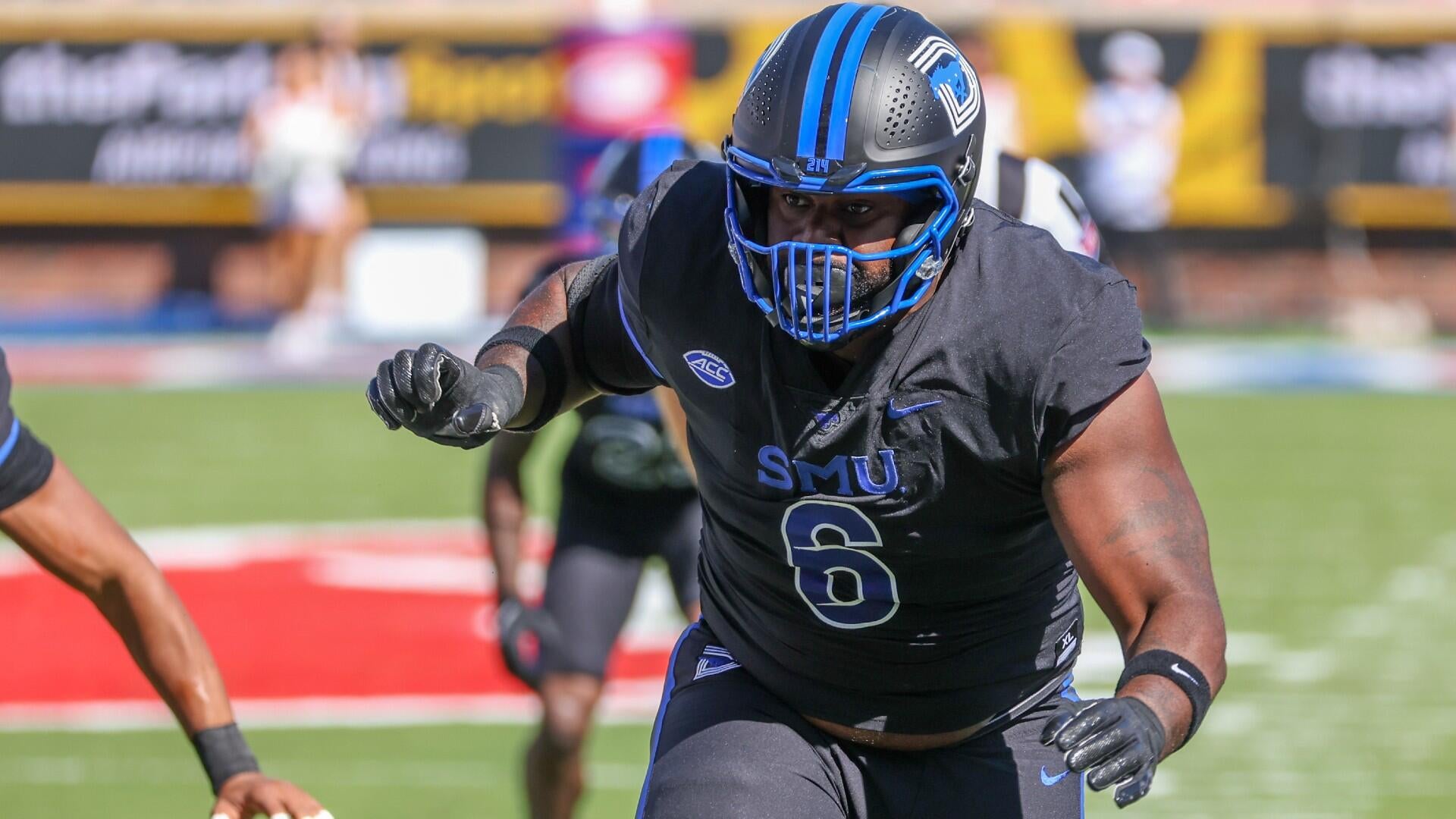
At 6-foot-5 and weighing anywhere from 290 to 330 pounds depending on the school and the scheme, M'ba is a physically imposing, "get-off-the-bus first" defensive lineman who looks like he was created in a lab. The former SMU standout had a great week of practice at the Senior Bowl, which came on the heels of a solid 2025 season.
He still went undrafted.
The reason isn't complicated. M'ba turned 27 in April, and he's still relatively new to football. For many teams, that combination of age and inexperience was enough to pass. But Washington signed him as an undrafted free agent, and M'ba will begin his NFL journey in earnest on Friday when the Commanders begin rookie minicamp.
The reality is that M'ba faces an improbable road. If 350-400 undrafted free agents sign following the conclusion of the draft, history tells us that roughly 10% of them will make final 53-man rosters in September. But long odds are nothing new for M'ba.
And to understand the player, you have to understand his journey -- a trek that spans three continents, four languages and a relentless pursuit of a dream that, for a long time, didn't even have a name.
A global odyssey
M'ba's story begins in Gabon, on Africa's west coast, where he lived his childhood on the move, stitched together by a mix of sports and constant change.
"I moved to France when I was four years old," M'ba told me at the Senior Bowl. His upbringing was a revolving door of cultures; he moved from France to Cameroon at age 13 -- a country he describes as a unique linguistic melting pot due to its colonial history with Germany, France and the United Kingdom.
"One part of the country speaks French, one part of the country speaks English, and in the north they speak a little bit of German as well."
This international upbringing didn't just sharpen his mind; it helped shape him into the athlete he would become. Long before he shed double-teams in the ACC, M'ba dabbled in a little bit of everything athletically. "I played a lot of different sports and that's what makes me so versatile. I did track, I did bike, I did judo. A little bit of horse riding."
Missing from the list: American football.
M'ba grew up playing soccer. Basketball was briefly suggested but quickly dismissed -- "I was just too bad at it," he said with a laugh. It wasn't until he returned to France as a teenager that he discovered the American version of football. And it wasn't long before he made the biggest bet of his life -- on himself; after just one year, he decided to leave for the United States to commit to a future he knew next to nothing about.
All alone in a foreign country
The leap M'ba took at 18 years old is one almost anyone of any age would find paralyzing. He didn't move with his family or have a safety net. He arrived in Baltimore, Maryland, to attend the powerhouse St. Frances Academy. He arrived with the freakish athletic traits that prompted his move in the first place but barely spoke the language, making the transition even tougher.
"I'm all alone here," M'ba said, reflecting on those early days. "I went to high school in Baltimore... they couldn't keep me because [of visa issues]. I wasn't really speaking fluent English when I came. I got [basic English] in France, but in France is nothing compared to when you come to Baltimore."
The culture shock was secondary to the bureaucratic headache of being an international student athlete. Between visa issues and school transfers -- moving from Baltimore to another prep school, St. Thomas More in Connecticut -- M'ba wondered if his career was stalling out before it even got off the ground.
"I feel like the first year of my career was a waste because I didn't have anybody behind me."
For a teenager thousands of miles from home, the easiest path would have been to return to the comfort of France or Gabon. Instead, M'ba leaned into the hardship. He viewed his international status not as a burden, but as an untapped asset, even if the American football world didn't initially see it that way.
"You know what is crazy about being international is that ... I thought when I came here it would be an asset," M'ba explained. "But the more I was here, the more I learned that international players – they tend to think that we're too nice. Because we know how to talk ... they think that we're too nice."
It was interesting to hear M'ba's perspective on this because it's not something I had ever thought about, mostly because I had never needed to think about it. In a sport that often equates "toughness" with whatever version of the stereotypical football player your mind conjures, M'ba's intelligence and multilingualism were sometimes mistaken for a lack of "dog" in him. He's spent his collegiate career proving that you can be smart, worldly, and still be the most violent man on the field.
That subtle, unique prejudice was just one more thing he had to overcome.
The ultimate shape-shifter
M'ba's collegiate path was as winding as his childhood. He spent time at Auburn and eventually found his stride at SMU after a stopover at Purdue. Along the way, he became a chameleon for his defensive coordinators.
In an era where many linemen are sometimes viewed as specialists, M'ba is a Swiss Army knife. His weight has fluctuated based on team needs -- a testament to both his work ethic and commitment.
"When I was at Auburn [I was] 315 pounds," M'ba said. "Then I went to Purdue and they wanted me to play 3-tech, so I dropped to 290. Then they wanted me to play inside ... I played at 315. Came back [to SMU last] spring, they told me they want me to play 3-tech, so I went back to 305. Then they wanted me to play nose, so during the summer I went back to 330."
He'll do whatever the team asks. And in the process, he's built an understanding of nearly every spot along the defensive line. And while he's happy to plug the A-gap at 330 pounds, he envisions himself more in the mold of the NFL's elite "big men who can move," name-checking players like Dexter Lawrence and Derrick Brown. He loves getting upfield and disrupting the pocket.
When I interview players, I'll often ask them about their favorite plays, in part because it makes them more relaxed, but also to get a better sense for who they are and what they like doing. M'ba pointed me to a sack he had against Stanford from the 2025 season, and his raw power is on full display in this one seven-second rep.
Former SMU DL Jeffrey M'ba (No. 6) went undrafted, in part because he's incredibly raw and just turned 27. But he's one of the strongest players in the '26 class. He signed with the Commanders and will have another chance to prove himself when rookie minicamp start on May 8. pic.twitter.com/Pk8zXt9VIb
— ryan wilson (@ryanwilsonCBS) May 5, 2026
Playing over the right guard, M'ba didn't rely on a library of sophisticated pass-rush moves. He simply exerted physical force. "I just push him back like I have no pass rush move," he said with a laugh. "I just use my length and I just push him out of the way. I love to make them lose balance."
That "grown man strength" is also what makes him so intriguing. (And I know "intriguing" is one of the most overused scouting terms on the internet, but it really does apply here.) M'ba isn't just a space-eater; he is a disruptor who's still learning the nuances of what he's capable of.
The value of maturity (even when your name isn't called)
When the draft came and went without his name being called, M'ba didn't flinch. The "older prospect" label he carried throughout the process didn't suddenly become a liability; if anything, it sharpened the perspective he's leaned on all along. While some teams target 21-year-olds with upside, M'ba has long viewed his age as a competitive edge.
Now, after signing with the Commanders as an undrafted free agent, that mindset matters even more. In a league where off-field distractions can derail a career before it starts, M'ba enters the building with clarity, purpose and a lived understanding of what's at stake.
"I feel like I have more experience ... wherever they draft me, wherever they sign me, wherever they give me -- you're never gonna go over my head," M'ba said. "I'm older, so all the things that the young guys will do -- like have fun doing this thing, this thing -- you never heard about me outside of football."
He points to the success of teams like the national champion Indiana Hoosiers, who excelled with older, experienced players.
"They're more mature … you know they're old dogs and they know how to play together."
M'ba is the ultimate old dog with a young ceiling. He's only been playing football for a few years, and he doesn't have the wear and tear of your average 27-year-old who has been dishing out punishment and absorbing hits for what could be 15 years by this point. Think about it this way: he's a high-performance engine in an older model -- and the driver is a grown-ass man.
What are the Commanders getting?
The Commanders didn't just sign a defensive lineman; they signed a survivor. They signed a man who navigated the complexities of international immigration as an 18-year-old, learned a new language on the fly and transformed his body countless times to fit defensive schemes.
Washington is getting a player who can line up over the center or kick outside without blinking. They're also getting a player who is still learning the game and still has so much untapped potential. M'ba is a project only in the sense that his technique is still catching up to his physical traits. The mental side -- toughness, adaptability, maturity -- might already be among the best in the locker room.
But that's where execution becomes everything.
I asked my CBS Sports colleague, Leger Douzable, who spent more than a decade as an NFL defensive lineman after going undrafted out of UCF, what M'ba needs to do over the coming days and weeks to give himself the best chance to make the team:
"He just has to maximize every opportunity he gets at rookie minicamp -- and for him, every rep he gets this spring and summer," Douzable told me this week. "Too many players in his situation try to do too much because they feel like they HAVE to make a play instead of just doing their job and playing within the defense. Because if they do that -- do what they're asked, and play it like it's drawn up -- some plays will come to them, and that's when you have a chance to shine, to stick out and get noticed.
"Just don't try to do too much because you can end up weeding yourself out -- basically telling the coaching staff that you can't be trusted to do what you've been asked. I would just say, do with your opportunities in Washington what you did at SMU -- show your versatility and just go out there and make plays."
That's the blueprint, because the traits are already there.
"I feel like a lot of people are still doubting my ability to play," M'ba explained. "So here is really the perfect place to show that I don't want -- I cannot -- be an NFL IPP (International Player Pathway) player. I have to be drafted or signed."
Because of the stigma, M'ba is looking for more than an international roster exemption. He's looking for a chance to compete, a chance to prove he belongs. He's looking to prove that the kid from Gabon, who arrived in Baltimore with little beyond a promise to himself, belongs on the same field as the NFL's best.
For Jeffrey M'ba, the journey has been long, winding and often lonely. But now is his chance -- and perhaps the only one he'll get -- to realize his dream.
Join the Conversation comments